Prepositions of Time For Intermediate learners
What Are Prepositions of Time?
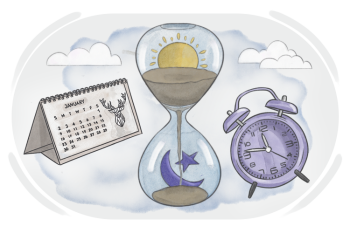
Prepositions of time (preposiciones de tiempo) link a verb, noun, or clause to a time reference, such as the moment or duration of an action. As prepositions, they are followed by nouns. The noun specifies the time or duration and the preposition establishes a relationship between the verb and that time reference. The preposition has a fixed form regardless of the noun that follows it. Common prepositions of time in Spanish include:
a
de
en
por
durante
desde
hasta
entre
A
When used as a preposition of time, "a" refers to an exact time, such as an hour or a moment. For example:
La clase empieza a las ocho.
The class starts at eight.
Terminé la tarea a las nueve.
I finished the homework at nine.
De
As a preposition of time, "de" is used to refer to a general time frame after specifying a more specific one; for example, specifying the part of day after an hour or specifying the month after a date. It is also used to refer to certain parts of the day: día, noche, and madrugada. Look at the examples:
Me despierto a las 8 de la mañana.
I wake up at 8 in the morning.
Trabajo de noche.
I work at night time.
Note that no article is used between "de" and the noun "noche."
En
When talking about longer periods of time, such as months, seasons, and years, "en" is used as a preposition of time.
Nos vemos en julio.
We'll see each other in July.
Nos casamos en 2019.
We got married in 2019.
It is also used to talk about a time in the future when something is planned or expected to happen.
Te veré en una hora.
I'll see you in an hour.
Por
This preposition can be used to refer to parts of the day or to show the duration of an action. For example:
Estudio por la mañana.
I study in the morning.
Notice how the article "la" is used with the noun after the preposition "por."
Corrimos por dos horas.
We ran for two hours.
showing duration
Durante
"Durante" is used to specify the duration of an activity, similar to "for" in English.
Viajamos durante tres semanas.
We traveled for three weeks.
Estudié español durante dos años.
I studied Spanish for two years.
It can also come before a period of time or event to refer to the whole duration of that period, similar to the English "during". Look at the examples:
¿Dónde estabas durante el intermedio?
Where were you during the intermission?
Desde
To mark the starting point of a period of time in the past, "desde" is used which is equivalent to the English "since."
Vivo aquí desde 2010.
I've lived here since 2010.
No lo he visto desde ayer.
I haven't seen him since yesterday.
Hasta
"Hasta" marks the ending of a period of time, similar to the English "until."
Trabajo hasta las seis.
I work until six.
La esperaremos hasta la miércoles.
We'll wait until Wednesday.
Tip!
Sometimes, "desde" and "hasta" are used together in the same sentence to specify both the beginning and ending of a period of time. For example:
Trabajo desde las nueve hasta las cinco.
I work from nine to five.
Entre
To refer to a period of time between two specific points or moments, "entre" is used. For example:
Descansamos entre las dos y las tres.
We rest between two and three.
Podemos hablar entre las cinco y las seis.
We can talk between five and six.
Quiz:
Elige la oración correcta.
La película empieza en las siete.
La película empieza a las siete.
La película empieza por las siete.
La película empieza desde las siete.
Completa cada oración con la preposición correcta.
Me quedaré aquí
el viernes.
Nos vemos
abril.
Trabajo
la tarde.
Estudié francés
tres años.
Elige la oración que indica un intervalo.
Llegaremos en media hora
Vivo en esta ciudad desde 2020.
Te espero hasta las ocho.
Podemos reunirnos entre las dos y las tres.
Ordena las palabras para formar una oración correcta.
Empareja cada inicio con el final más natural.
Comments
(0)Recommended

