The Present Tense For Intermediate learners
What Is the Present Tense (Le présent) in French?
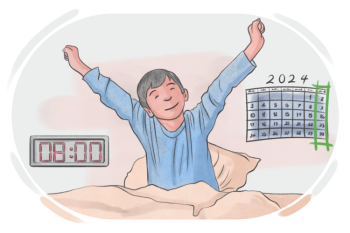
The present tense (le présent) is the most frequently used tense in French. It allows speakers to talk about current actions, habits, facts, states, and even future events. Unlike English, French does not distinguish between the present simple and the present continuous.
Look at the example below:
Je parle français.
I speak French / I am speaking French.
Elle travaille tous les jours.
She works every day.
Nous partons demain.
We leave tomorrow.
Main Uses of the Present Tense
The French present tense covers several meanings that are expressed using different tenses in English.
Actions Happening Now
This use describes actions that are taking place at the moment of speaking, even if they are temporary.
Je lis un livre.
I am reading a book.
Elle travaille à la maison aujourd'hui.
She is working from home today.
Tip!
In French, the same verb form translates both I read and I am reading.
Habitual or Repeated Actions
The present tense is commonly used to describe actions that happen regularly or repeatedly.
Je me lève à sept heures.
I get up at seven o'clock.
Nous prenons le train tous les jours.
We take the train every day.
Time expressions often used here:
toujours (always)
souvent (often)
parfois (sometimes)
tous les jours (every day)
General Truths and Permanent Facts
The present tense expresses scientific facts, universal truths, and permanent situations.
L'eau bout à 100 degrés.
Water boils at 100 degrees.
Le soleil se lève à l'est.
The sun rises in the east.
States, Feelings, and Opinions
Many verbs expressing emotions, mental states, or opinions naturally appear in the present tense.
Je pense que c'est une bonne idée.
I think it's a good idea.
Elle aime beaucoup ce film.
She really likes this movie.
Near Future Expressed with the Present
The present tense can refer to the near future when the time reference is clear.
Je pars demain matin.
I'm leaving tomorrow morning.
The time expression makes the future meaning clear.
On se voit ce soir.
We'll see each other tonight.
Instructions, Directions, and Explanations
The present tense is frequently used to give instructions, explain procedures, or describe steps.
Tu ajoutes le sucre à la fin.
You add the sugar at the end.
On tourne à gauche après le pont.
You turn left after the bridge.
How the Present Tense Is Formed
To conjugate a verb in the present tense, French combines a verb stem (radical) with a present ending (terminaison), which depends on the verb group. French verbs are traditionally divided into three groups based on their infinitive endings and conjugation patterns.
1. First Group Verbs (verbs ending in -er)
These verbs are the most numerous and the most regular in French.
Example: parler (to speak)
Stem: parl-
Subject pronoun | Ending | Verb form |
|---|---|---|
je (I) | -e | parle |
tu (you, informal) | -es | parles |
il / elle / on (he / she / one) | -e | parle |
nous (we) | -ons | parlons |
vous (you, formal or plural) | -ez | parlez |
ils / elles (they) | -ent | parlent |
Tip!
The ending -ent is always silent, and the spoken forms of parle, parles, and parlent sound identical.
je becomes j' before a vowel or a mute h: j'aime, j'habite.
Spelling Changes and Stem Changes
Some verbs change spelling to maintain pronunciation or due to irregular stems.
Verbs ending in -ger: Keep the e in nous form: nous mangeons, nous voyageons
Verbs ending in -cer: c → ç before a: nous commençons
Stem-changing verbs: e → è: je préfère, tu lèves, y → i: j'emploie, tu envoies, je paie / je paye (both forms are correct)
2. Second Group Verbs (verbs ending in -ir with -issons)
These verbs are regular and easy to identify. Look for -issons in nous to identify this group.
Example: finir (to finish)
Stem: fin-
Subject pronoun | Ending | Verb form |
|---|---|---|
je | -is | finis |
tu | -is | finis |
il / elle / on | -it | finit |
nous | -issons | finissons |
vous | -issez | finissez |
ils / elles | -issent | finissent |
3. Third Group Verbs (irregular verbs)
This group includes:
verbs ending in -re, -oir, and some -ir
verbs with irregular stems and endings
Endings in the Third Group
Unlike first- and second-group verbs, you cannot assume the endings in the present tense. Some patterns exist for subsets of verbs, but many verbs are completely irregular.
a) Regular-ish -re verb
Example: vendre (to sell)
Stem: vend-
Subject | Ending | Verb form |
|---|---|---|
je | -s | vends |
tu | -s | vends |
il / elle / on | – | vend |
nous | -ons | vendons |
vous | -ez | vendez |
ils / elles | -ent | vendent |
Here, endings look similar to regular patterns, but note that the stem (vend-) does not change.
b) Irregular -re verb
Example: prendre (to take)
Stem: prend
Subject | Ending | Verb form |
|---|---|---|
je | -s | prends |
tu | -s | prends |
il / elle / on | - | prend |
nous | -ons | prenons |
vous | -ez | prenez |
ils / elles | -nent | prennent |
Here, the stem changes in the plural vs singular forms (prend- vs pren-), and the third-person plural ending is -nent instead of the usual -ent.
c) Fully irregular verbs
Subject | être (to be) | avoir (to have) | aller (to go) | |
|---|---|---|---|---|
je / j' | suis | ai | vais | |
tu | es | as | vas | |
il / elle / on | est | a | va | |
nous | sommes | avons | allons | |
vous | êtes | avez | allez | |
ils / elles | sont | ont | vont |
Both the stem and the endings are irregular; there is no consistent pattern to follow.
Negation in the Present Tense
Negation wraps around the verb: ne + verb + pas
Je parle. → Je ne parle pas.
I speak. → I don't speak.
With vowel sounds or mute h:
Je n'aime pas le café.
I don't like coffee.
Tip!
In spoken French, ne is often dropped, but it remains important in writing. For example:
Je parle pas.
I don't speak.
Questions in the Present Tense
French has three main ways to ask questions:
intonation (spoken, informal)
Tu travailles aujourd'hui ?
Are you working today?
est-ce que
Est-ce que tu travailles aujourd'hui ?
Are you working today
inversion (formal)
Travailles-tu aujourd'hui ?
Are you working today?
Comments
(0)Recommended

