Demonstrative Determiners For Intermediate learners
What Are Demonstrative Determiners?
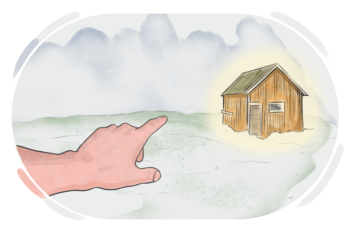
Demonstrative determiners (determinantes demostrativos) come before nouns and show physical, temporal, or metaphorical distance between the speaker and the noun. They enable the speaker to point to people or objects at different distances.
"Este" is used when something is close to the speaker, similar to the English "this."
"Ese" is used when something is out of the speaker's reach or close to the listener, similar to the English "that."
"Aquel" is used when something is at a considerable distance from both the speaker and listener, similar to the English "that (over there)."
Each of these can have four different forms based on gender and number of the noun:
Near | Middle | Far | |
|---|---|---|---|
Masculine singular | este | ese | aquel |
Masculine plural | estos | esos | aquellos |
Feminine singular | esta | esa | aquella |
Feminine plural | estas | esas | aquellas |
For example:
Este libro es mío.
This book is mine.
Estas sillas son cómodas.
These chairs are comfortable.
Ese coche es tuyo.
That car is yours.
Esa casa es grande.
That house is big.
Aquel edificio es antiguo.
That building over there is old.
Aquellas montañas son altas.
Those mountains over there are tall.
Temporal Distance
In addition to spatial distance, these determiners can also indicate temporal distance, the same gender and number agreement rules apply here and the same three levels of distance are valid: the near determiners refer to the present or current time frames, while the middle determiners refer to events in recent past or future and far determiners refer to distant past or future.
Este año ha sido difícil.
This year has been difficult.
Esa noche no dormí bien.
That night I didn't sleep well.
Aquella época fue más sencilla.
That era was simpler.
Demonstrative Determiners vs. Demonstrative Pronouns
Both demonstrative determiners and demonstrative pronouns establish a distance-based relationship; however, demonstrative determiners always appear before nouns while demonstrative pronouns replace nouns and can never be accompanied by nouns.
Este libro es mío; ese es tuyo.
This book is mine; that one is yours.
Here, "este" is a demonstrative determiner used before the noun "libro" and "ese" is a pronoun, replacing the noun "libro".
Quiz:
Elige la oración correcta.
Este mochila es muy pesada.
Esta mochila es muy pesada.
Estos mochila es muy pesada.
Estas mochila es muy pesada.
Empareja cada sustantivo con el determinante demostrativo correcto.
Completa la tabla con las formas correctas.
| M singular | M plural | F singular | F plural |
|---|---|---|---|
este | |||
esos | |||
aquellos |
Elige la oración que usa un demostrativo para hablar de un tiempo lejano.
Esta semana tengo mucho trabajo.
Este mes estamos estudiando gramática.
Esa tarde fuimos al cine después de clase.
Aquellos años fueron muy importantes para mi familia.
Elige la oración donde el demostrativo funciona como determinante.
Este es más barato.
Ese parece interesante.
Aquella vive cerca.
Estas revistas son nuevas.
Comments
(0)Recommended

