Indirect Object Pronouns For Intermediate learners
What are Indirect Object Pronouns?
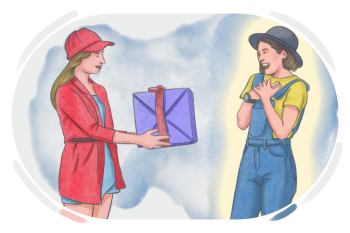
Indirect object pronouns (pronombres de objeto indirecto) indicate to whom/for whom the action of the verb is done. For example, in "Yo doy el libro a María." The indirect object is "María" because that's the person who receives the book. Indirect object pronouns can replace such nouns in sentences, reflecting their grammatical person and number. Spanish indirect object pronouns include:
Singular | Plural | |
|---|---|---|
First-person | me | nos |
Second-person | te/le | les |
Third-person | le | les |
Tip!
In Spain, a distinction is made between formal and informal usage in the plural second-person indirect object pronoun, where "os" is used in informal contexts and "les" is reserved for formal interactions. In Latin America, however, this distinction does not exist and "les" is used as the plural second-person pronouns in all contexts.
Os preparo la cena.
I make you dinner.
(informal – only used in Spain)
Les preparo la cena.
I make you dinner.
(formal in Spain – general in Latin America)
Placement in Sentences
Like direct object pronouns, indirect object pronouns come before the conjugated main verb of the sentence.
Te escribo una carta.
I write you a letter.
Le doy dinero.
I give him money.
However, if the main verb is in its infinitive or present participle form, the indirect object pronoun can attach to the verb ending or come before the helping verb (the first conjugated verb). If there is no helping verb, the pronoun attaches to the infinitive or participle verb form.
Voy a darle el regalo./Le voy a dar el regalo.
I'm going to give him a gift.
Estoy explicándote la lección./Te estoy explicando la lección.
I'm explaining the lesson to you.
In affirmative imperatives, the indirect object pronoun attaches to the end of the imperative verb:
Dime la verdad.
Tell me the truth.
Escríbanles una carta.
Write them a letter.
In negative sentences, the indirect object pronoun comes between the negative word and the main verb.
Le presto mi coche. → No le presto mi coche.
I lend him my car. → I don't lend him my car.
Cómprame el libro. → No me cómpres el libro.
Buy me the book. → Don't buy me the book.
When the sentence includes both a direct and an indirect object pronoun, the indirect object pronoun comes before the direct object pronoun. This is also the case when the pronouns are attached to the end of the verb:
Te lo digo.
I tell it to you.
Nos los muestran.
They show them to us.
Cómpramelo.
Buy it for me.
Tip!
When "le" is used together with a third-person direct object pronoun (lo/la/los/las) in a sentence, it changes to "se" in order to avoid pronunciation difficulties.
Se lo doy. (NOT "Le lo doy")
I give it to her/him.
Clarification
Since indirect object pronouns are not distinguished in terms of gender and have the same form in case of formal second-person and third-person singular as well as plural second and third person pronouns, there might be confusion as to who or what they actually refer to. To avoid such ambiguities, sometimes a prepositional phrase is added after the direct object to clarify the indirect object:
Le doy el libro a Juan.
I give the book to Juan.
Here, "a Juan" clarifies that the indirect object pronoun "le" refers to a masculine indirect object.
Le doy el libro a usted.
I give the book to you (formal).
Here, "a usted" shows that the speaker is addressing someone politely and the indirect object pronoun "le" is used as a formal second-person singular pronoun.
Quiz:
Empareja el pronombre con su forma:
Completa cada frase con el pronombre de objeto indirecto correcto.
Yo doy el libro a María →
doy el libro.
Escribo una carta a mis padres. →
escribo una carta.
Compra un regalo a mi hermana y a mí. →
compra un regalo.
¿Dónde va el pronombre de objeto indirecto en una oración simple?
Después del verbo
Antes del verbo conjugado
Después del sujeto
Solo al final de la frase
¿Cuál de las siguientes frases está correctamente formada en una oración negativa?
No le compro el libro.
Le no compro el libro.
No compro le el libro.
No el libro le compro.
¿Cuál de las siguientes frases está correctamente formada?
Lo te digo.
Te lo digo.
Lo digo te.
Digo te lo.
Comments
(0)Recommended

