Quotation Marks For Intermediate learners
What Are Quotation Marks?
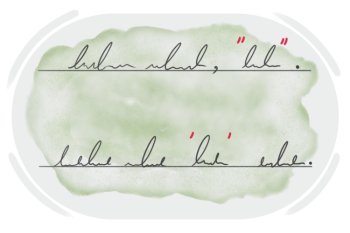
In Spanish, quotation marks (comillas) are used to indicate quoted speech, titles, irony, or to highlight words or expressions. Spanish uses three types of quotation marks with regional differences and hierarchical order of usage.
Forms
The three types of quotation mark in Spanish are:
« » → angular quotation marks → mostly preferred in Spain
" " → English quotation marks → mostly used in Latin America, or used inside angular quotation marks for a quotation inside another
' ' → simple quotation marks → used inside English quotation marks or for isolating specific words
Uses
Quotation marks are used to:
Quote speech directly → to repeat someone's exact words
Ella dijo: «No tengo tiempo».
She said: "I don't have time."
Respondió: "No sé qué hacer".
He/she replied: "I don't know what to do."
Refer to titles of short works → including songs, TV episodes, short stories, poems, etc. (not books)
Leí "La noche boca arriba" de Cortázar.
I read "The Night Face Up" by Cortázar.
Escuché "Bésame mucho".
I listened to "Bésame mucho."
Signal irony or metalanguage → to show that a word is used in an unusual meaning or the word itself is being referred to
El "experto" llegó dos horas tarde.
The "expert" arrived two hours late.
El verbo "ser" es irregular.
The verb "ser" is irregular.
Punctuation Placement
When the sentence includes a full stop, comma, question mark, or exclamation mark, the important point to consider is whether it belongs to the quotation or the main clause:
If the punctuation mark belongs to the quotation, it comes inside the quotation mark:
Preguntó: "¿Vienes mañana?".
He/she asked, "Are you coming tomorrow?"
If the punctuation mark belongs to the main clause, it goes outside of the quotation mark
«Estoy listo», dijo Juan.
"I'm ready," said Juan.
Dijo: «Estoy listo».
He said, "I'm ready."
¿Leíste "Don Juan Tenorio"?
Did you read "Don Juan Tenorio"?
Quiz:
Elige la oración que usa correctamente las comillas para citar palabras exactas.
Paula dijo: «Estoy cansada».
Paula dijo: (Estoy cansada).
Paula dijo: «Estoy cansada.»
Paula dijo: Estoy cansada».
Empareja cada oración con el uso de las comillas.
Elige la oración que usa correctamente comillas para el título de una obra.
Compré «un libro» nuevo ayer.
Leí «Cien años de soledad», una novela.
Leí «El río oscuro», un cuento breve.
Compré 'Don Quixote' la semana pasada.
Añade comillas donde sean necesarias.
El director anunció: La reunión empieza ahora.
→ El director anunció:
El artista copió todo el dibujo.
→
La palabra casa es un sustantivo.
→ La
¿Escuchaste Cielo gris?
→
Elige la oración con puntuación correcta.
«Tengo hambre,» dijo Elena.
«Tengo hambre», dijo Elena.
«Tengo hambre» dijo Elena.
«Tengo hambre.» dijo Elena.
Comments
(0)Recommended

