Spanish Vowels In European Spanish
What Are Spanish Vowels?
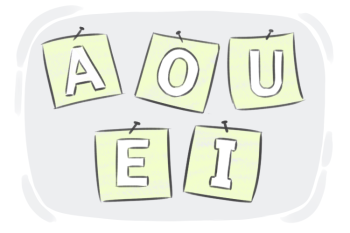
A vowel (la vocal in Spanish) is a speech sound made with no blockage or narrowing in the mouth, allowing the air to flow freely. Spanish has 5 vowel phonemes. These sounds are simple, stable, and highly consistent across different regions.
List of Spanish Vowels
The table below shows the Spanish vowels along with their articulation features and examples:
Sound | Height | Backness | Roundedness | Example | |
|---|---|---|---|---|---|
a | /a/ | low | central | unrounded | paz |
e | /e/ | mid | front | unrounded | tener |
i | /i/ | high | front | unrounded | brisa |
o | /o/ | mid | back | rounded | lobo |
u | /u/ | high | back | rounded | uno |
Features of Vowels
The feature 'height' shows how high or low the tongue is in the mouth during vowel production, where 'high' or 'close' means the tongue is raised close to the palate and 'low' or 'open' means the tongue is lowered.
/u/ and /i/→ high vowel
/e/and /o/ → mid vowel
/a/ → low vowel
'Backness' indicates the position of the tongue relative to the back of the mouth, where 'front' means the tongue is pushed forward and 'back' means it is pulled back.
/i/, /e/ → front vowels
/a/ → central vowel
/o/, /u/ → back vowels
Finally, 'roundedness' refers to the shape of the lips during articulation of the sound, where 'rounded' means the lips forms a circle and 'unrounded' means they are spread or relaxed.
/o/, /u/ → rounded vowels
/a/, /e/, /i/ → unrounded vowels
Diphthongs
Spanish diphthongs consist of a weak (/i/ and /u/) and a strong vowel (/a/, /o/, /i/) or two weak vowels. The weak vowels are sometimes pronounced as semivowels (/j/ and /w/) when they appear in diphthongs. Here are some of the common diphthongs in Spanish with examples:
ai → aire
ei → peine
ia → hacia
ie → cien
ua → cuadro
ue → bueno
iu → ciudad
ui → ruido
Comments
(0)Recommended

