
Științe Fundamentale - Astronomie
Studiați termeni legați de obiecte cerești, galaxii, fenomene cosmice, fazele lunii, eclipse și observații astronomice.
Revizuire
Fișe de studiu
Ortografie
Chestionar

a scientist who studies or observes planets, stars, and other happenings in the universe

astronom
Astronomul a descoperit o nouă exoplanetă folosind tehnologie avansată de telescop.
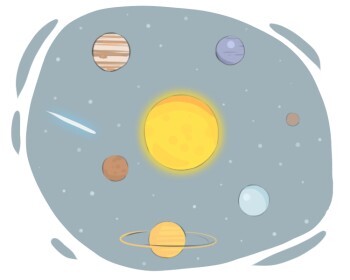
a huge round object that moves in an orbit, around the sun, or any other star
planetă, corp ceresc
Jupiter este cea mai mare planetă din sistemul nostru solar.

a planet that is outside the solar system
exoplanetă, planetă extrasolară
Astronomii au descoperit mii de exoplanete care orbitează stele din afara sistemului nostru solar.
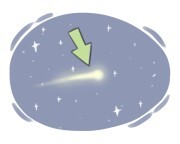
an object in space that is a mass of ice and dust and when it nears the sun it starts illuminating in the shape of a tail
cometă
Cometa Halley este una dintre cele mai faimoase comete, vizibilă de pe Pământ la fiecare aproximativ 76 de ani.
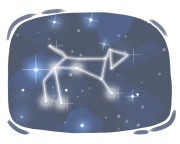
a specific group of stars that form a pattern and have a name related to their shape
constelație, grup de stele
Orion este o constelație bine cunoscută vizibilă pe cerul de iarnă.
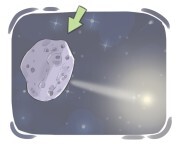
any of the rocky bodies orbiting the sun, ranging greatly in diameter, also found in large numbers between Jupiter and Mars
asteroid, corp ceresc stâncos
Oamenii de știință studiază asteroizii pentru a afla despre sistemul solar timpuriu și despre potențialele amenințări pentru Pământ.
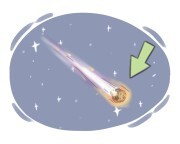
a usually small meteor that burns with a bright light when entering the earth's atmosphere
stea căzătoare, meteor
Am văzut o stea căzătoare în timp ce campam în munți aseară.
an exploding star that as a result is emitting a very large amount of light, more than the sun
supernova
O supernovă este o explozie puternică care are loc la sfârșitul ciclului de viață al unei stele masive.
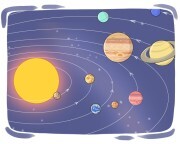
a natural body in space that moves around the earth or other planets
satelit, lună
Sistemul de inele al lui Saturn este compus din nenumărate particule și mici sateliți naturali.
(astronomy) a small, cool, faint star that is much less massive than the Sun and burns its fuel very slowly
a small, dense, and faint stellar remnant that is left after a medium-sized star exhausts the nuclear fuel in its core and undergoes gravitational collapse
pitică albă, stea pitică albă
O pitică albă este etapa finală din ciclul de viață al unei stele asemănătoare soarelui după ce și-a epuizat combustibilul nuclear.
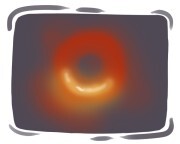
a place in the space with such high gravity that pulls in everything, even light
gaură neagră, gaură întunecată
Găurile negre sunt formate din rămășițele stelelor masive care și-au încheiat ciclurile de viață și s-au prăbușit sub propria gravitație.
(physics) a theoretical tunnel through space-time that could connect two distant points in the universe
very small particles originally derived from stars, serving as raw material for forming planets, and existing between galaxies, stars, and other celestial bodies
praf cosmic, praf stelar
Praful cosmic este format din particule minuscule de materie care plutesc în spațiu, compuse în principal din elemente precum carbonul, siliciul și fierul.
(physics) an invisible substance that makes up most of the universe's mass, detectable only through its gravitational effects
materie întunecată, materie neagră
Materia întunecată este o formă de materie care nu emite, nu absoarbe și nu reflectă lumina, făcând-o invizibilă și detectabilă doar prin efectele sale gravitaționale.

a large number of star systems bound together by gravitational force
galaxie
Galaxiile pot varia în formă și dimensiune, cu tipuri care includ galaxii spiralate, eliptice și neregulate, fiecare având structuri și caracteristici distincte.
a pale band of light seen in the sky at night that contains the solar system and billions of other stars
Calea Lactee, Galaxia
Calea Lactee este o galaxie spirală barată care conține sistemul nostru solar.
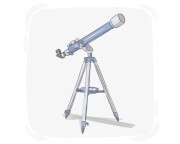
a piece of equipment by which the far objects, particularly those in space, are made clearly visible
telescop, lunetă
El a folosit un telescop pentru a observa stelele.
the outer layer of the Sun's atmosphere, observable as a plasma halo during a solar eclipse
coroană, atmosfera exterioară a Soarelui
În timpul unei eclipse solare totale, corona Soarelui devine vizibilă ca un halo radiant în jurul lunii.
related to the sun
solar, heliocentric
Eclipsele solare au loc când luna blochează lumina soarelui.
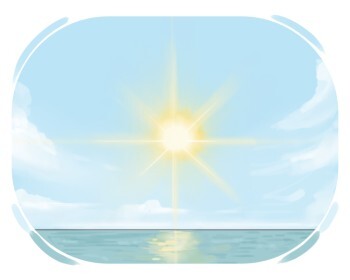
a single ray or beam of sunlight
the highest point that a certain celestial body reaches, directly above an observer
zenit, punctul cel mai înalt
La amiază, soarele a atins zenitul său, direct deasupra.
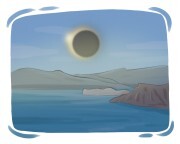
a period during which the sun or moon is temporarily obscured by the shadow of another celestial body
eclipsă, ocultație
Am urmărit eclipsa solară prin ochelari de protecție speciali.
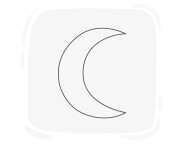
a curved shape with narrow points at the ends that appears wider in the middle, like the shape of the moon in its first and last quarters
semilună, lună în semilună
Luna atârna jos pe cer, semiluna ei subțire aruncând o lumină blândă.
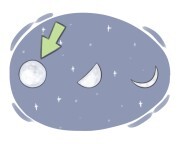
the complete and round-shaped moon as seen from the earth
lună plină, pliniluniu
Cuplul a decis să facă o plimbare în parc sub lună plină, bucurându-se de o seară romantică.
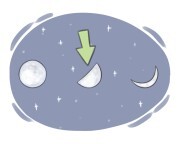
the moon when only half of its bright surface can be seen from the earth
semilună, lună în primul pătrar
Pe cerul de seară, o semilună captivantă atârna chiar deasupra orizontului.
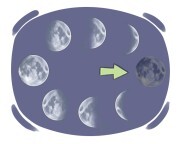
the moon when only a small portion of its bright side is visible from the earth
lună nouă, luna tânără
Observatorii cerului așteptau cu nerăbdare apariția lunii noi.

relating to the moon
lunar, selenic
A cumpărat un calendar lunar pentru a urmări fazele lunii.
(of the moon) to gradually decrease in its visible illuminated surface as it progresses from full to new moon
descrește, scădea
Luna a început să descrească după luna plină.
(of the moon) to progressively display a larger illuminated section until it turns into a full moon
crește, mări
Pe măsură ce luna a progresat, luna a început să crească, de la o semilună subțire la o lună plină.
the distance that light travels in a year (about 9.46 trillion kilometers)
an-lumină, al
Proxima Centauri, cea mai apropiată stea de Pământ, se află la 4,24 ani-lumină distanță.
