
Bokabularyo para sa IELTS Academic (Score 6-7) - Heolohiya
Dito, matututunan mo ang ilang mga salitang Ingles na may kaugnayan sa Heolohiya na kinakailangan para sa Academic IELTS exam.
Repasuhin
Flashcards
Pagbaybay
Pagsusulit


the outermost layer of the Earth, consisting of solid rock and divided into the continental crust and the oceanic crust

balat, balat ng Daigdig
Ang pag-aaral ng balat ng Daigdig, na kilala bilang heolohiya, ay nagbibigay ng mga pananaw sa kasaysayan, ebolusyon ng planeta, at mga proseso na humuhubog sa ibabaw nito.
particles of solid material that settle at the bottom of a liquid
latak, sedimento

the gradual wearing away and removal of soil, rock, or other surface material by natural forces such as water, wind, or ice
pagguho, erosyon
the scientific study of minerals, their composition, properties, and classification, often involving the analysis of crystal structures and the identification of various mineral species
mineralohiya, pag-aaral ng mga mineral
Ang mineralohiya ay sumusuri sa mga natatanging katangian ng mga mineral, kasama ang kanilang kulay, tigas, at istruktura ng kristal.
the branch of geology that focuses on the study of rocks, their classification, composition, origin, and the processes involved in their formation
petrolohiya, pag-aaral ng mga bato
Ang petrology ay nag-aaral sa iba't ibang uri ng mga bato na matatagpuan sa crust ng Earth at ang kanilang mga katangian.
the scientific study of landforms, their origin, development, and classification, often examining the processes that shape the Earth's surface, such as erosion, deposition, and tectonic activity
heomorpolohiya, pag-aaral ng mga anyong lupa
Ang geomorphology ay nag-aaral sa pagbuo at ebolusyon ng mga anyong lupa, kasama ang mga bundok, lambak, at kapatagan.
a tapering, icicle-like mineral formation hanging from the roof of a cave or underground structure, typically composed of calcium carbonate deposited by dripping water containing dissolved minerals
stalaktita, bituin ng mineral na nakabitin
Ang mga kuweba ay madalas na nagtatampok ng magagandang stalactite na nabuo sa paglipas ng panahon ng mineral-rich na tubig na tumutulo mula sa kisame.
a cone-shaped mineral formation rising from the floor of a cave or underground structure, formed by the deposition of minerals from dripping water containing dissolved substances
stalagmite, mineral na hugis-kono na tumutubo mula sa sahig ng kuweba
Ang mga kuweba ay nagtatanghal ng mga stalagmite, na tumutubo paitaas mula sa sahig ng kuweba dahil sa tubig na mayaman sa mineral na tumutulo mula sa itaas.
a vast and longest subdivision of geological time
eon, panahong heolohikal
Ang eon na Phanerozoic ay sumasaklaw sa pinakabagong 540 milyong taon at kasama ang kasalukuyang era, ang Cenozoic.
a supercontinent that existed during the late Paleozoic and early Mesozoic eras, comprising most of Earth's landmasses fused together before breaking apart into the continents we recognize today
Pangaea, Pangea
Ang Pangaea ay isang malawak na supercontinent na nabuo mga 335 milyong taon na ang nakalipas.
an ancient supercontinent that included South America, Africa, Antarctica, Australia, the Indian subcontinent, and the Arabian Peninsula
Gondwana, ang superkontinenteng Gondwana
Ang Gondwanaland ay isang malawak na masa ng lupa na may malaking papel sa kasaysayang heolohikal ng Daigdig.
a hypothetical ancient supercontinent that existed from the late Precambrian to the Jurassic period, comprising the landmasses of present-day North America, Europe, Asia, and parts of Antarctica, before it began to break apart
Ang Laurasia ay isang hipotetikal na sinaunang superkontinente na umiral mula sa huling Precambrian hanggang sa Jurassic period, na binubuo ng mga landmass ng kasalukuyang North America
Ang Laurasia ay isang makabuluhang landmass sa geological na nakaraan ng Earth, na sumasaklaw sa mga bahagi ng North America, Europe, at Asia.
the total amount of water on Earth, including oceans, seas, lakes, rivers, groundwater, and atmospheric water vapor
hidrospera, esphera ng tubig
Ang hydrosphere ay sumasakop sa humigit-kumulang 71% ng ibabaw ng Earth, pangunahing binubuo ng mga karagatan at dagat.
a principle in geology stating that in a sequence of undisturbed sedimentary rock layers, the youngest rocks are at the top, and the oldest rocks are at the bottom, helping determine the relative ages of geological formations
superposition, prinsipyo ng superposition
Ang prinsipyo ng superposition ay tumutulong sa mga geologist na maintindihan ang kronolohikal na pagkakasunud-sunod ng mga layer ng bato sa isang partikular na geological formation.
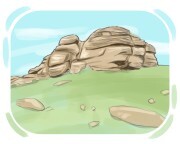
a visible exposure of rock or geological strata at the Earth's surface, often occurring on hillsides, cliffs, or other elevated areas, providing insight into the underlying geological structure
outcrop, paglitaw ng bato
Habang nagha-hiking sa kahabaan ng trail, nakakita kami ng isang kahanga-hangang outcrop ng sedimentary rock, na nagpapakita ng mga layer na nabuo sa loob ng milyun-milyong taon.
solid rock beneath surface materials, forming the Earth's crust foundation
batong-pundasyon, saligang bato
Ang paghuhukay para sa pundasyon ng gusali ay nagbunyag ng presensya ng matibay na bedrock, na tinitiyak ang katatagan ng istruktura.
the region of the Earth's interior, lying beneath the crust and extending to the outer core, composed of solid rock that can deform and flow over geological time scales
balabal, ang balabal ng Daigdig
Ang mantle ay isang layer ng interior ng Daigdig na nasa pagitan ng crust at outer core.
