
Listahan ng mga Salita sa Antas C2 - Pisika
Dito mo matututunan ang lahat ng mahahalagang salita para sa pag-uusap tungkol sa Pisika, na tinipon partikular para sa mga mag-aaral ng antas C2.
Repasuhin
Flashcards
Pagbaybay
Pagsusulit


a scientific idea that all particles are tiny vibrating strings, not point-like dots, and these vibrations create different particles and forces

teorya ng mga string, teorya ng mga superstring
Ang string theory ay nagmumungkahi na ang mga pangunahing bloke ng gusali ng sansinukob ay maliliit, nanginginig na mga string sa halip na mga particle na parang punto.
the bending, spreading, and interference of waves as they encounter obstacles or pass through narrow openings, often observed in the behavior of light, sound, or other waves
difraksyon, difraksyon ng alon
Ang difraksyon ng liwanag ay gumagawa ng mga pattern ng mga salit-salit na madilim at maliwanag na rehiyon kapag nakakatagpo ito ng isang makitid na slit o dumadaan sa isang hadlang.
a fundamental particle combining to form protons and neutrons, with fractional electric charge and six flavors
quark, quark (pangunahing partikulo)
Ang mga quark ang pinakamaliit na kilalang mga particle, na bumubuo sa mga bloke ng mga proton at neutron sa atomic nuclei.
a fundamental particle with half-integer spin, including electrons and their heavier counterparts, as well as neutrinos
lepton, pangunahing partikulo na may kalahating integer spin
Ang mga lepton ay mga elementaryong partikulo na kinabibilangan ng mga electron, muon, tau particle, at ang kanilang mga kaugnay na neutrino.
a tiny particle made up of even smaller parts called quarks, like protons and neutrons
hadron, partikulang hadroniko
Ang mga hadron ay nasa ilalim ng malakas na nuclear force, ang pangunahing interaksyon na nagbubuklod sa mga quark.
the speed at which something moves in a specific direction
bilis, tulin
(physics) the maximum distance a vibrating material, sound wave, etc. such as a pendulum travels from its first position
amplitude, lawak
Sa pisika, ang amplitude ay tumutukoy sa pinakamataas na pag-aalis ng isang alon mula sa posisyon ng equilibrium nito.
tiny particles that make up matter and have a property called spin, like the building blocks of atoms
fermion, partikulo ng Fermi
Ang mga electron, na umiikot sa nucleus ng isang atom, ay mga halimbawa ng fermion.
a tiny particle with whole-number spin, such as photons or the Higgs boson, often associated with carrying fundamental forces or giving mass to other particles
boson, partikulo na may buong bilang na ikot
Ang mga photon, mga partikulo ng liwanag, ay mga halimbawa ng boson na nagdadala ng electromagnetic force.
the force that acts on an object moving in a circular path, directed toward the center of the circle or the axis of rotation, preventing the object from moving in a straight line
puwersang sentripetal, puwersang patungo sa gitna
Kapag pinaikot mo ang isang bolang nakakabit sa isang tali sa isang pabilog na galaw, ang tensyon sa tali ay gumaganap bilang centripetal force.
the change in frequency or wavelength of a wave in relation to an observer who is moving relative to the source of the wave, producing a shift in pitch or color
epekto Doppler, penomenong Doppler
Ang Doppler effect ay nagpapaliwanag kung bakit nagbabago ang pitch ng sirena ng ambulansya habang ito ay lumalapit at pagkatapos ay dumadaan.
the energy possessed by an object due to its motion, defined as one-half the mass of the object multiplied by the square of its velocity, expressed by the equation KE = 0.5 * m * v^2
kinetiko na enerhiya, enerhiya ng galaw
Kapag ang isang kotse ay gumagalaw, ang kinetic energy nito ay nakadepende sa parehong masa at bilis nito.
(physics) an invisible substance that makes up most of the universe's mass, detectable only through its gravitational effects
madilim na bagay, itim na bagay
Ang dark matter ay isang uri ng matter na hindi naglalabas, sumisipsip, o nagpapakita ng liwanag, na nagiging sanhi upang ito ay hindi makita at matukoy lamang sa pamamagitan ng mga epekto nito sa gravity.
(physics) matter consisting of elementary particles that are the antiparticles of those of regular matter
antimaterya, materyang antimaterya
Ang antimatter ay binubuo ng mga antiparticle, na may parehong masa sa kanilang katumbas na mga particle ngunit kabaligtaran na electric charge.
(physics) the property of matter that gives it weight in a gravitational field and is a measure of its inertia
masa, dami ng materya
the smallest possible amount of a particular quantity that cannot be divided any further
quantum, ang pinakamaliit na posibleng halaga na hindi na maaaring hatiin pa
Ang pag-uugali ng mga subatomic particle ay pinamumunuan ng mga prinsipyo ng quantum mechanics.
(physics) the increase in velocity over time
pagbilis, pagtaas ng bilis
Pagpapabilis ay sumusukat kung gaano kabilis nagbabago ang bilis ng isang bagay.
the strength of a moving object determined by multiplying how heavy it is by how fast it is going
momentum, dami ng galaw
Tumaas ang momentum ng kotse habang ito ay bumibilis sa highway.
a fundamental particle of light that carries electromagnetic energy and exhibits both particle-like and wave-like properties
photon, kuantum ng liwanag
Ang mga photon ay ang quanta ng electromagnetic radiation, kasama ang visible light, radio waves, at X-rays.
the tendency of an object to resist changes in its state of motion, whether at rest or in uniform motion, and to remain in its current state unless acted upon by an external force
inertia, ang tendensya ng isang bagay na pigilan ang mga pagbabago sa estado ng paggalaw nito
Ang konsepto ng inertia ay nakapaloob sa unang batas ng paggalaw ni Newton, na nagsasabi na ang isang bagay na nagpapahinga ay mananatiling nagpapahinga, at ang isang bagay na gumagalaw ay mananatiling gumagalaw sa parehong bilis at sa parehong direksyon maliban kung kumilos dito ang isang panlabas na puwersa.
(physics) the back-and-forth motion of an object between two end points
pag-ugoy
Ang mga instrumentong pangmusika ay gumagawa ng mga natatanging tono sa pamamagitan ng pag-oscillate sa loob ng mga resonant acoustic cavities na nagpapatibay sa partikular na mga mode ng vibration.
the return of light, sound, heat, or another wave after it strikes a surface or boundary
repleksyon, pagmumuni-muni
a measure of a material's stiffness or elasticity in physics
modulus ni Young, modulus ng elasticity ni Young
Ang bakal ay may mataas na Young's modulus, na ginagawa itong matigas at malakas.
a theory stating that the exact position and momentum of a particle cannot be measured precisely at the same time
prinsipyo ng kawalan ng katiyakan, prinsipyo ng kawalan ng kasiguraduhan
Ang prinsipyo ng kawalan ng katiyakan ay isang pangunahing panuntunan sa quantum physics.
the unit of energy in the International System of Units
joule
Kailangan ng isang joule ng enerhiya para iangat ang isang maliit na mansanas ng isang metro.
a very small, electrically neutral particle that rarely interacts with matter
neutrino, partikulo ng neutrino
Ang mga neutrino ay mga subatomic particle na may napakaliit na masa.
the theory that adds the notion of time to that of a three-dimensional space
espasyo-panahon, tuloy-tuloy na espasyo-panahon
Ayon sa teorya ng pangkalahatang relativity ni Einstein, ang gravity ay hindi lamang isang puwersa sa pagitan ng mga masa ngunit ang curvature ng space-time na dulot ng mga masa na iyon.
the process or action of splitting a nucleus into two or more parts resulting in the release of a significant amount of energy
paghahati ng nucleus, nukleyar na paghahati
Ang nuclear fission ay isang proseso kung saan ang nucleus ng isang atom ay nahahati sa dalawa o higit pang mas maliliit na nuclei, na naglalabas ng malaking halaga ng enerhiya.
referring to the combined interaction of electric and magnetic fields, often associated with waves or radiation
elektromagnetiko, may kaugnayan sa mga electromagnetic field
Ang liwanag ay isang elektromagnetikong alon na maaaring maglakbay sa pamamagitan ng vacuum.
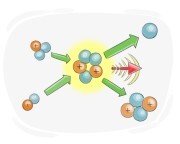
(physics) the reaction in which two nuclei join together and produce energy
nuclear fusion
Ang nuclear fusion ay ang proseso kung saan ang dalawang atomic nuclei ay nagsasama upang bumuo ng isang mas mabigat na nucleus, na naglalabas ng malaking halaga ng enerhiya sa proseso.
relating to or involving the transformation of heat energy
termiko, nauugnay sa init
Ang mga inhinyero ay nagdisenyo ng isang thermic power plant upang mahusay na i-convert ang init sa kuryente.
the capability of being easily changed or molded into many different things
plasticidad, kakayahang hubugin
Ang plasticity ay tumutukoy sa kakayahan ng isang materyal na sumailalim sa permanenteng deformation nang hindi napuputok kapag naipapailalim sa stress.
| Listahan ng mga Salita sa Antas C2 | |||
|---|---|---|---|
| Sikolohiya | Biyolohiya | Kemistri | Pisika |
| Astronomiya | Matematika | Heolohiya | Inhinyeriya |
| Pagsukat | |||
