
C2 Level Wordlist - Physics
Here you will learn all the essential words for talking about Physics, collected specifically for level C2 learners.
Review
Flashcards
Spelling
Quiz


a scientific idea that all particles are tiny vibrating strings, not point-like dots, and these vibrations create different particles and forces
the bending, spreading, and interference of waves as they encounter obstacles or pass through narrow openings, often observed in the behavior of light, sound, or other waves
a fundamental particle combining to form protons and neutrons, with fractional electric charge and six flavors
a fundamental particle with half-integer spin, including electrons and their heavier counterparts, as well as neutrinos
a tiny particle made up of even smaller parts called quarks, like protons and neutrons
the speed at which something moves in a specific direction
(physics) the maximum distance a vibrating material, sound wave, etc. such as a pendulum travels from its first position
tiny particles that make up matter and have a property called spin, like the building blocks of atoms
a tiny particle with whole-number spin, such as photons or the Higgs boson, often associated with carrying fundamental forces or giving mass to other particles
the force that acts on an object moving in a circular path, directed toward the center of the circle or the axis of rotation, preventing the object from moving in a straight line
the change in frequency or wavelength of a wave in relation to an observer who is moving relative to the source of the wave, producing a shift in pitch or color
the energy possessed by an object due to its motion, defined as one-half the mass of the object multiplied by the square of its velocity, expressed by the equation KE = 0.5 * m * v^2
(physics) an invisible substance that makes up most of the universe's mass, detectable only through its gravitational effects
(physics) matter consisting of elementary particles that are the antiparticles of those of regular matter
(physics) the property of matter that gives it weight in a gravitational field and is a measure of its inertia
the smallest possible amount of a particular quantity that cannot be divided any further
(physics) the increase in velocity over time
the strength of a moving object determined by multiplying how heavy it is by how fast it is going
a fundamental particle of light that carries electromagnetic energy and exhibits both particle-like and wave-like properties
the tendency of an object to resist changes in its state of motion, whether at rest or in uniform motion, and to remain in its current state unless acted upon by an external force
(physics) the back-and-forth motion of an object between two end points
the return of light, sound, heat, or another wave after it strikes a surface or boundary
a measure of a material's stiffness or elasticity in physics
a theory stating that the exact position and momentum of a particle cannot be measured precisely at the same time
the unit of energy in the International System of Units
a very small, electrically neutral particle that rarely interacts with matter
the theory that adds the notion of time to that of a three-dimensional space
the process or action of splitting a nucleus into two or more parts resulting in the release of a significant amount of energy
referring to the combined interaction of electric and magnetic fields, often associated with waves or radiation
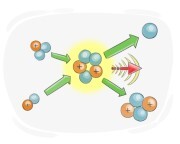
(physics) the reaction in which two nuclei join together and produce energy
relating to or involving the transformation of heat energy
the capability of being easily changed or molded into many different things
| C2 Level Wordlist | |||
|---|---|---|---|
| Psychology | Biology | Chemistry | Physics |
| Astronomy | Mathematics | Geology | Engineering |
| Measurement | |||
