
Список Слов Уровня C2 - Физика
Здесь вы узнаете все основные слова для разговора о физике, собранные специально для изучающих уровень C2.
Обзор
Флэш-карточки
Правописание
Тест


a scientific idea that all particles are tiny vibrating strings, not point-like dots, and these vibrations create different particles and forces

теория струн, теория суперструн
Теория струн предполагает, что основные строительные блоки Вселенной - это крошечные, вибрирующие струны, а не точечные частицы.
the bending, spreading, and interference of waves as they encounter obstacles or pass through narrow openings, often observed in the behavior of light, sound, or other waves
дифракция, дифракция волн
Дифракция света создает узоры из чередующихся темных и светлых областей, когда он встречает узкую щель или проходит через препятствие.
a fundamental particle combining to form protons and neutrons, with fractional electric charge and six flavors
кварк, кварк (элементарная частица)
Кварки — это самые маленькие известные частицы, образующие строительные блоки протонов и нейтронов в атомных ядрах.
a fundamental particle with half-integer spin, including electrons and their heavier counterparts, as well as neutrinos
лептон, элементарная частица с полуцелым спином
Лептоны — это элементарные частицы, которые включают электроны, мюоны, тау-частицы и связанные с ними нейтрино.
a tiny particle made up of even smaller parts called quarks, like protons and neutrons
адрон, адронная частица
Адроны подчиняются сильному ядерному взаимодействию, фундаментальному взаимодействию, которое связывает кварки вместе.
the speed at which something moves in a specific direction
скорость
Скорость объекта — это скорость изменения его положения относительно времени.
(physics) the maximum distance a vibrating material, sound wave, etc. such as a pendulum travels from its first position
амплитуда
В физике амплитуда относится к максимальному смещению волны от её положения равновесия.
tiny particles that make up matter and have a property called spin, like the building blocks of atoms
фермион, частица Ферми
Электроны, которые вращаются вокруг ядра атома, являются примерами фермионов.
a tiny particle with whole-number spin, such as photons or the Higgs boson, often associated with carrying fundamental forces or giving mass to other particles
бозон, частица с целым спином
Фотоны, частицы света, являются примерами бозонов, которые переносят электромагнитную силу.
the force that acts on an object moving in a circular path, directed toward the center of the circle or the axis of rotation, preventing the object from moving in a straight line
центростремительная сила, сила
Когда вы вращаете мяч, прикрепленный к веревке, по круговой траектории, натяжение веревки действует как центростремительная сила.
the change in frequency or wavelength of a wave in relation to an observer who is moving relative to the source of the wave, producing a shift in pitch or color
эффект Доплера, явление Доплера
Эффект Доплера объясняет, почему высота звука сирены скорой помощи меняется по мере ее приближения и прохождения мимо.
the energy possessed by an object due to its motion, defined as one-half the mass of the object multiplied by the square of its velocity, expressed by the equation KE = 0.5 * m * v^2
кинетическая энергия, энергия движения
Когда автомобиль находится в движении, его кинетическая энергия зависит как от его массы, так и от скорости.
(physics) an invisible substance that makes up most of the universe's mass, detectable only through its gravitational effects
темная материя
Тёмная материя — это форма материи, которая не излучает, не поглощает и не отражает свет, что делает её невидимой и обнаруживаемой только по её гравитационным эффектам.
(physics) matter consisting of elementary particles that are the antiparticles of those of regular matter
антивещество
Антиматерия состоит из античастиц, которые имеют ту же массу, что и соответствующие частицы, но противоположный электрический заряд.
(physics) the property of matter that gives it weight in a gravitational field and is a measure of its inertia
масса
В физике масса — это мера количества вещества в объекте.
the smallest possible amount of a particular quantity that cannot be divided any further
квант, минимальная неделимая величина
Поведение субатомных частиц регулируется принципами квантовой механики.
(physics) the increase in velocity over time
ускорение, увеличение скорости
Ускорение измеряет, как быстро меняется скорость объекта.
the strength of a moving object determined by multiplying how heavy it is by how fast it is going
импульс
Импульс автомобиля увеличивался по мере ускорения по шоссе.
a fundamental particle of light that carries electromagnetic energy and exhibits both particle-like and wave-like properties
фотон, квант света
Фотоны — это кванты электромагнитного излучения, включая видимый свет, радиоволны и рентгеновские лучи.
the tendency of an object to resist changes in its state of motion, whether at rest or in uniform motion, and to remain in its current state unless acted upon by an external force
инерция
Концепция инерции заключена в первом законе движения Ньютона, который гласит, что объект в покое остается в покое, а объект в движении продолжает двигаться с той же скоростью и в том же направлении, если на него не действует внешняя сила.
(physics) the back-and-forth motion of an object between two end points
осцилляция
Гравитационно связанные двойные звездные системы подвергаются регулярным орбитальным колебаниям, когда пара вращается вокруг их общего центра масс.
the action or process where a wave, such as light or sound, bounces back from a surface instead of passing through
отражение
Спокойная поверхность озера служила идеальным зеркалом, обеспечивая четкое отражение окружающих гор.
a measure of a material's stiffness or elasticity in physics
модуль Юнга, модуль упругости Юнга
Сталь имеет высокий модуль Юнга, что делает её жёсткой и прочной.
a theory stating that the exact position and momentum of a particle cannot be measured precisely at the same time
принцип неопределённости, принцип неопределенности
Принцип неопределённости — это фундаментальное правило в квантовой физике.
the unit of energy in the International System of Units
джоуль
Для поднятия маленького яблока на один метр требуется один джоуль энергии.
a very small, electrically neutral particle that rarely interacts with matter
нейтрино, частица нейтрино
Нейтрино — это субатомные частицы с очень маленькой массой.
the theory that adds the notion of time to that of a three-dimensional space
пространство-время
Согласно теории общей относительности Эйнштейна, гравитация — это не просто сила между массами, а искривление пространства-времени, вызванное этими массами.
the process or action of splitting a nucleus into two or more parts resulting in the release of a significant amount of energy
ядерное деление
Ядерное деление — это процесс, при котором ядро атома расщепляется на два или более меньших ядра, высвобождая большое количество энергии.
referring to the combined interaction of electric and magnetic fields, often associated with waves or radiation
электромагнитный
Свет — это электромагнитная волна, которая может распространяться в вакууме.
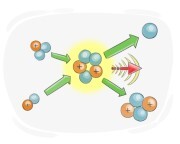
(physics) the reaction in which two nuclei join together and produce energy
ядерной синтез
Ядерный синтез — это процесс, в котором два атомных ядра объединяются, образуя более тяжелое ядро, выделяя при этом большое количество энергии.
relating to or involving the transformation of heat energy
тепловой, термический
Инженеры разработали тепловую электростанцию для эффективного преобразования тепла в электричество.
the capability of being easily changed or molded into many different things
пластичность
Пластичность относится к способности материала подвергаться постоянной деформации без разрыва при воздействии напряжения.
| Список Слов Уровня C2 | |||
|---|---|---|---|
| Психология | Биология | Химия | Физика |
| Астрономия | Математика | Геология | Инженерия |
| Измерение | |||
