Advanced Vocabulary for the GRE - What's on Your Mind?

Here you will learn some English words about opinion, such as "belie", "deem", "maintain", etc. that are needed for the GRE exam.

review-disable

review

flashcard-disable

flashcard

spelling-disable

spelling

quiz-disable

quiz

start-learning
Advanced Vocabulary for the GRE
adverse [adjective]

against someone or something's advantage

Ex: The adverse economic conditions led to layoffs and financial hardship for many families .
arbitrary [adjective]

not based on reason but on chance or personal impulse, which is often unfair

Ex: The teacher 's grading system appeared arbitrary , causing confusion among students .
to belie [verb]

to create an impression of something or someone that is false

Ex: Her friendly smile belies a competitive nature .
candid [adjective]

open and direct about one's true feelings or intentions
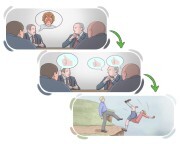
Ex: Despite the discomfort , she decided to be candid about her concerns during the meeting .

to decisively conclude something, such as an argument or a contract
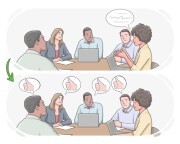
Ex: The real estate agent 's expert negotiation tactics clinched the sale of the luxurious property .

to express agreement with a particular opinion, statement, action, etc.

Ex: After a thorough discussion , the team was able to concur on the strategy to address the challenges they were facing in the project .
conversely [adverb]

in a way that is different from what has been mentioned

Ex: Although she expected increased vitality through exercise , conversely , she felt more fatigued after each workout .
to deem [verb]

to consider in a particular manner

Ex: After the interview , they deemed her qualifications suitable for the position .

to give or have opinions that differ from those officially or commonly accepted

Ex:
equivocal [adjective]

having two or more possible meanings

Ex: The clues in the puzzle were designed to be equivocal , adding to the challenge .
esoteric [adjective]

intended for or understood by only a small, specialized group, often due to complexity

Ex: His esoteric knowledge of ancient languages fascinated the scholars in the field .
exponent [noun]

a supporter of a theory, belief, idea, etc. who tries to persuade others that it is true or good in order to gain their support
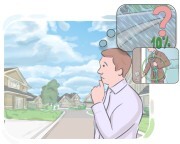
Ex: The senator is a prominent exponent of environmental protection laws .

to indicate in advance that something, particularly something bad, will take place

Ex: His sudden silence during the meeting foreshadowed unexpected news .

to disagree or deny that something is true

Ex: It is difficult to gainsay the impact of climate change on our environment .
inasmuch as [conjunction]

used to introduce additional information that explains the extent or reasons for something
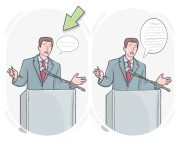
Ex: Can you explain the decision , inasmuch as it seems to contradict previous plans ?
laconic [adjective]

conveying something whilst using a very small number of words

Ex: The detective ’s laconic answers only added to the mystery .

to firmly and persistently express an opinion, belief, or statement as true and valid

Ex: The scientist maintains that climate change is a significant threat that needs immediate attention .

used to introduce an opposing statement

Ex: She doubted his motives ; she trusted him nevertheless .

to severely scold or express disapproval

Ex: During the meeting , he objurgated the staff for their poor performance .

to state one's opinion in such a manner that shows one believes to be the only person to fully know it and be unarguably correct

Ex: She is pontificating about technology trends , believing her knowledge is superior .
raillery [noun]

a type of teasing and joking that is friendly and good-natured

Ex: At the party , the guests engaged in friendly raillery that added to the fun atmosphere .

to argue and express one's disagreement or objection to something

Ex: The students remonstrated with the administration over the strict dress code policy .
scathing [adjective]

severely critical or harsh

Ex: The scathing report highlighted numerous flaws in the company 's financial practices .
to table [verb]

to suggest or decide to reschedule discussing something

Ex: She tabled the proposal , asking the committee to revisit it at a later date .
tangential [adjective]

not or barely relevant to something

Ex: The article had some tangential information that was unrelated to the central thesis .
unconscionable [adjective]

excessively unreasonable or unfair and therefore unacceptable
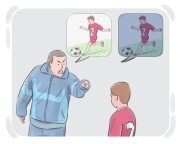
Ex: His unconscionable behavior during the negotiation left everyone feeling insulted .

to criticize someone for doing or saying something that one believes to be wrong

Ex: Displeased with the service , the customer upbraided the waiter for the mistakes in the order .

a type of criticism or insult that is hurtful and angry

Ex: The online forum was overwhelmed with vituperation directed at the new policy .
lucid [adjective]

able to think and express oneself in a way that is clear and comprehensible, particularly if one usually does not have this ability

Ex: After a restful night , she was surprisingly lucid during the important meeting .

to attentively listen

Ex: By the end of the presentation , the attendees had harkened to every point made .