
Sciences ACT - Biochimie et structure cellulaire
Apprenez le vocabulaire scientifique de l'ACT pour la biochimie et la structure cellulaire, y compris les protéines, les enzymes, les membranes, les organites, le métabolisme et les processus cellulaires.
Réviser
Flashcards
Orthographe
Quiz

a substance found in the cell walls of plants, providing structure and making up dietary fiber

cellulose, fibre végétale
La cellulose confère rigidité et résistance aux cellules végétales.
a natural sugar found in fruits and honey, often used to sweeten foods and drinks
fructose, lévulose
Le sirop de maïs à haute teneur en fructose est un édulcorant dérivé du fructose.
(biochemistry) a simple sugar that is the main source of energy for cells in the body
glucose
a short chain of amino acids linked together, which can function as a building block for proteins or act as a signaling molecule in the body
peptide, chaîne courte d'acides aminés
Les peptides jouent un rôle crucial dans la communication cellulaire et la régulation métabolique.
a type of pigment found in plants, algae, and some bacteria, responsible for bright red, yellow, and orange colors and important for photosynthesis and antioxidant activity
caroténoïde, pigment caroténoïde
Les caroténoïdes dans les feuilles aident à protéger les cellules végétales des dommages causés par une lumière excessive.
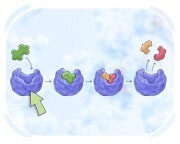
a biological molecule, usually a protein, that speeds up a specific chemical reaction without being consumed in the process
enzyme
the entire set of proteins expressed by a cell, tissue, or organism at a specific time under defined conditions
protéome, l'ensemble des protéines
Comprendre le protéome du cerveau est essentiel pour démêler les troubles neurologiques complexes.
a molecule that forms the basic building block of DNA and RNA, consisting of a sugar, a phosphate group, and a nitrogenous base
nucléotide
L'épine dorsale de l'ADN et de l'ARN est formée par des molécules de sucre et de phosphate dans les nucléotides.
a simple sugar molecule, the most basic form of carbohydrates that cannot be further hydrolyzed
monosaccharide
L'absorption rapide des monosaccharides fournit une énergie rapide.
a fundamental compound derived from glutamic acid, integral to biological functions and known for its role as a neurotransmitter in the central nervous system
glutamate, un composé fondamental dérivé de l'acide glutamique
Le glutamate est un composant clé de la saveur umami, contribuant à la richesse des aliments comme le fromage Parmesan et les champignons.
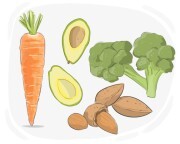
a substance, such as vitamin E, that helps clean the body of harmful substances
antioxydant
Les noix étaient une bonne source d'antioxydants, ce qui en faisait une option de collation saine pour le cœur.
(biochemistry) an oily or fatty molecule that does not dissolve in water and is a key building block of cell membranes
lipide
relating to or characteristic of mitochondria, which are organelles found in cells responsible for energy production
mitochondrial, mitochondriale
Le cycle de Krebs, également connu sous le nom de cycle de l'acide citrique, se produit dans la matrice mitochondriale.
the gel-like, semifluid substance within a cell that surrounds the organelles, providing a medium for cellular activities, including metabolism, transport of substances, and support for cellular structures
cytoplasme, substance cytoplasmique
C'est une substance semblable à un gel qui abrite divers organites, leur permettant de flotter à l'intérieur de la cellule.
a green pigment found in all green plants and cyanobacteria that is responsible for the absorption of the sunlight needed for the photosynthesis process
chlorophylle
Dans la photosynthèse, la chlorophylle capte la lumière du soleil et la convertit en énergie chimique pour la synthèse du glucose.
a thin layer of living tissue that covers, lines, connects, or separates parts of an organism
membrane
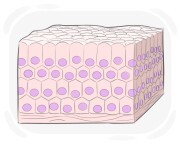
a group of similar cells that work together to form a particular part of a human, animal, or plant
tissu
a cellular organelle involved in the processing, packaging, and distribution of proteins and lipids within the cell, consisting of a stack of flattened membrane sacs called cisternae
Appareil de Golgi, Complexe de Golgi
L'appareil de Golgi joue un rôle crucial dans le tri et l'orientation des protéines vers leurs emplacements cellulaires désignés.
a tiny structure within cells that assembles proteins by reading the genetic instructions carried by messenger RNA
ribosome
Les ribosomes jouent un rôle fondamental dans les activités cellulaires en produisant les diverses protéines nécessaires à la structure et à la fonction de la cellule.
a small, enzyme-filled sac in a cell that breaks down waste materials and unwanted substances
lysosome, vésicule enzymatique
Les enzymes digestives dans les lysosomes sont capables de décomposer les protéines, les lipides, les glucides et les acides nucléiques.
a cell organelle in plants, fungi, and some protists that stores nutrients, manages waste, and helps maintain cell pressure
vacuole, vésicule
Dans les cellules végétales, la vacuole centrale stocke l'eau et aide à maintenir la pression de turgescence de la cellule.
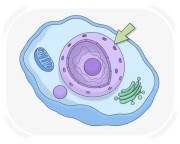
(biology) the part of a cell that contains most of the genetic information
noyau
a plant cell organelle that uses sunlight to produce energy and make glucose through photosynthesis
chloroplaste, organite photosynthétique
Les chloroplastes ont une structure à double membrane et un système de membrane interne appelé thylakoïdes, où se produisent les réactions dépendantes de la lumière.
a network of protein fibers in a cell that gives it shape, supports its structure, and aids in movement
cytosquelette, squelette cellulaire
Les filaments intermédiaires, faisant partie du cytosquelette, confèrent une résistance mécanique aux cellules et aux tissus.
a branch of biology concerning the scientific study of the form and structure of an organism including plants and animals
morphologie
a specialized, membrane-bound structure within a cell that performs specific functions, contributing to the cell's overall structure and function
organite, organelle
Les mitochondries, des organites producteurs d'énergie, génèrent de l'ATP par la respiration cellulaire.
a layer of actively dividing cells in plants, responsible for secondary growth by producing new xylem and phloem tissues
cambium, assise génératrice
Le cambium produit des cellules de liège dans l'écorce externe des plantes ligneuses, offrant protection et isolation.
