
Список Слов Уровня C2 - Астрономия
Здесь вы узнаете все основные слова для разговора об астрономии, собранные специально для учащихся уровня C2.
Обзор
Флэш-карточки
Правописание
Тест


a region beyond Neptune in the solar system containing icy objects like dwarf planets, asteroids, and comets

пояс Койпера, кольцо Койпера
Плутон когда-то считался девятой планетой до его переклассификации в карликовую планету в поясе Койпера.
a highly energetic celestial object emitting powerful radiation from the center of a galaxy, often associated with a supermassive black hole
квазар, квазизвёздный объект
Астрономы наблюдали далёкий квазар, что даёт представление о ранней вселенной.
a distant, hypothetical region surrounding the solar system, thought to harbor icy bodies and comets
облако Оорта, облако Оорта
Облако Оорта — это теоретическое скопление комет и ледяных тел, простирающееся далеко за пределы Солнечной системы.
the outer layer of the Sun's atmosphere, observable as a plasma halo during a solar eclipse
корона
Во время полного солнечного затмения корона Солнца становится видимой в виде сияющего ореола вокруг Луны.
the apparent path that the Sun traces in the sky over the course of a year, which is also the plane of the Earth's orbit around the Sun
эклиптика
Эклиптика — это путь, по которому Солнце, кажется, движется по небу в течение года.
the apparent displacement or difference in the apparent position of an object when viewed along two different lines of sight, often used in astronomy to measure the distance of nearby stars
параллакс, видимое смещение
Астрономы используют звездный параллакс для измерения расстояний до ближайших звезд, наблюдая их видимое смещение на фоне более далеких звезд.
a highly magnetized, rotating neutron star that emits beams of electromagnetic radiation from its magnetic poles
пульсар, вращающаяся нейтронная звезда
Пульсары были впервые обнаружены в 1967 году астрономами Джоселин Белл Бернелл и Энтони Хьюишем.
a unit of measurement equal to the average distance between the Earth and the Sun, approximately 149.6 million kilometers
астрономическая единица, а.е.
Астрономическая единица измеряет расстояния в нашей солнечной системе.
a unit of astronomical distance equivalent to about 3.26 light-years
парсек, единица астрономического расстояния
Астрономы используют парсек для измерения расстояний до звезд и галактик.
a high-energy particle, mainly originating from outside the Solar System, that travels through space at nearly the speed of light
космический луч, космическая частица
Космические лучи играют роль в формировании атмосферы и климата Земли.
(cosmology) the faint glow of radiation spreading through the universe, believed to be residual radiation from the Big Bang
космическое микроволновое фоновое излучение, реликтовое излучение
Реликтовое излучение замечательно равномерно по всему небу.
(cosmology) a theory proposing that the solar system formed from a rotating nebula of gas and dust about 4.6 billion years ago
туманная гипотеза, теория туманности
Туманная гипотеза предполагает, как сформировалась наша солнечная система.
(cosmology) a measure of the rate at which the universe is expanding, determined from the observation of distant galaxies' recession velocities
постоянная Хаббла, параметр Хаббла
Постоянная Хаббла говорит нам, насколько быстро расширяется вселенная.
the matter and radiation that exists in the space between stars within a galaxy
межзвёздная среда, межзвёздное вещество
Межзвездная среда состоит из газа, пыли и космических лучей.
the space surrounding the Sun dominated by solar wind
гелиосфера, сфера солнечного влияния
Частицы солнечного ветра создают границу гелиосферы.
very small particles originally derived from stars, serving as raw material for forming planets, and existing between galaxies, stars, and other celestial bodies
космическая пыль
Космическая пыль состоит из крошечных частиц материи, плавающих в пространстве, в основном состоящих из таких элементов, как углерод, кремний и железо.
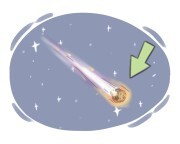
a small celestial body that becomes visible as a meteor upon entrance into the atmosphere of the earth
метеороид
Метеороид — это небольшой каменистый или металлический объект в космическом пространстве, который значительно меньше астероида и больше микрометеороида.
(cosmology) the rapid expansion of the universe following the Big Bang
инфляция, быстрое расширение
Инфляция — это теория, объясняющая быстрое расширение Вселенной.
a disruption in earth's magnetic field caused by solar activity, resulting in variations that can impact electronic systems and communications on earth
магнитная буря
Магнитная буря, также известная как геомагнитная буря, это возмущение в магнитосфере Земли, вызванное взаимодействиями с солнечным ветром.
the colored lights, mainly green and red, in the sky seen primarily near the southern magnetic pole
полярное сияние
Аврора аустралис, также известная как Южное сияние, это природное световое явление, которое происходит в высокоширотных регионах Южного полушария.

the colored lights, mainly green and red, in the sky seen primarily near the northern magnetic pole
полярное сияние
Северное сияние, также известное как полярное сияние, представляет собой природное световое явление, которое происходит в высокоширотных регионах Северного полушария.
associated with the phenomena, processes, or theories related to the origin and formation of the universe or celestial bodies
космогонический, связанный с космогонией
Космогонические теории исследуют, как возникла и развивалась вселенная.
study of celestial objects outside the Milky Way galaxy
внегалактическая астрономия, изучение небесных объектов за пределами Млечного Пути
Внегалактическая астрономия исследует объекты за пределами нашей Галактики.
relating to or resembling a nebula, which is a cloud of gas and dust in outer space
туманностный, относящийся к туманности
Туманная теория предполагает, что звезды и планетные системы образуются в результате гравитационного коллапса туманностей.
relating to the stars or constellations, especially in terms of their positions relative to Earth
звёздный, сидерический
Звёздное время основано на вращении Земли относительно далёких звёзд, а не Солнца.
| Список Слов Уровня C2 | |||
|---|---|---|---|
| Психология | Биология | Химия | Физика |
| Астрономия | Математика | Геология | Инженерия |
| Измерение | |||
