pattern

Basic Sciences - Mathematics

Study terms related to mathematical fields, equations, functions, variables, graphs, proofs, probability, and trigonometric concepts.

Review

Flashcards

Spelling

Quiz
Start learning
Words Related to Basic Sciences
mathematical
mathematical
[Adjective]

related to or used in mathematics

Ex: She employed mathematical equations to solve complex problems in physics. 
Close
Sign in
mathematician

someone who is a specialist or expert in mathematics
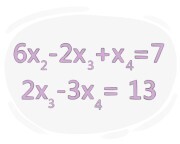
Ex: The mathematician worked late into the night on his latest theory. 
Close
Sign in
algebra
algebra
[noun]

a branch of mathematics in which abstract letters and symbols represent numbers in order to generalize the arithmetic
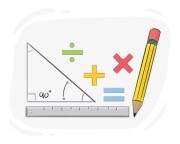
Ex: In high school, students typically begin studying algebra to learn about equations and variables. 
Close
Sign in
arithmetic

a branch of mathematics that deals with addition, subtraction, multiplication, etc.
Ex: Students in elementary school learn basic arithmetic operations such as addition, subtraction, multiplication, and division. 
Close
Sign in
calculus
calculus
[noun]

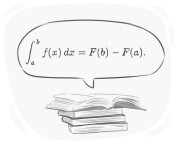
the branch of mathematics that comprises differentials and integrals

Ex: Calculus is used to find the area under a curve. 
Close
Sign in
integral calculus

(mathematics) the branch of calculus that finds total amounts like areas, volumes, and accumulated sums

Ex: Integral calculus is used to calculate the area under a curve on a graph. 
Close
Sign in
differential calculus

a branch of mathematics that focuses on studying rates of change and instantaneous variations through the concept of derivatives

Ex: Differential calculus helps us find how quickly something changes. 
Close
Sign in
geometry
geometry
[noun]

the branch of mathematics that deals with the relation between the lines, angles and surfaces or the properties of the space
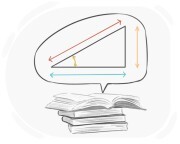
Ex: She studied geometry to understand the principles of shapes and angles. 
Close
Sign in
trigonometry

a branch of mathematics that deals with the relationships between the angles and sides of triangles
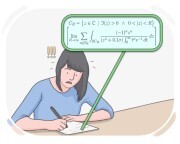
Ex: In trigonometry, the sine function (sin) relates the ratio of the length of the opposite side to the hypotenuse in a right-angled triangle. 
Close
Sign in
problem
problem
[noun]

a question that can be answered by mathematics or logical thinking
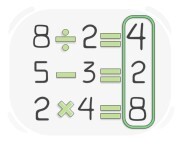
Ex: In the competition, each team had to solve the same set of problems 
Close
Sign in
solution
solution
[noun]

a correct answer to a problem in mathematics or a puzzle

Ex: After careful analysis, she found the solution to the complex algebraic equation. 
Close
Sign in
product
product
[noun]

the result of multiplying two or more numbers or quantities together

Ex: The product of 3 and 4 is 12. 
Close
Sign in
variable
variable
[noun]

(mathematics) a quantity that is capable of assuming different values in a calculation

Ex: In algebra, variables such as x, y, and z represent quantities that can vary or change in value. 
Close
Sign in
domain
domain
[noun]

the set of all possible input values for which a given function is defined

Ex: To find the domain of a rational function, exclude any values that make the denominator zero. 
Close
Sign in
equation
equation
[noun]

(mathematics) a statement indicating the equality between two values

Ex: In algebra, solving equations involves finding the values of variables that satisfy the equality stated. 
Close
Sign in
polynomial

a mathematical expression with variables raised to powers and combined using arithmetic operations

Ex: Polynomials are used to represent curves in algebraic geometry. 
Close
Sign in
formula
formula
[noun]

(mathematics) a rule or law represented in symbols, letters, or numbers

Ex: The quadratic formula provides a method for finding the roots of a quadratic equation. 
Close
Sign in
proof
proof
[noun]

a logical argument composed of a series of steps, each following from the previous, demonstrating that a statement is true

Ex: The mathematician presented a proof of the theorem. 
Close
Sign in
function
function
[noun]

(mathematics) a quantity whose value changes according to another quantity's varying value

Ex: In calculus, a function represents a relationship between input and output variables, often denoted as f(x). 
Close
Sign in
logarithm
logarithm
[noun]

a mathematical function that represents the exponent to which a fixed number, called the base, must be raised to produce a given number

Ex: In the logarithm log₂(8) = 3, the base 2 raised to the power of 3 equals 8. 
Close
Sign in
ratio
ratio
[noun]

the result of dividing one number, quantity, or expression by another

Ex: The ratio of 10 to 2 is 5. 
Close
Sign in
matrix
matrix
[noun]

a rectangular array of numbers or symbols organized in rows and columns, commonly used in linear algebra for representing equations, transformations, and vector operations

Ex: A 2x3 matrix represents a collection of numbers organized in two rows and three columns. 
Close
Sign in
operator
operator
[noun]

(in mathematics) a function or symbol that performs a mathematical operation

Ex: The plus sign is an operator that adds two numbers. 
Close
Sign in
probability

(mathematics) a number representing the chances of something specific happening

Ex: The probability of rolling a six on a fair die is one-sixth. 
Close
Sign in
sine
sine
[noun]

(mathematics) the ratio of the length of the side opposite the given angle to the length of the hypotenuse

Close
Sign in
cosine
cosine
[noun]

(mathematics) the ratio of the adjacent side to the hypotenuse

Close
Sign in
tangent
tangent
[noun]

(mathematics) the ratio of the opposite to the adjacent side of a triangle that has one angle of 90°
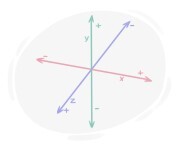
Ex: If the tangent of an angle is 1, it means the height and base of our triangle are the same. 
Close
Sign in
axis
axis
[noun]

a straight line that defines the symmetry or structure of a figure or object

Ex: The artist drew an axis to guide the proportions of the face. 
Close
Sign in
graph
graph
[noun]

(in mathematics) a set of points with coordinates that satisfy specific relationships

Ex: The function's graph showed a clear linear pattern. 
Close
Sign in
curve
curve
[noun]

a line on a graph or chart representing a set of data

Ex: The curve on the graph showed rising temperatures over the year. 
Close
Sign in
infinity
infinity
[noun]

(mathematics) a quantity or value that is larger than any finite number and has no limit

Ex: The sequence of counting numbers goes on to infinity without ever ending. 
Close
Sign in
theorem
theorem
[noun]

a statement or proposition that has been proven to be true based on previously established axioms, definitions, and other theorems within a particular mathematical or logical system

Ex: Mathematicians often prove theorems to establish mathematical truths. 
Close
Sign in
LanGeek
Download LanGeek app