pattern

Basic Sciences - Arithmetic

Study terms related to averages, fractions, basic operations, percentages, powers, roots, and classifications of numbers.

Review

Flashcards

Spelling

Quiz
Start learning
Words Related to Basic Sciences
decimal
decimal
[noun]

(mathematics) a number less than one, called a fraction, that is represented as a period followed by the number of tenths, hundredths, etc.
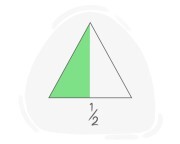
Ex: In mathematics, decimals are a way to represent fractions or portions of a whole using a decimal point. 
Close
Sign in
fraction
fraction
[noun]

a number obtained by dividing one integer or rational number by another, typically written in the form a/b
Ex: One-half (1/2) is a simple fraction. 
Close
Sign in
numerator
numerator
[noun]

Fractional number above the line

Close
Sign in
addition
addition
[noun]

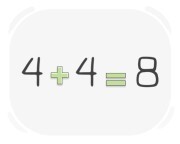
the calculation of the total of two or more numbers added together
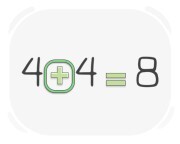
Ex: Addition is the process of combining two or more numbers to get a total. 
Close
Sign in
subtraction

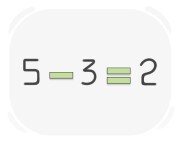
the mathematical process of finding the difference between two numbers, quantities, or expressions
Ex: In subtraction, 15 minus 7 equals 8. 
Close
Sign in
multiplication

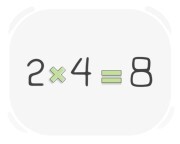
the process or action of adding a number to itself a specific number of times
Ex: The teacher explained that multiplication can be represented using the "×" symbol. 
Close
Sign in
division
division
[noun]

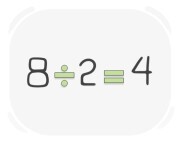
the process of calculating how many times a number can contain another number

Ex: In division, the number being divided is called the dividend. 
Close
Sign in
divisor
divisor
[noun]

(mathematics) the number that divides another number in a division problem

Ex: A divisor is a number that divides another number evenly without leaving a remainder. 
Close
Sign in
denominator

the number below the line in a fraction that shows how many parts the numerator divides into

Close
Sign in
common denominator

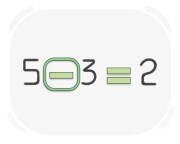
(mathematics) a number divisible by all the numbers that are below the line in a set of fractions
Close
Sign in
minus
minus
[noun]

the sign - in mathematics, used to indicate subtraction or a negative number
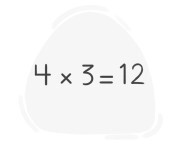
Ex: In algebra, the minus is used to denote the opposite or negative of a number or variable. 
Close
Sign in
times
times
[preposition]

used to multiply a number by another

Ex: Three times four equals twelve. 
Close
Sign in
plus
plus
[noun]

the sign + in mathematics, used to indicate addition or a positive number
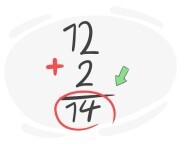
Ex: In arithmetic, the plus is used to combine numbers or quantities. 
Close
Sign in
sum
sum
[noun]

the whole amount of numbers added together

Ex: The sum of 5, 6, and 7 is 18. 
Close
Sign in
percentage

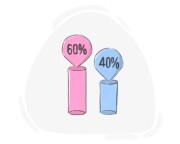
a number or amount expressed as a fraction of 100

Ex: The percentage of students who passed the exam increased significantly this year. 
Close
Sign in
factorial
factorial
[noun]

the product of all positive whole numbers from 1 to a given number

Ex: The factorial of 5 is calculated as 5!=5×4×3×2×1=120. 
Close
Sign in
power
power
[noun]

(mathematics) the exponent in an expression, indicating how many times a base is multiplied by itself

Ex: In the expression 3^4, the power is 4. 
Close
Sign in
root
root
[noun]

a value that, when multiplied by itself a specified number of times, results in the given number

Ex: The square root of 16 is 4. 
Close
Sign in
square
square
[noun]

the second exponent of any given number produced when multiplied by itself

Close
Sign in
cube
cube
[noun]

the result of multiplying a number by itself three times

Ex: The cube of two is eight. 
Close
Sign in
prime number

a number greater than 1 with only two devisors which can be itself or 1

Ex: 7 is a prime number because its only divisors are 1 and 7. 
Close
Sign in
rational number

a number that can be written as a fraction, where both the top and bottom are whole numbers, and the bottom is not zero

Ex: 3/4 is a rational number because it can be written as a fraction of two integers. 
Close
Sign in
irrational number

a number incapable of being expressed as a ratio of two integers

Ex: The square root of 2 is an irrational number. 
Close
Sign in
natural number

(mathematics) any positive whole number starting from 1 and counting upward, like 1, 2, 3, 4, and so on
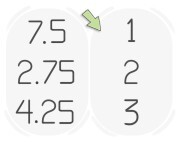
Ex: The set of natural numbers begins with 1 and never ends. 
Close
Sign in
whole number

any positive number without fractions or decimals, including zero

Ex: The numbers 0, 1, 2, 3, and so on are all whole numbers. 
Close
Sign in
integer
integer
[noun]

any number without fractions or decimals, including positive numbers, negative numbers, and zero

Ex: The numbers -3, 0, and 7 are all integers. 
Close
Sign in
real number

any number that can be found on the number line, including both positive and negative numbers, zero, and fractions
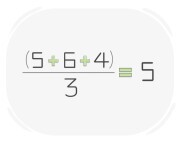
Ex: The number 5 is a real number because it can be located on the number line. 
Close
Sign in
to average

to find the sum of a set of numbers and then divide by the total number of values in the set
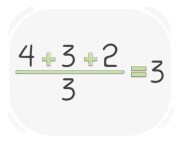
Ex: The teacher averaged the students' test scores to determine their overall performance in the class. 
Close
Sign in
mean
mean
[noun]

(mathematics) the average value of a set of quantities calculated by adding them, and dividing them by the total number of the quantities

Ex: To find the mean of 4, 6, and 8, add them together and divide by 3. 
Close
Sign in
even number

(mathematics) any integer that can be divided by 2 without leaving a remainder

Ex: The numbers 2, 4, 6, and 8 are all even numbers. 
Close
Sign in
odd number

(mathematics) any integer that cannot be divided by 2 without leaving a remainder of 1

Ex: The numbers 1, 3, 5, and 7 are all odd numbers. 
Close
Sign in
LanGeek
Download LanGeek app