SAT Humanities - Conflict and Compliance

Here you will learn some English words related to conflict and compliance, such as "subvert", "coerce", "appease", etc. that you will need to ace your SATs.

review-disable

review

flashcard-disable

flashcard

spelling-disable

spelling

quiz-disable

quiz

start-learning
SAT Humanities

to formally oppose or challenge a decision or a statement

Ex: They will contest the new policy at the upcoming board meeting .

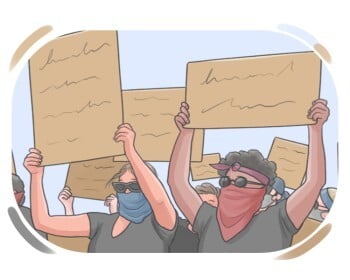
to show disagreement by taking action or expressing it verbally, particularly in public

Ex: Activists peacefully marched to protest racial injustice and advocate for equality .

to object to the legality or acceptability of something
Ex: He planned to challenge the results of the election based on alleged irregularities .

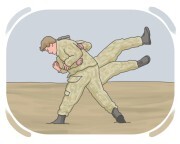
to fight or contend against someone or something, often in a physical or armed conflict

Ex: Soldiers are trained to combat enemies on the battlefield .

(of two ideas, opinions, etc.) to oppose each other
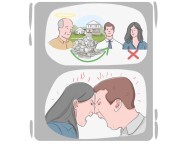
Ex:
to feud [verb]

to have a lasting and heated argument with someone
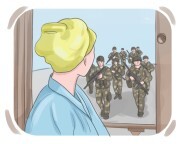
Ex: The rival gangs feuded over control of the neighborhood for years .

to enter a territory using armed forces in order to occupy or take control of it
Ex: The conquerors were determined to invade the island and claim it for their empire .

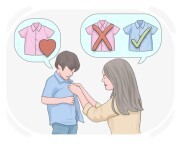
to force someone to do what they do not want
Ex: Governments should avoid imposing excessive taxes that burden the citizens .

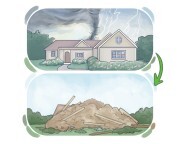
to cause or impose something unpleasant, harmful, or unwelcome upon someone or something

Ex: The criminal 's goal was to inflict fear on the community through acts of violence .

to force someone to do something through threats or manipulation

Ex: The bully tried to coerce his classmates into giving him their lunch money through threats .

to struggle or fight with someone, particularly to get something
Ex: In a crowded marketplace , people may tussle to secure the last available product on sale .
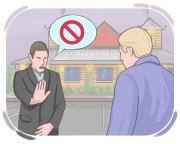
to bar [verb]

to not allow someone to do something or go somewhere

Ex: Players who violate the rules may face penalties , including being barred from future competitions .

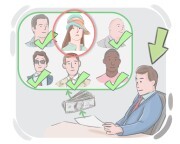
to illegally take someone away, especially by force or deception
Ex: The organization was notorious for attempting to abduct scientists to gain access to classified information .

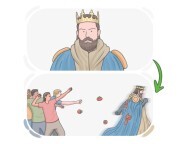
to cause the downfall or removal of rulers or leaders
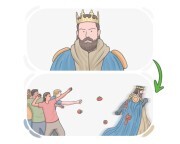
Ex: The military coup successfully overturned the existing leadership , prompting political instability .

to cause the downfall of authority figures or rulers
Ex: Attempts to subvert the monarchy were met with harsh consequences .

to treat someone unfairly or cruelly, often because of their race, gender, religion, or beliefs
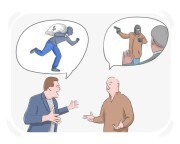
Ex: Throughout history , women have been persecuted for advocating for their rights and equality .

to make secret plans with other people to commit an illegal or destructive act

Ex: The court found evidence that the suspects had conspired to commit white-collar crimes .

to force someone to act in a certain way

Ex: The rules of the game constrained the players to follow a specific strategy .

to launch a vigorous or violent attack on someone or something, either physically or verbally
Ex: Burglars assailed the homeowner as he entered , demanding money and valuables .

to defeat someone or something using superior strength, force, or influence

Ex: The storm 's strong winds threatened to overpower the structures in its path .
to defy [verb]

to refuse to respect a person of authority or to observe a law, rule, etc.

Ex: The outspoken employee was willing to defy company policies in order to advocate for change .
campaign [noun]

a set of actions organized in order to serve a political purpose
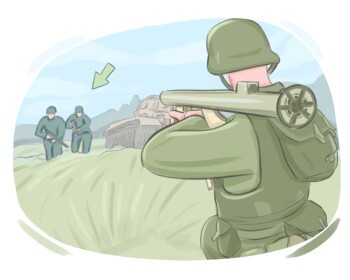
Ex: The anti-smoking campaign used shocking ads to discourage teens from vaping .

a person that one is opposed to and fights or competes with

Ex: As a lawyer , she was used to meeting her adversary in the courtroom .
assault [noun]

an act of crime in which someone physically attacks another person
Ex: Witnesses testified that the assault occurred in broad daylight outside the shopping mall .
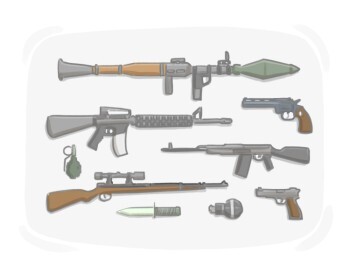
armament [noun]

the military equipment and weaponry used by a country or military force

Ex: During the Cold War , both superpowers engaged in a race to build up their nuclear armament , leading to a tense arms race .

a fierce and intense attack, often with the goal of overwhelming the opponent

Ex: The military base prepared for an impending onslaught , fortifying defenses and mobilizing troops for the anticipated attack .

disagreement or conflict within a group expected to collaborate

Ex: The coach 's challenge was not just training the team but also managing the dissension among players .

behavior or feelings that are aggressive or unfriendly

Ex: Despite their initial hostility , the two coworkers eventually found a way to collaborate effectively .
nemesis [noun]

a formidable opponent or persistent force that causes misery, defeat, or downfall

Ex: Drought proved to be the nemesis of the farming community , leading to widespread famine .

a state of heated disagreement, often coming from different viewpoints or interests

Ex: The negotiation process was marked by contention over contract terms .

a sudden and brief attack to other territory, especially in large numbers and across a border

fort [noun]

a building or group of buildings used by troops to protect an area

Ex: Archaeologists uncovered the ruins of an ancient fort dating back to Roman times .

a situation of hostility or strong disagreement between two opposing individuals, parties, or groups

Ex: The police were called to intervene in a confrontation between protesters and counter-protesters .
raid [noun]

a surprise attack against a place or a group of people

Ex: The police conducted a raid on the warehouse , uncovering a large cache of illegal weapons .
defenseless [adjective]

being without protection or means of defending oneself from harm or attack

Ex: The elderly woman felt defenseless against the scam artists who preyed on her .
disobedient [adjective]

refusing or failing to follow rules, orders, or instructions, often showing resistance to authority

Ex: The soldiers were punished for being disobedient and not following their commanding officer 's orders .
combative [adjective]

eager or inclined to engage in fighting or arguing

Ex: The combative nature of the protesters led to clashes with the police .
forcibly [adverb]

with a significant amount of physical strength or authority
Ex: He was forcibly evicted from the premises after refusing to leave voluntarily .

to end or lessen a person's anger by giving in to their demands
Ex: The company plans to appease customer complaints by improving its customer service .

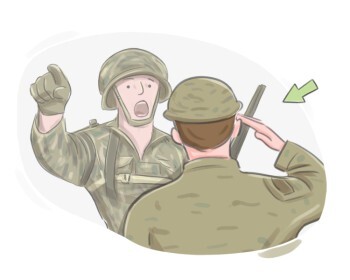
to act in accordance with rules, regulations, or requests

Ex: The company implemented new security measures , and everyone needs to comply .
to abide [verb]

(always negative) to tolerate someone or something

Ex: He could n't abide the arrogance of the new manager , leading him to consider finding a job elsewhere .

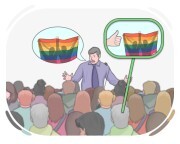
to devotedly follow or support something, such as a rule, belief, plan, etc.
Ex:

to adopt or accept a particular cause, ideology, practice, method, or lifestyle as one's own

Ex: As he learned more about the philosophy , he decided to embrace Buddhism and incorporate its principles into his life .

the act of solving a problem, dispute, or difficulty

Ex: The team worked toward the resolution of technical issues .

the act of becoming friendly with someone once more after ending a disagreement

a middle state between two opposing situations that is reached by slightly changing both of them, so that they can coexist

Ex: After hours of debate , the committee settled on a compromise that satisfied both parties .
submissive [adjective]

showing a tendency to be passive or compliant

Ex: The submissive nature of the character in the novel highlighted the power dynamics at play .