Cambridge English: CAE (C1 Advanced) - Media, Publishing & Information Dynamics

review-disable

review

flashcard-disable

flashcard

spelling-disable

spelling

quiz-disable

quiz

start-learning
Cambridge English: CAE (C1 Advanced)
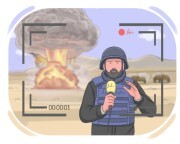
to break [verb]

(of news) to be released or made known to the public

Ex: The celebrity 's engagement news broke on social media .

the total number of copies of a newspaper or magazine distributed, including both sales and delivery to readers
Ex: That journal has the widest circulation among scientists .
to cover [verb]

to provide a report on or talk about an event in a news piece or media
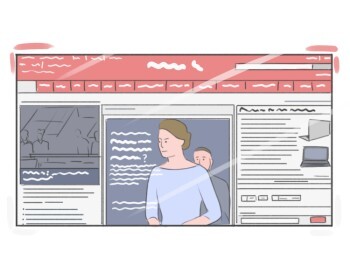
Ex: The newspaper covered the groundbreaking ceremony for the new hospital , highlighting key speeches .

important social or political events that are happening and are covered in the news

Ex: Discussions on current affairs often dominate the morning talk shows .

the statistical study of populations, including their size, distribution, composition, and changes over time due to factors such as birth, death, migration, and aging

Ex: The field of demography encompasses a wide range of methods and theories used to study human populations and their dynamics .
to draft [verb]

to write something for the first time that needs corrections for the final presentation

Ex: The students were instructed to draft their research papers and then seek feedback from their peers .

an observable fact, event, or situation, often unusual or not yet fully explained

Ex: Scientists study each phenomenon carefully .

the number of people who read a particular magazine, newspaper, or book on a regular basis

Ex: The author 's latest book has attracted a diverse readership , spanning multiple age groups and interests .
revenue [noun]

the total income generated from business activities or other sources

Ex: The new product line significantly boosted their revenue .
to run [verb]

(with reference to a newspaper, magazine, story, etc.) to print and publish

Ex: The radio station ran an interview with the famous author .
source [noun]

a book or a document that supplies information in a research and is referred to

Ex: The article lists all its sources at the end for further reading .

an arrangement where an individual or entity pays a recurring fee or provides contact info to access content, services, or updates from a specific source

Ex: Companies manage subscriptions for software access .
tablet [noun]

a flat, small, portable computer that one controls and uses by touching its screen

Ex: He prefers reading e-books on his tablet because it 's easier to carry around than physical books .

a movement, development, or shift from one stage, subject, or place to another

Ex: The transition from theory to practice proved difficult .
scenario [noun]

a hypothetical sequence of events or a plausible situation that could unfold

Ex: The novel explores a dystopian scenario where technology controls every aspect of society .
exposure [noun]

the act of making something visible or known to the public

Ex: The product received wide exposure at the trade show .

using websites and apps to interact and build social relationships
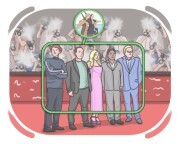
Ex: The rise of social networking has changed the way people communicate and share information .
cast [noun]

all the actors and actresses in a movie, play, etc.

Ex: A talented cast can make even a simple story compelling .

used to describe someone or something that attracts a great deal of public attention

Ex: He has been in the public eye ever since his breakthrough performance .

freelance photographers who aggressively pursue and take pictures of celebrities, often in invasive or intrusive ways

Ex: Despite attempts to avoid attention , the singer was constantly hounded by the paparazzi .

a TV or radio show, broadcast regularly, dealing with the routine life of a group of people and their problems

Ex: He used to listen to soap operas on the radio with his grandmother .
villain [noun]

the main bad character in a movie, story, play, etc.

Ex: The villain ’s motives were revealed at the end of the story .

a person who provides live commentary on a sports event, performance, or broadcast

Ex: A famous commentator covered the Olympic Games .
flyer [noun]

a small piece of paper that has information about something being advertised, usually printed in color and handed out to people by hand

Ex: They distributed flyers to promote the concert .

to suddenly appear very briefly on a screen or display
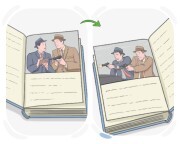
Ex:
plot [noun]

the events that are crucial to the formation and continuity of a story in a movie, play, novel, etc.

Ex: She explained the plot of the play , highlighting the main conflicts and resolutions .
subtitled [adjective]

(of a film or video) featuring written translations of spoken dialogue displayed on the screen, typically in a language different from the original audio

Ex:

to represent or show something or someone by a work of art

Ex: The mural on the city wall depicts scenes from local history , showcasing significant events and figures .

a person, brand, or product widely known and recognized by the general public

Ex: Her novel made her a household name in literary circles .

to make a person, place, or thing widely known, often for the first time
Ex: The invention put the company on the map as a global leader .

to simplify or reduce the intellectual content of something in order to make it more accessible or appealing to a wider audience

Ex:
Cambridge English: CAE (C1 Advanced)
Ecological Principles & Conservation Pollution, Waste & Human Impact Energy, Resources & Environmental Events Physics & States of Matter
Chemical & Material Processes Biology, Genetics & Life Processes Art Forms & Creative Processes The Art Scene
Sports Medical Practices & Treatments Illnesses, Injuries & Specific Conditions General Health & Medical Systems
Social Disadvantage & Core Issues Personal Traits & Character Societal Frameworks, Governance & Welfare Recruitment & Job Roles
Workplace Culture & Career Trade & Market Dynamics Technological Devices & Systems Telephoning & Direct Speech
Physical Appearance & Form Academic Studies & Qualifications Skills & Competencies Crime & Legal Consequences
Apparel, Cost & Styles Historical Societies & Economic Systems Work Performance & Conditions Financial Management & Economic Health
Corporate Structures & Strategic Actions Social Navigation & Behavior Patterns Perspectives, Beliefs & Navigating Challenges Traits & Self-Concept
Cognitive Processes & Memory Analysis, Judgment & Problem Solving Innovation, Development & Function Superstition & Supernatural
Media, Publishing & Information Dynamics Emotional States & Reactions Communicative Interpretation & Expression Formal Communication & Information Exchange
Social Influence & Strategies Personal Conduct & Self-Management State & Condition Relational & Abstract Qualities
Clarity, Perception & Reality Style & Atmosphere Negative Judgments & Flaws Positive Judgments & High Value
Challenging Interactions & Social Tactics Family & Social Connections Adverbs & Adverbial Phrases Manual Actions or Physical Movement
Level & Intensity Everyday Objects & Domestic Life Food, Cooking & Dining Creatures & Their Behaviors