
pattern

Applied Science and Research - Programming

Study terms related to programming languages, code structure, algorithms, data processing, software development, and debugging.

Review

Flashcards

Spelling

Quiz

Start learning
Words Related to Applied Science and Research
front end
front end
[noun]

a part of a computer that is easily accessible and one uses constantly

Ex: The front end of a computer typically refers to the user interface, including the monitor, keyboard, mouse, and other input devices. 
Close
Sign in
binary
binary
[Adjective]

based on or using a numerical system that operates only on 0 and 1

Ex: The binary system is fundamental to digital technology and computing. 
Close
Sign in
bit
bit
[noun]

(computing) the smallest unit of data, representing a binary state of 0 or 1

Close
Sign in
byte
byte
[noun]

a unit for measuring the size of computer data that equals 8 bits
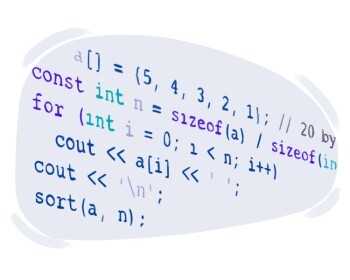
Ex: The text file is 1 megabyte in size, which is equivalent to 8 million bytes. 
Close
Sign in
to code
to code
[Verb]

to write a computer program using specific instructions

Ex: She coded a new software application to automate tasks at work. 
Close
Sign in
command
command
[noun]

an instruction that tells a computer to perform a specific task or function
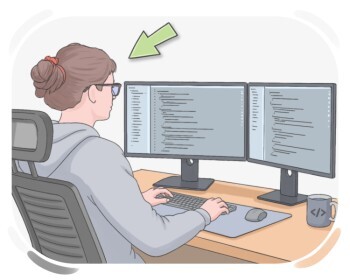
Ex: She entered the command to save the document before closing the application. 
Close
Sign in
programmer

a person who writes computer programs

Ex: She's a skilled programmer who develops mobile applications for smartphones. 
Close
Sign in
software engineer

a person who designs and creates computer programs using special tools and languages

Close
Sign in
back end
back end
[noun]

a part of a computer responsible for storing and controlling data where users cannot easily access

Ex: The back end of a website comprises the server, database, and application logic that work together to process and store data submitted by users. 
Close
Sign in
dataset
dataset
[noun]

(computing) a collection of data treated as a single unit

Ex: The dataset contained over 10,000 images for training the model. 
Close
Sign in
deep learning

an AI method using neural networks to learn patterns from massive data

Ex: Deep learning powers the voice recognition in most modern assistants. 
Close
Sign in
machine learning

a branch of artificial intelligence where computers learn how to perform specific operations without previous instructions
Close
Sign in
to encode
to encode
[Verb]

to transform data into a coded form

Ex: Computer programmers encode sensitive information to protect it from unauthorized access. 
Close
Sign in
to encrypt

to convert data or information into a coded form, mainly to prevent unauthorized access

Ex: The company encrypts sensitive customer data to protect it from hackers. 
Close
Sign in
to generate

to create a new set of data by using a mathematical or logical process to transform an existing set of data
Ex: The computer program generates random numbers to simulate various scenarios in the statistical model. 
Close
Sign in
instruction

a line of command that tells a computer what to do

Ex: Each instruction in the program directs the computer to perform a specific task, such as adding numbers or displaying text. 
Close
Sign in
markup
markup
[noun]

detailed instructions, often written on a manuscript, indicating how text should be formatted or printed

Ex: The editor added markup to the manuscript to indicate italics and bold text. 
Close
Sign in
patch
patch
[noun]

a small piece of code or update applied to existing software to fix issues, enhance functionality, or address vulnerabilities

Ex: You need to install the latest patch to improve the app’s performance. 
Close
Sign in
to program

to write a set of codes in order to make a computer or a machine perform a particular task

Ex: She programmed the robot to navigate through the maze autonomously. 
Close
Sign in
script
script
[noun]

(computing) a sequence of instructions executed in response to an event or command

Ex: The script ran automatically when the user clicked the submit button. 
Close
Sign in
source code

a text containing instructions in a specific order that supports a programming language which human can read and it specifies the behaviors of a computer system

Ex: The developer reviewed the source code to fix the bug. 
Close
Sign in
machine code

the low-level instructions that a computer's processor executes directly

Ex: The compiler translates source code into machine code for execution. 
Close
Sign in
reserved word

(computing) a keyword with a predefined meaning that cannot be used as a variable name

Ex: You cannot name your variable "if" because it is a reserved word. 
Close
Sign in
query language

a language that uses procedural operators to request and retrieve data from a database

Ex: SQL is the most widely used query language for relational databases. 
Close
Sign in
Pascal
Pascal
[noun]

a high-level programming language designed for teaching structured programming

Ex: She learned programming concepts using Pascal in her first computer science course. 
Close
Sign in
graphical user interface

the visual interaction that users have with the computer through icons, menus, etc.

Ex: The software update included a new graphical user interface. 
Close
Sign in
Extensible Markup Language

(computing) a markup system for structuring text and data in a machine-readable format

Ex: The configuration file is stored in Extensible Markup Language for easy parsing. 
Close
Sign in
algorithm
algorithm
[noun]

a finite sequence of well-defined, mathematical instructions for completing a specific task or solving a problem

Ex: The Euclidean algorithm is used to find the greatest common divisor of two integers. 
Close
Sign in
loop
loop
[noun]

(computing) a single iteration of a repeated sequence of instructions

Close
Sign in
statement
statement
[noun]

(computing) a single line of code that performs a specific action

Close
Sign in
syntax
syntax
[noun]

the set of rules that defines how statements and commands must be written in a computer programming language

Ex: A missing semicolon can cause a syntax error. 
Close
Sign in
compiler
compiler
[noun]

a program that translates source code written in a programming language into machine code or bytecode, allowing the computer's central processing unit (CPU) to execute the program

Ex: Programmers use a compiler to convert high-level programming code into machine code that a computer can execute. 
Close
Sign in
framework
framework
[noun]

a structure or model guiding organization or development, often with rules or principles

Ex: The legal framework outlines the rules and regulations governing business operations. 
Close
Sign in
programming language

(computing) a formal language used to write instructions for computers

Close
Sign in
command line

a text interface where users type commands to execute programs

Ex: She used the command line to compile the source code. 
Close
Sign in
LanGeek
Download LanGeek app
