
pattern

C2 Level Wordlist - War and Army

Here you will learn all the essential words for talking about War and Army, collected specifically for level C2 learners.

Review

Flashcards

Forms

Spelling

Quiz

Start learning
CEFR C2 Vocabulary
armada
armada
[noun]

a massive group of warships organized for military or strategic purposes

Ex: The coastal town watched nervously as the armada approached from the horizon .
Close
Sign in
armistice
armistice
[noun]

a temporary stoppage or truce in hostilities between parties engaged in a war or conflict

Ex: The armistice allowed both sides to retrieve their wounded and dead from no man 's land between the trenches .
Close
Sign in
mercenary
mercenary
[noun]

a professional soldier hired to serve in a foreign army, often motivated by payment rather than ideological or national allegiance

Ex: Mercenaries were often employed in colonial conflicts to supplement the regular army .
Close
Sign in
barricade
barricade
[noun]

a defensive barrier erected during wartime to obstruct enemy movement and provide protection for defending forces

Ex: Soldiers utilized abandoned vehicles and debris to improvise barricades, impeding the enemy 's ability to maneuver .
Close
Sign in
battalion
battalion
[noun]

a military unit composed of a varying number of companies or platoons, typically commanded by a lieutenant colonel

Ex: Each battalion had its own distinct set of responsibilities during the operation .
Close
Sign in
platoon
platoon
[noun]

a military unit, subdivision of a company, typically with a headquarters and two or more squads, usually led by a lieutenant

Ex: During drills , the platoon practiced coordinated maneuvers .
Close
Sign in
espionage
espionage
[noun]

the covert gathering of information for political, military, or economic purposes, often conducted by intelligence agencies

Ex: Cyber espionage has become a prominent threat , with hackers infiltrating networks to steal confidential information and disrupt operations .
Close
Sign in
coup d'etat

a sudden, violent seizure of governmental power by a small group

Ex: The citizens took to the streets in protest against the coup d'état, demanding the restoration of democratic governance.
Close
Sign in
onslaught
onslaught
[noun]

a fierce and intense attack, often with the goal of overwhelming the opponent
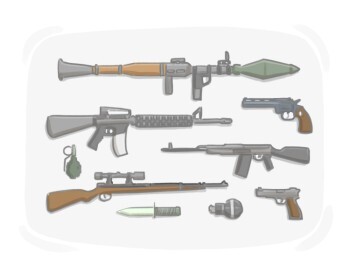
Ex: In the final stages of the war , the combined forces launched a coordinated naval and aerial onslaught, leading to the enemy 's surrender .
Close
Sign in
armament
armament
[noun]

the military equipment and weaponry used by a country or military force

Ex: The arms manufacturer showcased its latest armament innovations, attracting interest from various military branches around the world.
Close
Sign in
arsenal
arsenal
[noun]

a building, complex, or site used for producing, keeping, or repairing arms and ammunition

Ex: Enemy forces targeted the weapons arsenal to weaken defenses .
Close
Sign in
deterrent
deterrent
[noun]

a military strategy or capability designed to dissuade an adversary from aggression

Ex: Cybersecurity measures serve as a deterrent against cyberattacks on critical infrastructure .
Close
Sign in
ammunition

bullets, shells, or other projectiles used in firearms

Ex: Ammunition was stored in reinforced bunkers .
Close
Sign in
catapult
catapult
[noun]

a large weapon that was used in ancient times to throw stones or other objects with great force

Ex: Modern historians study the mechanics and design of ancient catapults to better understand siege warfare technologies of the past .
Close
Sign in
bazooka
bazooka
[noun]

a portable rocket launcher designed for use against tanks and armored vehicles

Ex: The military museum displayed historical bazookas alongside other iconic weapons from different eras.
Close
Sign in
shrapnel
shrapnel
[noun]

fragments from an explosion, causing damage to surroundings

Ex: The military surgeon removed shrapnel fragments from the injured soldier 's leg during surgery .
Close
Sign in
musket
musket
[noun]

an early firearm with a long barrel, used by infantry from the 16th to 18th centuries
Ex: The musket's introduction led to the decline of armor , as bullets easily penetrated traditional armor plating .
Close
Sign in
mortar
mortar
[noun]

a short-barreled, muzzle-loaded artillery piece that fires explosive shells at high angles for close-range support

Ex: The platoon relied on mortar support to suppress enemy fire and facilitate their advance during the assault .
Close
Sign in
air raid
air raid
[noun]

an attack by aircraft, typically involving the dropping of bombs, on a location or a series of locations

Ex: The military base implemented air raid drills to ensure preparedness for potential attacks .
Close
Sign in
bridgehead

an area in hostile territory captured and secured as a foothold for further troops and supplies

Ex: Securing the bridgehead allowed the army to advance inland .
Close
Sign in
evacuee
evacuee
[noun]

an individual who is forced to flee from a dangerous place or region

Ex: The government deployed helicopters to airlift evacuees from the disaster zone to safety .
Close
Sign in
garrison
garrison
[noun]

a military stronghold where soldiers are stationed for defense
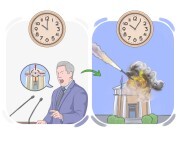
Ex: Engineers upgraded the garrison with modern defenses .
Close
Sign in
to blitz
to blitz
[Verb]

to carry out a sudden and intense military attack

Ex: The air force executed a strategic plan to blitz key enemy installations, disrupting their command and control.
Close
Sign in
to pillage

to plunder, typically during times of war or civil unrest

Ex: The invading forces systematically pillaged strategic locations , disrupting the local economy .
Close
Sign in
to lance
to lance
[Verb]

to thrust or strike with a long-pointed weapon
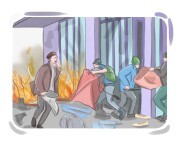
Ex: In historical accounts , cavalry units were known for their ability to lance adversaries effectively in swift , coordinated attacks .
Close
Sign in
to plunder

to steal goods from a place or person, especially during times of war, chaos, or civil disorder

Ex: Last year , pirates unexpectedly plundered a fleet of merchant ships in the region .
Close
Sign in
to strafe
to strafe
[Verb]

to attack ground targets, such as enemy troops or installations, with gunfire from low-flying aircraft

Ex: The pilot skillfully strafed the enemy convoy , creating chaos and preventing it from reaching its destination .
Close
Sign in
to outflank

to maneuver around the side of an enemy force, position, or defensive line in order to gain a tactical advantage
Ex: The nimble cavalry units were deployed to outflank the slower-moving armored divisions and strike at vulnerable points .
Close
Sign in
to vanquish

to defeat someone completely and decisively

Ex: The knights set out on a noble quest to vanquish the dragon that terrorized the nearby villages .
Close
Sign in
siege
siege
[noun]

the act of surrounding the enemy, a town, etc. and cutting off their supplies so that they would surrender

Ex: Historically , sieges have been a common tactic in warfare , used to conquer fortified positions or cities .
Close
Sign in
to retaliate

to make a counterattack or respond in a similar manner

Ex: The organization decided to retaliate hacking attempts by counterattacking the source .
Close
Sign in
LanGeek
Download LanGeek app
