
Listahan ng mga Salita sa Antas C2 - Astronomiya
Dito matututunan mo ang lahat ng mahahalagang salita para sa pagsasalita tungkol sa Astronomy, na tinipon partikular para sa mga mag-aaral ng antas C2.
Repasuhin
Flashcards
Pagbaybay
Pagsusulit


a region beyond Neptune in the solar system containing icy objects like dwarf planets, asteroids, and comets

Kuiper belt, singsing ng Kuiper
Ang Pluto ay minsang itinuturing na ikasiyam na planeta bago ito muling ikategorya bilang isang dwarf planet sa loob ng Kuiper Belt.
a highly energetic celestial object emitting powerful radiation from the center of a galaxy, often associated with a supermassive black hole
quasar, bagay na parang bituin
Naobserbahan ng mga astronomo ang isang malayong quasar, na nagbibigay ng mga pananaw sa sinaunang uniberso.
a distant, hypothetical region surrounding the solar system, thought to harbor icy bodies and comets
ulap ng Oort, ang ulap ng Oort
Ang Oort Cloud ay isang teoretikal na imbakan ng mga kometa at mga yelong katawan na umaabot nang malayo sa solar system.
the outer layer of the Sun's atmosphere, observable as a plasma halo during a solar eclipse
korona, panlabas na atmospera ng Araw
Sa panahon ng isang total solar eclipse, ang corona ng Araw ay nagiging visible bilang isang maliwanag na halo sa palibot ng buwan.
the apparent path that the Sun traces in the sky over the course of a year, which is also the plane of the Earth's orbit around the Sun
ekliptika
Ang ecliptic ay ang landas kung saan tila gumagalaw ang Araw sa kalangitan sa loob ng isang taon.
the apparent displacement or difference in the apparent position of an object when viewed along two different lines of sight, often used in astronomy to measure the distance of nearby stars
paralaks, maliit na paglipat
Ginagamit ng mga astronomo ang stellar parallax para sukatin ang mga distansya sa malalapit na bituin sa pamamagitan ng pagmamasid sa kanilang maliwanag na paglipat laban sa mas malalayong background na mga bituin.
a highly magnetized, rotating neutron star that emits beams of electromagnetic radiation from its magnetic poles
pulsar, neutron star na umiikot
Ang mga pulsar ay unang natuklasan noong 1967 ng mga astronomo na sina Jocelyn Bell Burnell at Antony Hewish.
a unit of measurement equal to the average distance between the Earth and the Sun, approximately 149.6 million kilometers
astronomical unit, AU
Ang astronomical unit ay sumusukat ng mga distansya sa loob ng ating solar system.
a unit of astronomical distance equivalent to about 3.26 light-years
parsec, yunit ng astronomikong distansya na katumbas ng mga 3.26 light-year
Ginagamit ng mga astronomo ang parsec para sukatin ang distansya sa mga bituin at kalawakan.
a high-energy particle, mainly originating from outside the Solar System, that travels through space at nearly the speed of light
sinag kosmiko, partikula kosmiko
Ang cosmic rays ay may papel sa paghubog ng atmospera at klima ng Earth.
(cosmology) the faint glow of radiation spreading through the universe, believed to be residual radiation from the Big Bang
kosmikong microwave background, nalalabing radyasyon mula sa Malaking Pagsabog
Ang cosmic microwave background ay kapansin-pansing pare-pareho sa buong kalangitan.
(cosmology) a theory proposing that the solar system formed from a rotating nebula of gas and dust about 4.6 billion years ago
nebular hypothesis, nebular theory
Ang nebular hypothesis ay nagmumungkahi kung paano nabuo ang ating solar system.
(cosmology) a measure of the rate at which the universe is expanding, determined from the observation of distant galaxies' recession velocities
konstanteng Hubble, parameter ng Hubble
Ang Hubble constant ay nagsasabi sa atin kung gaano kabilis lumalawak ang uniberso.
the matter and radiation that exists in the space between stars within a galaxy
interstellar medium, materyang interstellar
Ang interstellar medium ay binubuo ng gas, alikabok, at cosmic rays.
the space surrounding the Sun dominated by solar wind
heliospera, espasyo na pinangingibabawan ng solar wind
Ang mga particle ng solar wind ay lumilikha ng hangganan ng heliosphere.
very small particles originally derived from stars, serving as raw material for forming planets, and existing between galaxies, stars, and other celestial bodies
alikabok ng kosmos, alikabok ng bituin
Ang cosmic dust ay binubuo ng maliliit na particle ng matter na lumulutang sa kalawakan, pangunahing binubuo ng mga elemento tulad ng carbon, silicon, at iron.
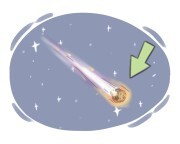
a small celestial body that becomes visible as a meteor upon entrance into the atmosphere of the earth
meteoroid, maliit na katawan sa kalawakan
Ang isang meteoroid ay isang maliit na batong o metalikong bagay sa kalawakan na mas maliit kaysa sa isang asteroid at mas malaki kaysa sa isang micrometeoroid.
(cosmology) the rapid expansion of the universe following the Big Bang
implasyon, mabilis na paglawak
a disruption in earth's magnetic field caused by solar activity, resulting in variations that can impact electronic systems and communications on earth
bagyong magnetico, unos na magnetico
Ang isang magnetic storm, na kilala rin bilang geomagnetic storm, ay isang pagkagambala sa magnetosphere ng Earth na dulot ng mga interaksyon sa solar wind.
the colored lights, mainly green and red, in the sky seen primarily near the southern magnetic pole
aurora australis, mga ilaw ng timog
Ang aurora australis, na kilala rin bilang Southern Lights, ay isang natural na pagpapakita ng liwanag na nagaganap sa mga rehiyon na may mataas na latitud sa Southern Hemisphere.

the colored lights, mainly green and red, in the sky seen primarily near the northern magnetic pole
aurora borealis, mga ilaw sa hilaga
Ang aurora borealis, na kilala rin bilang Northern Lights, ay isang natural na pagpapakita ng liwanag na nangyayari sa mga rehiyon ng mataas na latitud sa Northern Hemisphere.
associated with the phenomena, processes, or theories related to the origin and formation of the universe or celestial bodies
kosmogoniko, may kaugnayan sa pinagmulan at pagbuo ng sansinukob o mga celestial na katawan
Ang mga teoryang cosmogonic ay nag-explore kung paano nagsimula at umunlad ang sansinukob.
study of celestial objects outside the Milky Way galaxy
extragalactic astronomy, pag-aaral ng mga celestial na bagay sa labas ng Milky Way galaxy
Ang extragalactic astronomy ay nag-explore ng mga bagay na lampas sa ating Milky Way.
relating to or resembling a nebula, which is a cloud of gas and dust in outer space
ulap, may kaugnayan sa ulap
Ang teoryang nebular ay nagpapalagay na ang mga bituin at sistemang planetaryo ay nabubuo mula sa gravitational collapse ng mga nebulae.
relating to the stars or constellations, especially in terms of their positions relative to Earth
pang-alaala, may kaugnayan sa mga bituin
Ang sidereal na oras ay batay sa pag-ikot ng Earth kaugnay ng malalayong bituin kaysa sa araw.
| Listahan ng mga Salita sa Antas C2 | |||
|---|---|---|---|
| Sikolohiya | Biyolohiya | Kemistri | Pisika |
| Astronomiya | Matematika | Heolohiya | Inhinyeriya |
| Pagsukat | |||
