

书籍 Headway - 高级 - 最后一句话(单元2)

在这里,您将找到Headway Advanced课本中The Last Word单元2的词汇,如"contraction"、"apostrophe"、"proofread"等。

review-disable

审查

flashcard-disable

闪卡

spelling-disable

拼写

quiz-disable

测验

开始学习
书籍 Headway - 高级
preposition [名词]
اجرا کردن

介词

Ex: She struggled with prepositions in English because they often do n’t translate directly from her native language .

她在英语介词上很吃力,因为它们通常不能直接从她的母语翻译过来。

اجرا کردن

分裂不定式

Ex: The sentence " She promised to always love him " contains a split infinitive , with " always " interrupting " to love . "

句子“她承诺永远爱他”包含了一个分裂不定式,其中“永远”打断了“爱”。

contraction [名词]
اجرا کردن

缩略

Ex: When writing informally , contractions make the language feel more relaxed .

非正式写作时,缩略词让语言感觉更轻松。

conjunction [名词]
اجرا کردن

连词

Ex:

语法测验测试了学生识别和正确使用从属连词的能力。

اجرا کردن

被动语态

Ex: When you use passive voice , the object of the action becomes the subject of the sentence .

当你使用被动语态时,动作的对象成为句子的主语。

اجرا کردن

反问

Ex: The speaker posed a rhetorical question to engage the audience more effectively .

演讲者提出了一个反问句,以更有效地吸引观众。

apostrophe [名词]
اجرا کردن

撇号

Ex: Use an apostrophe to show possession , as in " Jessica 's book . "

使用撇号来表示所有,如"杰西卡的书"。

اجرا کردن

校对

Ex: The newspaper editor always proofreads articles before they are published to maintain the publication 's high standards of accuracy .

报纸编辑总是在文章发表前校对,以保持出版物的高准确性标准。

اجرا کردن

主语代词

Ex: " You " is a subject pronoun used when referring to the person or people being spoken to .

“You”是一个主格代词,用于指代被交谈的人或人们。

to agree [动词]
اجرا کردن

一致

Ex:

代词“她”在性别和数量上与它的先行词“爱丽丝”一致

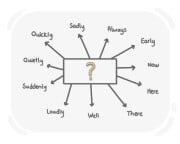
adverb [名词]
اجرا کردن

副词

Ex:

在英语中,副词经常修饰动词,为我们提供更多关于动作的信息。

اجرا کردن

助动词

Ex: Auxiliary verbs are essential in forming perfect tenses , as in ' They have finished their homework .

助动词在形成完成时态中是必不可少的,如'他们已经完成了作业'。

idiom [名词]
اجرا کردن

习语

Ex: When someone says ' it 's raining cats and dogs , ' they 're using an idiom to describe very heavy rain , not an actual downpour of animals .

当有人说'下倾盆大雨'时,他们是在用习语来描述非常大的雨,而不是真正的动物雨。

اجرا کردن

双重否定

Ex: The phrase " I do n't know nothing about it " uses a double negative , which actually means " I know something about it . "

“我对此一无所知”这句话使用了双重否定,实际上意思是“我对此有所了解”。