
Vocabulaire Essentiel pour le GRE - La Science
Ici, vous apprendrez quelques mots anglais sur la science, tels que "antigène", "clone", "lymphe", etc., qui sont nécessaires pour l'examen GRE.
Réviser
Flashcards
Orthographe
Quiz

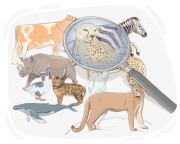
a branch of science that deals with animals

zoologie
Le département de zoologie de l'université mène des recherches sur un large éventail d'espèces animales.

the scientific study of plants, their structure, genetics, classification, etc.
botanique
Ses recherches en botanique se sont concentrées sur l'adaptation des plantes au changement climatique.

the production of a substance through chemical or biological reactions
synthèse
any foreign substance in the body that can trigger a response from the immune system
antigène
Le test sanguin détecte la présence d'un antigène pour diagnostiquer les infections.
a steroid hormone that the body produces and is used in medicine to help cure skin diseases
cortisol
Les médecins prescrivent parfois du cortisol pour traiter les affections cutanées graves.
a cell or a group of cells created through a natural or artificial process from a source that they are genetically identical to
clone
Chaque clone des cellules végétales a été soigneusement surveillé pour s'assurer qu'il se développe en spécimens sains et identiques.
(of genes) causing a person to inherit a particular physical feature, even if it is only present in one parent's genome
dominant
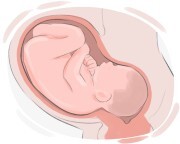
an offspring of a human or animal that is not born yet, particularly a human aged more than eight weeks after conception
fœtus
À douze semaines, le battement de cœur du fœtus pouvait être détecté.
all of the genes that are available within breeding populations of a particular species of animal or plant
pool génétique, réserve génétique
Les efforts de conservation visent à protéger le pool génétique des plantes rares.
the complete set of genetic material of any living thing
génome
Le séquençage du génome de différents organismes aide les scientifiques à comprendre leurs relations évolutives et leur diversité génétique.
the controlled maintenance of a specific temperature; fostering optimal conditions for the development of organisms, processes, or materials
incubation
Une incubation appropriée est cruciale pour la réussite de l'éclosion des œufs.
a colorless liquid consisting of white blood cells that helps to prevent infections from spreading
lymphe
La lymphe circule à travers le système lymphatique pour combattre les infections.
a thin layer of living tissue that covers, lines, connects, or separates parts of an organism
membrane
to experience genetic changes
subir une mutation
En réponse aux facteurs environnementaux, les organismes vivant dans un habitat particulier peuvent naturellement muter.
a chemical substance that transmits messages from a neuron to another one or to a muscle
neurotransmetteur
Les problèmes avec les niveaux de neurotransmetteur peuvent conduire à des troubles neurologiques.
a close and often long-term interaction between two different species living in close physical association, typically to the advantage of both
symbiose
Les acacias et les fourmis illustrent une symbiose mutualiste, où les arbres fournissent un abri et de la nourriture sous forme de nectar tandis que les fourmis défendent les arbres contre les herbivores et autres menaces.
an individual example or sample of something, especially one examined or studied as representative of its type
spécimen, exemplaire, échantillon
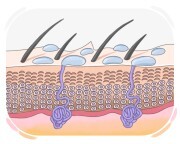
(of a cell, gland, or organ) to produce and release a liquid substance in the body
sécréter
Le pancréas sécrète l'insuline, régulant ainsi les niveaux de sucre dans le sang dans le corps.
the process of natural multiplication; representing the expansion of a population over time
propagation, multiplication
La propagation de l'espèce végétale s'est produite rapidement dans le nouvel environnement.
the natural coloring of tissues, surfaces, or structures; contributing to the characteristic hues or tones observed in animals, plants, or human beings
pigmentation, coloration
La pigmentation de la peau humaine est influencée par la génétique et l'environnement.

the field of science that studies the function or interactions among organisms
physiologie
La physiologie est essentielle pour comprendre comment l'exercice affecte le corps.
(of a female animal or human) to produce an ovum from the ovary
ovuler
Certains médicaments peuvent affecter la fréquence à laquelle vous ovulez.
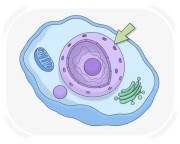
(biology) the part of a cell that contains most of the genetic information
noyau

the chemical processes through which food is changed into energy for the body to use
métabolisme
a method used for measuring how old an organic material is by calculating the amount of carbon they contain
datation au carbone 14
Les scientifiques ont utilisé la datation au carbone pour déterminer l'âge des restes fossilisés.
the study of how communication and control work in living organisms and machines, focusing on information flow, feedback, and system regulation
la cybernétique, l'étude des systèmes de contrôle et de communication
Les véhicules autonomes utilisent des principes de la cybernétique pour naviguer et effectuer des ajustements en temps réel basés sur les retours des capteurs.
a branch of medical science primarily focusing on the study of the causes and effects of disease or injury
pathologie
L'étude de la pathologie implique l'investigation des changements cellulaires et moléculaires associés aux processus pathologiques.
the scientific and experimental operations performed on live animals
vivisection
Le scientifique a expliqué que la vivisection est essentielle pour certaines recherches médicales.
the study of the behavior of air as it interacts with solid objects, particularly the flow of air around and through objects, and the effects of this interaction on the objects
aérodynamique, étude de l'aérodynamique
L'étude de l'aérodynamique joue un rôle crucial dans le développement des trains à grande vitesse, en réduisant la résistance de l'air pour améliorer l'efficacité.
having a tendency to change rapidly and unpredictably, often characterized by fluctuations or instability
volatile, instable
Le composé chimique est volatile et doit être manipulé avec précaution.
a space that is utterly empty of all matter
vide
Le concept d'un vide parfait, où aucune particule ou énergie n'existe, est théorique et est utilisé dans les expériences de pensée et la physique théorique.
(physics) relating to or produced by heat
thermique
the bending of the wave's path as it passes from one medium to another; caused by a change in its speed or direction
réfraction, déviation des ondes
La réfraction fait paraître les objets sous l'eau plus proches qu'ils ne le sont réellement.
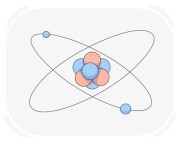
an extremely small unit of matter or radiation treated as a discrete entity in physics
particule

to move back and forth repeatedly between two points or positions
osciller
Le métronome sur le piano oscillait, fournissant un rythme régulier que le musicien pouvait suivre.
the process or action of splitting a nucleus into two or more parts resulting in the release of a significant amount of energy
fission nucléaire
La découverte de la fission nucléaire dans les années 1930 a ouvert la voie au développement des armes nucléaires et des réacteurs nucléaires.
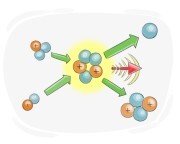
(physics) the reaction in which two nuclei join together and produce energy
fusion nucléaire
L'énergie du soleil est générée par des réactions de fusion nucléaire dans son noyau, impliquant principalement la fusion de noyaux d'hydrogène en noyaux d'hélium.
the strength of a moving object determined by multiplying how heavy it is by how fast it is going
élan
Lorsque le train prend de la vitesse, son élan augmente considérablement.
each of two or more forms of the same element that contain equal numbers of protons but different numbers of neutrons in their nuclei, leading to variation in atomic mass
isotope, forme isotopique
Le deutérium et le tritium sont des isotopes de l'hydrogène, distingués par leurs nombres différents de neutrons.
relating to the energy associated with motion or movement, emphasizing the dynamic state of objects in action
cinétique
L'art cinétique intègre le mouvement ou des motifs changeants pour créer des expériences visuelles dynamiques.
