pattern

Matematică și Logică SAT - Aritmetică și Statistică

Aici vei învăța câteva cuvinte în engleză legate de aritmetică și statistică, cum ar fi "divizibil", "interval", "mediană", etc., de care vei avea nevoie pentru a trece de SAT-urile tale.

Revizuire

Fișe de studiu

Ortografie

Chestionar
Începe să înveți
SAT Vocabulary for Math and Logic
mixed number
mixed number
[substantiv]

a combination of a whole number and a proper fraction

număr mixt, fracție mixtă

număr mixt, fracție mixtă

Ex: When working with measurements, such as lengths or amounts, we often encounter mixed numbers instead of whole numbers. 

Când lucrăm cu măsurători, cum ar fi lungimi sau cantități, întâlnim adesea numere mixte în loc de numere întregi.

Închide
Conectare
prime number
prime number
[substantiv]

a number greater than 1 with only two devisors which can be itself or 1

număr prim

număr prim

Ex: 7 is a prime number because its only divisors are 1 and 7. 

7 este un număr prim pentru că singurii săi divizori sunt 1 și 7.

Închide
Conectare
rational number
rational number
[substantiv]

a number that can be written as a fraction, where both the top and bottom are whole numbers, and the bottom is not zero

număr rațional, fracție rațională

număr rațional, fracție rațională

Ex: The decimal 0.5 is a rational number because it can be converted to the fraction 1/2, with 1 and 2 being integers. 

Decimalul 0,5 este un număr rațional deoarece poate fi convertit în fracția 1/2, cu 1 și 2 fiind numere întregi.

Închide
Conectare
irrational number
irrational number
[substantiv]

a number incapable of being expressed as a ratio of two integers

număr irațional, număr incomensurabil

număr irațional, număr incomensurabil

Ex: The decimal form of an irrational number goes on forever without repeating. 

Forma zecimală a unui număr irațional continuă la nesfârșit fără a se repeta.

Închide
Conectare
complex number
complex number
[substantiv]

a number that has both a real part and a part involving a unit that, when squared, gives a negative result

număr complex, complex

număr complex, complex

Ex: Operations with complex numbers follow specific rules different from those of real numbers. 

Operațiile cu numere complexe urmează reguli specifice diferite de cele ale numerelor reale.

Închide
Conectare
real number
real number
[substantiv]

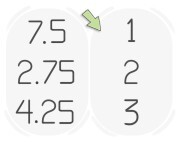
any number that can be found on the number line, including both positive and negative numbers, zero, and fractions

număr real, real

număr real, real

Ex: The number 5 is a real number because it can be located on the number line. 

Numărul 5 este un număr real deoarece poate fi localizat pe linia numerică.
Închide
Conectare
whole number
whole number
[substantiv]

any positive number without fractions or decimals, including zero

număr întreg, număr natural

număr întreg, număr natural

Ex: Unlike fractions and decimals, whole numbers represent complete units. 

Spre deosebire de fracții și zecimale, numerele întregi reprezintă unități complete.

Închide
Conectare
integer
integer
[substantiv]

any number without fractions or decimals, including positive numbers, negative numbers, and zero

număr întreg

număr întreg

Ex: The numbers -3, 0, and 7 are all integers. 

Numerele -3, 0 și 7 sunt toate numere întregi.
Închide
Conectare
fraction
fraction
[substantiv]

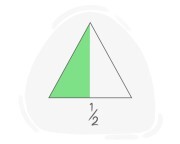
a number obtained by dividing one integer or rational number by another, typically written in the form a/b

fracție, fracție ordinară

fracție, fracție ordinară

Ex: One-half (1/2) is a simple fraction. 

O jumătate (1/2) este o simplă fracție.

Închide
Conectare
decimal
decimal
[substantiv]

(mathematics) a number less than one, called a fraction, that is represented as a period followed by the number of tenths, hundredths, etc.

zecimal, număr zecimal

zecimal, număr zecimal

Ex: In mathematics, decimals are a way to represent fractions or portions of a whole using a decimal point. 

În matematică, zecimalele sunt o modalitate de a reprezenta fracții sau părți ale unui întreg folosind un punct zecimal.

Închide
Conectare
improper fraction
improper fraction
[substantiv]

a fraction where the the top number is greater than or equal to the equal to the bottom number

fracție improprie

fracție improprie

Ex: The teacher explained how to simplify an improper fraction to a whole number if the division is exact. 

Profesorul a explicat cum să simplifici o fracție improprie la un număr întreg dacă împărțirea este exactă.
Închide
Conectare
mean
mean
[substantiv]

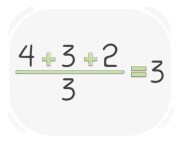
(mathematics) the average value of a set of quantities calculated by adding them, and dividing them by the total number of the quantities

medie, medie aritmetică

medie, medie aritmetică

Ex: To find the mean of 4, 6, and 8, add them together and divide by 3. 

Pentru a găsi media lui 4, 6 și 8, adunați-le și împărțiți la 3.

Închide
Conectare
divisible
divisible
[adjectiv]

having the quality of being divided, especially by a number

divizibil

divizibil

Închide
Conectare
root
root
[substantiv]

a value that, when multiplied by itself a specified number of times, results in the given number

rădăcină, radical

rădăcină, radical

Ex: The square root of 16 is 4. 

Rădăcina pătrată a lui 16 este 4.

Închide
Conectare
range
range
[substantiv]

the difference between the highest and lowest values in a set of numbers

interval, amplitudine

interval, amplitudine

Ex: The range of exam scores in the class was 40 points, from a low of 55 to a high of 95. 

Intervalul notelor la examen în clasă a fost de 40 de puncte, de la un minim de 55 la un maxim de 95.

Închide
Conectare
square
square
[substantiv]

the second exponent of any given number produced when multiplied by itself

pătrat, puterea a doua

pătrat, puterea a doua

Închide
Conectare
average
average
[adjectiv]

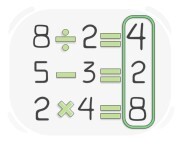
calculated by adding a set of numbers together and dividing this amount by the total number of amounts in that set

mediu
mediu

Ex: The average height of the students in the class is 5 feet 6 inches. 

Media înălțimii elevilor din clasă este de 5 picioare și 6 țoli.

Închide
Conectare
solution
solution
[substantiv]

a correct answer to a problem in mathematics or a puzzle

soluție, răspuns

soluție, răspuns

Ex: After careful analysis, she found the solution to the complex algebraic equation. 

După o analiză atentă, ea a găsit soluția ecuației algebrice complexe.

Închide
Conectare
product
product
[substantiv]

the result of multiplying two or more numbers or quantities together

produs, rezultatul înmulțirii

produs, rezultatul înmulțirii

Ex: When you multiply 7 by 5, the product is 35. 

Când înmulți 7 cu 5, produsul este 35.

Închide
Conectare
quotient
quotient
[substantiv]

the result obtained by dividing one quantity or number by another, expressed as the outcome of a division operation

cât

cât

Ex: In the division problem 12 ÷ 4, the quotient is 3. 

În problema de împărțire 12 ÷ 4, câtul este 3.

Închide
Conectare
factor
factor
[substantiv]

(mathematics) one of the numbers that another number can be divided by

factor

factor

Ex: A factor of a number divides it evenly without leaving a remainder. 

Un factor al unui număr îl împarte uniform fără a lăsa rest.

Închide
Conectare
value
value
[substantiv]

(mathematics) an amount that is shown by a sign or letter

valoare, cantitate

valoare, cantitate

Ex: In algebra, variables represent unknown values that can be determined through equations. 

În algebră, variabilele reprezintă valori necunoscute care pot fi determinate prin ecuații.

Închide
Conectare
inequality
inequality
[substantiv]

a statement that compares two quantities, expressions, or values and indicates their relative sizes

inegalitate

inegalitate

Ex: The inequality x>5 represents all real numbers greater than 5. 

Inegalitatea x>5 reprezintă toate numerele reale mai mari decât 5.

Închide
Conectare
equation
equation
[substantiv]

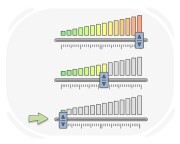
(mathematics) a statement indicating the equality between two values

ecuație
ecuație

Ex: In algebra, solving equations involves finding the values of variables that satisfy the equality stated. 

În algebră, rezolvarea ecuațiilor implică găsirea valorilor variabilelor care satisfac egalitatea enunțată.

Închide
Conectare
minimum
minimum
[substantiv]

the lowest amount, degree, or extent there is or is possible, allowed or required

minimum, cel mai mic

minimum, cel mai mic

Ex: The job requires a minimum of five years of experience in the industry. 

Locul de muncă necesită un minimum de cinci ani de experiență în industrie.

Închide
Conectare
exponential
exponential
[substantiv]

a mathematical expression where a number is multiplied by itself a certain number of times determined by a variable

exponențială, funcție exponențială

exponențială, funcție exponențială

Ex: In population studies, the growth can often be modeled by an exponential. 

În studiile de populație, creșterea poate fi adesea modelată printr-o exponențială.

Închide
Conectare
linear
linear
[adjectiv]

related to equations that create straight lines when graphed, indicating a constant rate of change

liniar

liniar

Ex: In this math problem, we need to solve a set of linear equations to find the values of x and y. 

În această problemă de matematică, trebuie să rezolvăm un set de ecuații liniare pentru a găsi valorile lui x și y.

Închide
Conectare
common ratio
common ratio
[substantiv]

the constant ratio between consecutive terms

rație comună, raport constant

rație comună, raport constant

Ex: In the geometric sequence 2, 6, 18, 54, ..., the common ratio between consecutive terms is r=3. 

În secvența geometrică 2, 6, 18, 54, ..., raportul comun între termenii consecutivi este r=3.

Închide
Conectare
common multiple
common multiple
[substantiv]

a number that is a multiple of two or more given numbers

multiplu comun, comun multiplu

multiplu comun, comun multiplu

Ex: The smallest common multiple of 4 and 5 is 20. 

Cel mai mic multiplu comun al numerelor 4 și 5 este 20.

Închide
Conectare
common factor
common factor
[substantiv]

a number that divides exactly into two or more given numbers without leaving a remainder

factor comun, divizor comun

factor comun, divizor comun

Ex: The common factors of 12 and 18 include 1, 2, 3, and 6. 

Factorii comuni ai numerelor 12 și 18 includ 1, 2, 3 și 6.

Închide
Conectare
common denominator
common denominator
[substantiv]

(mathematics) a number divisible by all the numbers that are below the line in a set of fractions

numitor comun, comun numitor

numitor comun, comun numitor

Ex: To add 1/2 and 1/3, find a common denominator like 6. 
Închide
Conectare
least common denominator

the smallest positive integer that is a common multiple of the denominators of two or more fractions

cel mai mic numitor comun, numitorul comun cel mai mic

cel mai mic numitor comun, numitorul comun cel mai mic

Ex: The teacher explained that the least common denominator helps simplify the process of adding fractions with different denominators. 

Profesorul a explicat că cel mai mic numitor comun ajută la simplificarea procesului de adunare a fracțiilor cu numitori diferiți.

Închide
Conectare
probability
probability
[substantiv]

(mathematics) a number representing the chances of something specific happening

probabilitate

probabilitate

Ex: The probability of it raining tomorrow is 70 percent. 
Închide
Conectare
to estimate

to guess the value, number, quantity, size, etc. of something without exact calculation

estima, evalua

estima, evalua

Ex: I estimate that there are about 100 people at the party. 

Estimez că sunt aproximativ 100 de persoane la petrecere.

Închide
Conectare
arithmetic sequence

a sequence of numbers in which the difference between any two consecutive terms is constant

secvență aritmetică, progresie aritmetică

secvență aritmetică, progresie aritmetică

Ex: In the arithmetic sequence 2, 5, 8, 11, 14, ..., each term increases by 3, which is the common difference. 

În șirul aritmetic 2, 5, 8, 11, 14, ..., fiecare termen crește cu 3, care este diferența comună.

Închide
Conectare
frequency
frequency
[substantiv]

the number of times a particular event occurs within a specific period or among a set of observations

frecvență

frecvență

Ex: The frequency of heads in 100 coin flips was 52. 

Frecvența capetelor în 100 de aruncări de monedă a fost de 52.

Închide
Conectare
distribution
distribution
[substantiv]

(statistics) an arrangement of values of a variable showing how often each occurs, either observed or theoretical

distribuție, repartizare

distribuție, repartizare

Ex: The histogram shows the distribution of exam scores. 

Histograma arată distribuția scorurilor de la examene.

Închide
Conectare
median
median
[substantiv]

a statistical measure that represents the middle value of a data set when the values are arranged in ascending or descending order

mediană, valoare mediană

mediană, valoare mediană

Ex: In the set {2, 5, 8, 10, 12}, the median is 8, as it is the middle value when arranged in ascending order. 

În setul {2, 5, 8, 10, 12}, mediana este 8, deoarece este valoarea din mijloc atunci când este aranjată în ordine crescătoare.

Închide
Conectare
mode
mode
[substantiv]

the value that appears most frequently in a data set

mod, valoare modală

mod, valoare modală

Închide
Conectare
bimodal
bimodal
[adjectiv]

having or involving two distinct modes, peaks, or most frequent values

bimodal, cu două moduri

bimodal, cu două moduri

Ex: The bimodal distribution of exam scores indicated two groups of students with different performance levels. 

Distribuția bimodală a scorurilor la examen a indicat două grupuri de studenți cu niveluri diferite de performanță.

Închide
Conectare
standard deviation
standard deviation
[substantiv]

a measure of how much the values in a set typically differ from the average

deviație standard, abatere standard

deviație standard, abatere standard

Ex: A low standard deviation indicates that the data points are close to the mean. 

O deviație standard scăzută indică faptul că punctele de date sunt apropiate de medie.

Închide
Conectare
margin of error
margin of error
[substantiv]

the range within which the true value is expected to fall, accounting for potential inaccuracies in measurement or sampling

marja de eroare, interval de eroare

marja de eroare, interval de eroare

Ex: The poll results have a margin of error of ±3%, indicating the possible range of true public opinion. 

Rezultatele sondajului au o marjă de eroare de ±3%, indicând intervalul posibil al opiniei publice reale.

Închide
Conectare
random
random
[adjectiv]

occurring in such a way that each possible outcome has a certain probability of occurring, but the specific outcome cannot be predicted with certainty

aleatoriu, întâmplător

aleatoriu, întâmplător

Ex: A random sample is selected from the population in such a way that each member has an equal chance of being chosen. 

Un eșantion aleatoriu este selectat din populație în așa fel încât fiecare membru are o șansă egală de a fi ales.

Închide
Conectare
trend line
trend line
[substantiv]

a straight line drawn through a set of data points on a graph to represent the general direction or pattern of the data

linie de trend, linie de tendință

linie de trend, linie de tendință

Ex: The trend line on the stock chart indicates a steady increase in prices over the past year. 

Linia de trend pe graficul bursier indică o creștere constantă a prețurilor în ultimul an.

Închide
Conectare
dot plot
dot plot
[substantiv]

a type of statistical chart consisting of dots that represent individual data points

diagramă cu puncte, grafic cu puncte

diagramă cu puncte, grafic cu puncte

Ex: The teacher used a dot plot to show the distribution of test scores in the class. 

Profesorul a folosit o diagramă cu puncte pentru a arăta distribuția scorurilor la test în clasă.

Închide
Conectare
linear model
linear model
[substantiv]

a mathematical representation that describes the relationship between two or more variables using a linear equation

model liniar, model de regresie liniară

model liniar, model de regresie liniară

Ex: The linear model y=2x+3 suggests that for every unit increase in x, y increases by 2. 

Modelul liniar y=2x+3 sugerează că pentru fiecare creștere a x cu o unitate, y crește cu 2.

Închide
Conectare
LanGeek
Descarcă aplicația LanGeek