Solutions - Upper-Intermediate - Unit 3 - 3C

Here you will find the vocabulary from Unit 3 - 3C in the Solutions Upper-Intermediate coursebook, such as "submit", "omit", "anticipate", etc.

review-disable

review

flashcard-disable

flashcard

spelling-disable

spelling

quiz-disable

quiz

start-learning
Solutions - Upper-Intermediate
good [adjective]

having a quality that is satisfying

Ex: The movie was really good ; it made me laugh and cry .

to accept something to be true even without proof
Ex: I find it hard to believe that she won the lottery twice in a row .
to meet [verb]

to come together as previously scheduled for social interaction or a prearranged purpose

Ex: We should meet at the theater before the movie starts .
pleasure [noun]

a feeling of great enjoyment and happiness

Ex: He took great pleasure in cooking for his family .
to allow [verb]

to let someone or something do a particular thing

Ex: The school policy does not allow students to use their phones during class .

to tell someone our name so they can know us, or to tell them someone else's name so they can know each other, normally happening in the first meeting

Ex: I want to introduce my parents .

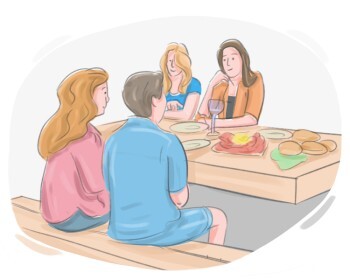
someone with whom one works

Ex: During the annual company retreat , I had the chance to bond with colleagues from different departments , which helped strengthen our professional network .
to fetch [verb]

to go and bring a person or thing, typically at someone's request or for a specific purpose

Ex: I 'll need to fetch some groceries from the store on my way home .
kind [noun]

a group of people or things that have similar characteristics or share particular qualities

Ex: The festival attracts people of different kinds , all celebrating together .
to offer [verb]

to present or propose something to someone

Ex: The teacher offered valuable feedback to help the students improve their work .
formal [adjective]

used to describe a way of speaking or writing that follows traditional rules and is considered appropriate for serious or professional situations
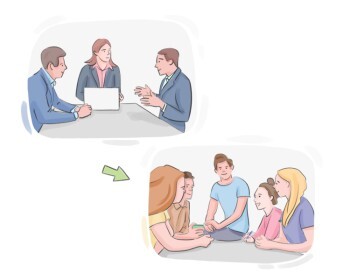
Ex: His formal writing style made the academic paper easy to follow and understand .
informal [adjective]

suitable for friendly, relaxed, casual, or unofficial occasions and situations

Ex: The music festival had an informal atmosphere where everyone could relax .
language [noun]

the system of communication by spoken or written words, that the people of a particular country or region use

Ex: She practices speaking the language with native speakers to improve her fluency .

to move from a person or place

Ex: She told the persistent salesperson to go away because she was n't interested .

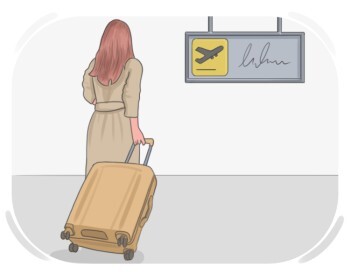
to leave a location, particularly to go on a trip or journey

Ex: Passengers are kindly requested to be at the airport two hours before their flights are set to depart .

to focus one's attention on something or someone in order to observe or examine them

Ex: The detective looked at the crime scene for clues .
to view [verb]

to carefully look at something

Ex: The scientist is viewing the microscopic cells under the microscope .

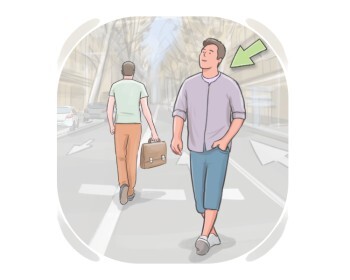
to move toward someone, usually in order to talk to them

Ex:
to arise [verb]

to begin to exist or become noticeable

Ex: Tensions began to arise among team members due to differing opinions on the project 's direction .

to give information about someone or something, especially in an official manner

Ex: The manager informed the team of the changes in the project timeline to keep everyone updated .

to agree or consent to undergo a particular process, approach, or way of handling

Ex: After a long discussion , they agreed to submit to the terms of the contract .

to be an image, sign, symbol, etc. of something
Ex: The statue in the square has long represented freedom .

to expect or predict that something will happen

Ex: The scientist anticipated the discovery of a new species based on research findings .
to omit [verb]

to leave out or exclude something or someone, usually intentionally, from a list, text, or action

Ex: Please do not omit any important information when filling out the form .

to arrange or put off an activity or an event for a later time than its original schedule

Ex: He postponed the project deadline to allow more time for preparation .

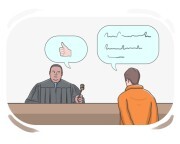
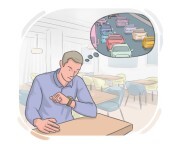
to tell a person that one is sorry for having done something wrong

Ex: In a professional setting , it is common to apologize for any errors and take responsibility .

to give a person information about something

Ex: I let him know about the change in plans .

to cause a person to dislike someone or something

Ex:
sorry [adjective]

feeling ashamed or apologetic about something that one has or has not done

Ex: I 'm really sorry for the mistake I made earlier .