
pattern

Vocabulary for IELTS Academic (Band 6-7) - Maths and Graphs

Here, you will learn some English words related to Maths and Graphs that are necessary for the Academic IELTS exam.

Review

Flashcards

Spelling

Quiz

Start learning
Vocabulary for Academic IELTS (6-7)
logarithm
logarithm
[noun]

a mathematical function that represents the exponent to which a fixed number, called the base, must be raised to produce a given number

Ex: In the logarithm log₂(8) = 3, the base 2 raised to the power of 3 equals 8. 
Close
Sign in
theorem
theorem
[noun]

a statement or proposition that has been proven to be true based on previously established axioms, definitions, and other theorems within a particular mathematical or logical system

Ex: Mathematicians often prove theorems to establish mathematical truths. 
Close
Sign in
vector
vector
[noun]

an ordered set of numbers that describes both magnitude and direction, commonly used to represent quantities like displacement, velocity, or force in physics and engineering

Ex: In physics, force is often represented as a vector, considering both its magnitude and direction. 
Close
Sign in
function
function
[noun]

(mathematics) a quantity whose value changes according to another quantity's varying value

Ex: In calculus, a function represents a relationship between input and output variables, often denoted as f(x). 
Close
Sign in
pi
pi
[noun]

a mathematical constant representing the ratio of a circle's circumference to its diameter, approximately equal to 3.14159

Ex: Trigonometric functions involving angles in radians often yield results containing multiples of pi. 
Close
Sign in
series
series
[noun]

a mathematical representation of the sum of the terms of a sequence, often denoted by the symbol Σ (sigma), where the terms are added together in a specified order
Ex: The arithmetic series 1 + 3 + 5 + 7 + 9 has a common difference of 2 between consecutive terms. 
Close
Sign in
trigonometry

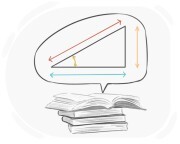
a branch of mathematics that deals with the relationships between the angles and sides of triangles

Ex: In trigonometry, the sine function (sin) relates the ratio of the length of the opposite side to the hypotenuse in a right-angled triangle. 
Close
Sign in
quotient
quotient
[noun]

the result obtained by dividing one quantity or number by another, expressed as the outcome of a division operation

Ex: In the division problem 12 ÷ 4, the quotient is 3. 
Close
Sign in
hypotenuse

the longest side of a right-angled triangle, opposite the right angle, and defined as the side opposite the right angle in a right-angled triangle

Ex: In a right-angled triangle with legs of length 3 and 4 units, the hypotenuse can be calculated using the Pythagorean theorem as √(3² + 4²) = 5. 
Close
Sign in
interval
interval
[noun]

a set of real numbers that includes all the numbers between any two specified numbers within the set

Ex: The interval (a, b), where a and b are real numbers, represents all numbers between a and b but excludes the endpoints. 
Close
Sign in
grid
grid
[noun]

a framework of spaced lines, horizontal and vertical, used as a reference for plotting points

Close
Sign in
median
median
[noun]

a statistical measure that represents the middle value of a data set when the values are arranged in ascending or descending order

Ex: In the set {2, 5, 8, 10, 12}, the median is 8, as it is the middle value when arranged in ascending order. 
Close
Sign in
mode
mode
[noun]

the value that appears most frequently in a data set

Close
Sign in
infographic

a visual representation of information or data, designed to convey complex information quickly and clearly

Close
Sign in
distribution

(statistics) an arrangement of values of a variable showing how often each occurs, either observed or theoretical
Ex: The histogram shows the distribution of exam scores. 
Close
Sign in
mean
mean
[noun]

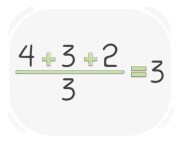
(mathematics) the average value of a set of quantities calculated by adding them, and dividing them by the total number of the quantities

Ex: To find the mean of 4, 6, and 8, add them together and divide by 3. 
Close
Sign in
cluster
cluster
[noun]

a grouping or concentration of data points in a specific region, often used in statistics and data analysis to describe a set of values that are close to each other

Ex: In a scatter plot, a cluster of data points close to each other may indicate a strong correlation between the variables. 
Close
Sign in
histogram
histogram
[noun]

a diagram consisting of bars with different heights that represent the amount of a variable

Close
Sign in
sector
sector
[noun]

a portion of a circle, defined by an arc and the two radii that connect the arc's endpoints to the circle's center

Ex: In a pizza, each slice represents a sector of the circular pizza, defined by the central angle and the radii. 
Close
Sign in
ratio
ratio
[noun]

the result of dividing one number, quantity, or expression by another

Ex: The ratio of 10 to 2 is 5. 
Close
Sign in
LanGeek
Download LanGeek app
