
Matemáticas y Evaluación ACT - Matemáticas
Aprende vocabulario ACT para matemáticas, incluyendo números, operaciones, ecuaciones, variables, fórmulas y otros términos utilizados en la resolución de problemas cuantitativos.
Revisión
Tarjetas de memoria
Ortografía
Cuestionario


(mathematics) a quantity whose value changes according to another quantity's varying value

función
to make a representation of something, especially one based on mathematics
modelar
a quantity or value that remains the same and does not change in a specific mathematical context
constante
a combination of numbers, variables, operations, and grouping symbols that collectively represent a numerical value or relationship
expresión, fórmula
(of mathematical expressions or quantities) having the same value or function, even if they appear in different forms
equivalente
(mathematics) a quantity that is capable of assuming different values in a calculation
variable
a system of numerical values used to quantify and compare levels, degrees, or values
escala, baremo
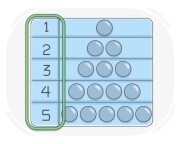
a symbol that represents any number between 0 and 9
cifra
the set of all input values for which a mathematical function is defined
dominio, conjunto de definición
the set of points whose coordinates satisfy a particular equation or mathematical relation
gráfico
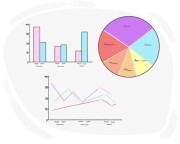
a simplified drawing or plan used to show the parts, structure, operation, or relationships of something
diagrama
a diagram consisting of bars with different heights that represent the amount of a variable
histograma
a type of graph used in statistics and data analysis to display and compare two sets of numerical data
gráfico de dispersión, diagrama de puntos
El gráfico de dispersión indicó un grupo de puntos de datos en la esquina superior derecha, sugiriendo una tendencia.
the point where a line, curve, or surface crosses an axis on a graph
la intersección, el punto de intersección
El profesor explicó cómo calcular los interceptos de una ecuación cuadrática.
a flat, two-dimensional surface that extends infinitely in all directions
plano, superficie plana
any set of numbers that represents an exact position on a map or graph
coordenadas
a straight line drawn through the center of a group of data points on a scatter plot representing the best approximation of the relationship between the variables being studied
línea de mejor ajuste, recta de regresión
El diagrama de dispersión con la línea de mejor ajuste nos ayudó a comprender la relación entre la temperatura y el consumo de energía.
to meet or cross another path, line, etc. at a particular point
cruzarse
Los senderos se cruzan cerca del lago, lo que facilita el cambio de ruta.
a set of real numbers that includes all the numbers between any two specified numbers within the set
intervalo, rango
a mathematical function that creates a straight line when graphed
función lineal, aplicación lineal
El profesor explicó que cualquier ecuación de la forma y=mx+b representa una función lineal.
a function that can be expressed as the ratio of two polynomials, where the denominator is not zero
función racional, fracción racional
Para encontrar las asíntotas verticales de una función racional, iguala el denominador a cero y resuelve para x.
a fixed numerical value that is a whole number, either positive, negative, or zero
constante entera, constante de número entero
Las constantes enteras se utilizan en expresiones matemáticas para representar valores numéricos fijos.
not following a straight or predictable line, sequence, or pattern
no lineal, no rectilíneo
Las ecuaciones no lineales son más complejas y pueden tener múltiples soluciones.
to be directly related to or paired with another value, element, or item
corresponder, equivaler
a single number, variable, or the product of numbers and variables in an expression or equation, separated by addition or subtraction operators
término, elemento
a reference line used in coordinate systems to provide a framework for locating points
eje, línea de referencia
Para trazar los datos con precisión, alinee los puntos con las coordenadas apropiadas en el eje x y el eje y.
a mathematical function that can be expressed as a sum of terms, where each term is a constant multiplied by a variable raised to a non-negative integer power
función polinómica, función polinomial
Las funciones polinómicas se utilizan para modelar fenómenos como el crecimiento de la población, las tendencias económicas y el movimiento de los proyectiles.
to fulfill the conditions of a mathematical equation, inequality, or other statement
satisfacer, cumplir
a numerical or constant factor that multiplies a variable in an algebraic term
coeficiente, factor multiplicativo
En el sistema de ecuaciones, los coeficientes de las variables deben estar alineados para utilizar métodos matriciales.
an equation where the highest power of the variable is squared
cuadrática
Un cuadrático puede tener cero, una o dos soluciones reales dependiendo del discriminante.
a statistical method used to model and analyze the relationship between a dependent variable and one or more independent variables
regresión
La regresión múltiple permite el análisis del efecto de varias variables independientes sobre una variable dependiente.
having equal distances from two or more points
equidistante, a igual distancia
El nuevo parque está equidistante de todas las principales áreas residenciales de la ciudad.
having points that lie on the same straight line
colineal, alineado
En geometría, demostrar que los puntos son colineales puede simplificar muchos problemas.
a statement or proposition that has been proven to be true based on previously established axioms, definitions, and other theorems within a particular mathematical or logical system
teorema
El teorema de Pitágoras es un principio bien conocido en geometría.
a recurring interval or length associated with a mathematical function or pattern
período, intervalo
to determine the numerical value of a mathematical expression, function, or quantity
evaluar, calcular
a way of representing numbers as the sum of each digit multiplied by its place value
notación expandida, descomposición numérica
Al escribir números en notación expandida, cada dígito se representa según su valor posicional.
a method of writing numbers as the product of a coefficient and a power of 10
notación científica, escritura científica
Los científicos utilizan la notación científica para expresar los tamaños extremadamente pequeños de las partículas subatómicas, como los quarks y los neutrinos.
a rectangular arrangement of numbers, symbols, or expressions in rows and columns
matriz
a single number calculated from the elements of a square matrix that indicates important properties, like whether the matrix can be inverted
determinante
Comprender los determinantes es esencial para estudios avanzados en valores propios y vectores propios.
the product of all positive whole numbers from 1 to a given number
factorial, factórico
Para resolver el problema, necesitas encontrar el factorial de 7.
an ordered set of numbers that describes both magnitude and direction, commonly used to represent quantities like displacement, velocity, or force in physics and engineering
vector, vector
La aceleración, un vector en cinemática, representa la tasa de cambio de la velocidad con el tiempo.
a two-dimensional system used to represent points in space
plano de coordenadas estándar, plano cartesiano estándar
Los estudiantes aprenden a identificar los cuadrantes en el plano de coordenadas estándar y a ubicar puntos usando pares ordenados (x, y).
a mathematical function that relates the angles of a triangle to the lengths of its sides, commonly including sine, cosine, and tangent
función trigonométrica
Las gráficas de las funciones trigonométricas, como el seno y el coseno, exhiben un comportamiento periódico.
a way of representing a system of linear equations in matrix form
matriz aumentada, matriz ampliada
En álgebra lineal, los estudiantes aprenden a manipular matrices aumentadas para resolver sistemas de ecuaciones y realizar otras operaciones.
a vector that has a magnitude of 1 and represents direction without regard to scale
vector unitario, vector de magnitud 1
El campo eléctrico en un punto debido a una partícula cargada puede expresarse como una cantidad vectorial utilizando un vector unitario para representar la dirección.
