
ACT Math and Assessment - Math
Learn ACT vocabulary for mathematics, including numbers, operations, equations, variables, formulas, and other terms used in quantitative problem solving.
Review
Flashcards
Spelling
Quiz


(mathematics) a quantity whose value changes according to another quantity's varying value
to make a representation of something, especially one based on mathematics
a quantity or value that remains the same and does not change in a specific mathematical context
a combination of numbers, variables, operations, and grouping symbols that collectively represent a numerical value or relationship
(of mathematical expressions or quantities) having the same value or function, even if they appear in different forms
(mathematics) a quantity that is capable of assuming different values in a calculation
a system of numerical values used to quantify and compare levels, degrees, or values
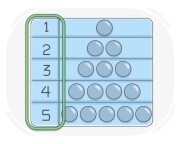
a symbol that represents any number between 0 and 9
the set of all input values for which a mathematical function is defined
the set of points whose coordinates satisfy a particular equation or mathematical relation
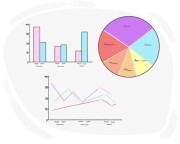
a simplified drawing or plan used to show the parts, structure, operation, or relationships of something
a diagram consisting of bars with different heights that represent the amount of a variable
a type of graph used in statistics and data analysis to display and compare two sets of numerical data
the point where a line, curve, or surface crosses an axis on a graph
a flat, two-dimensional surface that extends infinitely in all directions
any set of numbers that represents an exact position on a map or graph
a straight line drawn through the center of a group of data points on a scatter plot representing the best approximation of the relationship between the variables being studied
to meet or cross another path, line, etc. at a particular point
a set of real numbers that includes all the numbers between any two specified numbers within the set
a mathematical function that creates a straight line when graphed
a function that can be expressed as the ratio of two polynomials, where the denominator is not zero
a fixed numerical value that is a whole number, either positive, negative, or zero
not following a straight or predictable line, sequence, or pattern
to be directly related to or paired with another value, element, or item
a single number, variable, or the product of numbers and variables in an expression or equation, separated by addition or subtraction operators
a reference line used in coordinate systems to provide a framework for locating points
a mathematical function that can be expressed as a sum of terms, where each term is a constant multiplied by a variable raised to a non-negative integer power
to fulfill the conditions of a mathematical equation, inequality, or other statement
a numerical or constant factor that multiplies a variable in an algebraic term
an equation where the highest power of the variable is squared
a statistical method used to model and analyze the relationship between a dependent variable and one or more independent variables
having equal distances from two or more points
having points that lie on the same straight line
a statement or proposition that has been proven to be true based on previously established axioms, definitions, and other theorems within a particular mathematical or logical system
a recurring interval or length associated with a mathematical function or pattern
to determine the numerical value of a mathematical expression, function, or quantity
a way of representing numbers as the sum of each digit multiplied by its place value
a method of writing numbers as the product of a coefficient and a power of 10
a rectangular arrangement of numbers, symbols, or expressions in rows and columns
a single number calculated from the elements of a square matrix that indicates important properties, like whether the matrix can be inverted
the product of all positive whole numbers from 1 to a given number
an ordered set of numbers that describes both magnitude and direction, commonly used to represent quantities like displacement, velocity, or force in physics and engineering
a two-dimensional system used to represent points in space
a mathematical function that relates the angles of a triangle to the lengths of its sides, commonly including sine, cosine, and tangent
a way of representing a system of linear equations in matrix form
a vector that has a magnitude of 1 and represents direction without regard to scale
