Top Notch 3B - Unit 9 - Lesson 1

Here you will find the vocabulary from Unit 9 - Lesson 1 in the Top Notch 3B coursebook, such as "terminology", "election", "liberal", etc.

review-disable

review

flashcard-disable

flashcard

spelling-disable

spelling

quiz-disable

quiz

start-learning
Top Notch 3B
political [adjective]

related to or involving the governance of a country or territory

Ex: The political landscape of the country shifted dramatically after the election .

a set of specialized terms that are used in a specific science, art, business, or profession
Ex: The textbook includes a glossary of technical terminology for students .

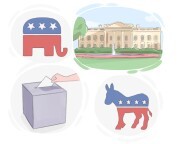
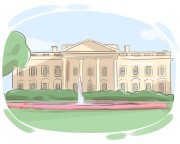
the group of politicians in control of a country or state

Ex: The government is responsible for ensuring that laws are followed and citizens ' rights are protected .
campaign [noun]

a series of organized activities that are intended to achieve a particular goal
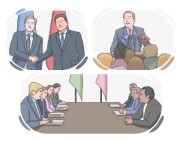
Ex: The environmental group launched a campaign to reduce plastic waste in oceans .
politics [noun]

a set of ideas and activities involved in governing a country, state, or city

Ex: Understanding the complex landscape of global politics is crucial for anyone aspiring to work in diplomacy .

a belief or ideology that supports governance by the people, emphasizing equal participation in the political process
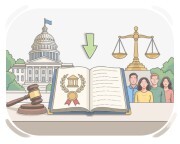
Ex: He joined the movement to promote democracy and social justice .

the official laws and principles by which a country or state is governed

Ex: The Indian constitution is one of the longest and most detailed in the world , outlining the structure of government and the rights of its people .
monarchy [noun]

a system of government or a country or state that is ruled by a king or queen
Ex: The citizens celebrated the anniversary of their monarchy with a grand parade .
election [noun]

the process in which people choose a person or group of people for a position, particularly a political one, through voting

Ex: Election results are announced after votes are counted , and winners are declared based on the majority or plurality of votes received .

a form of government where power is concentrated in the hands of a single individual or a small group, often with absolute authority, without the consent of the people
Ex: The people lived in fear under the dictatorship ’s strict laws .
vote [noun]

an official choice made by an individual or a group of people in a meeting or election
Ex: The referendum resulted in a close vote on the new school funding measure .
constitutional [adjective]

relating to or in accordance with the rules laid out in a constitution, which is a set of fundamental laws for a country or organization

Ex: Constitutional rights protect citizens ' freedoms and limit government power .

a continuous series or range of elements or events that gradually change without any clear division between them
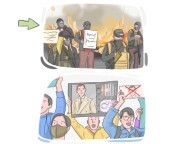
Ex: The continuum of human development includes physical , mental , and emotional growth .
radical [adjective]

supporting total and extreme social or political changes

Ex: The party 's radical proposal for healthcare reform divided public opinion .
liberal [adjective]

related to or characteristic of a political ideology that emphasizes individual freedoms, equality, and government intervention for social welfare and economic opportunity

Ex: The liberal approach to economics favors government regulation to address market failures and promote income equality .
moderate [adjective]

(of a person or ideology) not extreme or radical and considered reasonable by a majority of people

Ex: The professor 's lecture offered a moderate perspective on the historical event , emphasizing multiple viewpoints .
conservative [adjective]

supporting traditional values and beliefs and not willing to accept any contradictory change

Ex: The conservative religious group opposed any changes to their traditional practices or doctrines .
reactionary [adjective]

strongly against any political or social changes or any new ideas

Ex: His reactionary comments during the debate shocked many observers .