
Mathématiques et Évaluation ACT - Arithmétique et Statistiques
Apprenez le vocabulaire ACT pour l'arithmétique et les statistiques, y compris les calculs, les moyennes, les ratios, les pourcentages, les données, les probabilités et l'interprétation des informations numériques.
Réviser
Flashcards
Orthographe
Quiz


any number without fractions or decimals, including positive numbers, negative numbers, and zero

entier
En programmation, les entiers sont couramment utilisés pour compter et indexer.
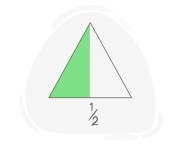
a number expressed as one quantity divided by another, especially one written with a numerator and denominator
fraction
(mathematics) a number less than one, called a fraction, that is represented as a period followed by the number of tenths, hundredths, etc.
décimal
L'étudiant a converti la fraction 3/5 en un décimal pour faciliter les calculs.
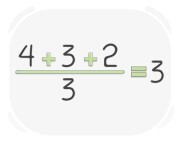
(mathematics) the average value of a set of quantities calculated by adding them, and dividing them by the total number of the quantities
moyenne
calculated by adding a set of numbers together and dividing this amount by the total number of amounts in that set
moyen
a combination of a whole number and a proper fraction
nombre mixte, nombre fractionnaire
Pour convertir un nombre mixte en une fraction impropre, nous multiplions la partie entière par le dénominateur et ajoutons le numérateur.
a number greater than 1 with only two devisors which can be itself or 1
nombre premier
La cryptographie repose sur les propriétés des nombres premiers pour un chiffrement sécurisé.
a number that can be written as a fraction, where both the top and bottom are whole numbers, and the bottom is not zero
nombre rationnel
Le décimal 0,5 est un nombre rationnel car il peut être converti en fraction 1/2, avec 1 et 2 étant des entiers.
a number incapable of being expressed as a ratio of two integers
nombre irrationnel
La forme décimale d'un nombre irrationnel continue indéfiniment sans se répéter.
a number that has both a real part and a part involving a unit that, when squared, gives a negative result
nombre complexe, complexe
Les opérations avec des nombres complexes suivent des règles spécifiques différentes de celles des nombres réels.
any number that can be found on the number line, including both positive and negative numbers, zero, and fractions
nombre réel, réel
Les nombres négatifs, comme -3, sont aussi des nombres réels.
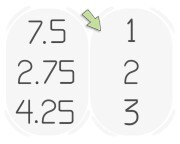
any positive number without fractions or decimals, including zero
nombre entier, entier naturel
Contrairement aux fractions et aux décimales, les nombres entiers représentent des unités complètes.
a value that, when multiplied by itself a specified number of times, results in the given number
racine, radical
the difference between the highest and lowest values in a set of numbers
plage, étendue
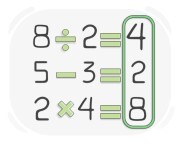
a correct answer to a problem in mathematics or a puzzle
solution
the result of multiplying two or more numbers or quantities together
produit, résultat de la multiplication
(mathematics) one of the numbers that another number can be divided by
facteur
(mathematics) an amount that is shown by a sign or letter
valeur
a mathematical statement showing that one quantity or expression is greater or less than another
inéquation, inégalité
(mathematics) a statement indicating the equality between two values
équation
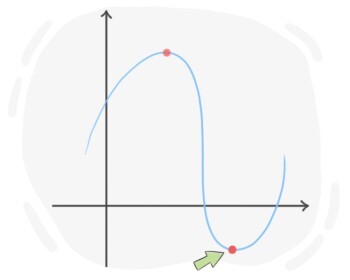
having the least or smallest amount possible
minimum
a mathematical expression where a number is multiplied by itself a certain number of times determined by a variable
exponentielle, fonction exponentielle
Le graphique d'une exponentielle augmente rapidement à mesure que la variable augmente.
a sequence of numbers in which the difference between any two consecutive terms is constant
suite arithmétique, séquence arithmétique
Les suites arithmétiques sont couramment utilisées en finance pour modéliser des situations où il y a une augmentation ou une diminution constante de la valeur au fil du temps.
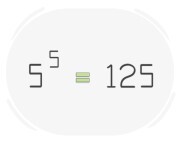
to multiply a value or number by itself
élever au carré, mettre au carré
a fraction where the the top number is greater than or equal to the equal to the bottom number
fraction impropre
L'enseignant a expliqué comment simplifier une fraction impropre en un nombre entier si la division est exacte.
the result obtained by dividing one quantity or number by another, expressed as the outcome of a division operation
quotient
Le quotient de 20 et 5 est 4, car 20 divisé par 5 égale 4.
the constant ratio between consecutive terms
raison commune, ratio commun
La raison commune d'une suite géométrique peut être négative, indiquant des signes alternés entre les termes consécutifs.
a number that is a multiple of two or more given numbers
multiple commun, commun multiple
Pour trouver un multiple commun de 6 et 8, vous pouvez lister leurs multiples et identifier le plus petit qu'ils partagent.
a number that divides exactly into two or more given numbers without leaving a remainder
facteur commun, diviseur commun
Les nombres 8 et 12 ont des facteurs communs de 1, 2 et 4.
(mathematics) a shared multiple of the bottom numbers of two or more fractions
dénominateur commun
the smallest positive integer that is a common multiple of the denominators of two or more fractions
plus petit dénominateur commun, dénominateur commun le plus petit
L'enseignant a expliqué que le plus petit dénominateur commun aide à simplifier le processus d'addition de fractions avec des dénominateurs différents.

a mathematical measure of how likely an event is to occur, expressed as a number between zero and one
probabilité
a statistical measure that represents the middle value of a data set when the values are arranged in ascending or descending order
médiane, valeur médiane
Pour l'ensemble de données {3, 6, 8, 12, 15, 19}, la médiane est 10, la moyenne des deux valeurs centrales 8 et 12.
the value that appears most frequently in a data set
mode, valeur modale
having or involving two distinct modes, peaks, or most frequent values
bimodal, à deux modes
Dans un climat bimodal, il y a généralement deux saisons des pluies distinctes.

to guess the value, number, quantity, size, etc. of something without exact calculation
estimer
the number of times a particular event occurs within a specific period or among a set of observations
fréquence
(statistics) an arrangement of values of a variable showing how often each occurs, either observed or theoretical
distribution, répartition
a measure of how much the values in a set typically differ from the average
écart type, déviation standard
L'écart type des résultats aux tests a montré que la plupart des étudiants ont obtenu des scores autour de la moyenne.
the range within which the true value is expected to fall, accounting for potential inaccuracies in measurement or sampling
marge d'erreur, intervalle d'erreur
Lors du calcul de la marge d'erreur de l'enquête, les chercheurs ont pris en compte la taille de l'échantillon et la variabilité.
occurring in such a way that each possible outcome has a certain probability of occurring, but the specific outcome cannot be predicted with certainty
aléatoire, hasardeux
La variable aléatoire X représente le nombre de faces obtenues en lançant une pièce trois fois.
a straight line drawn through a set of data points on a graph to represent the general direction or pattern of the data
ligne de tendance, courbe de tendance
En traçant une ligne de tendance à travers les données de vente, l'entreprise a pu prévoir les performances futures.
a type of statistical chart consisting of dots that represent individual data points
diagramme à points, graphique à points
En examinant le diagramme à points, nous avons pu identifier rapidement le mode de l'ensemble de données.
a mathematical representation that describes the relationship between two or more variables using a linear equation
modèle linéaire, modèle de régression linéaire
Les économistes utilisent des modèles linéaires pour prédire les dépenses des consommateurs en fonction de facteurs tels que le revenu et les taux d'intérêt.
| Mathématiques et Évaluation ACT | |||
|---|---|---|---|
| Mathématiques | Arithmétique et Statistiques | Géométrie | Quantité et Partitifs |
| Économie | Temps et Ordre | Processus d'Actions | Bourse et Innovation |
| Inclusion et Classification | Comparaison | Importance | Louange |
| Évaluation et Critique | Changement | Statut | Gestion des Articles |
