
Vocabular pentru IELTS Academic (Scor 5) - Fizică
Aici, vei învăța câteva cuvinte în engleză legate de Fizică care sunt necesare pentru examenul academic de bază IELTS.
Revizuire
Fișe de studiu
Ortografie
Chestionar


a small particle in an atom with negative charge

electron, particulă mică într-un atom cu sarcină negativă
Electronii circulă prin fire pentru a crea curent electric.
a small positively charged particle present in atoms
proton
Numărul de protoni dintr-un atom îi definește numărul atomic.
a small particle with no charge present in atoms
neutron, particulă neutră
Neutronii acționează ca "clei" în nucleu, prevenind repulsia protonilor.
the smallest possible amount of a particular quantity that cannot be divided any further
cuantum, cea mai mică cantitate indivizibilă
Comportamentul particulelor subatomice este guvernat de principiile mecanicii cuantice.
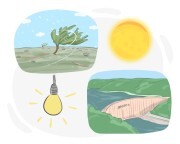
(physics) a source of power that is required to do any work that may exist in potential, kinetic, thermal and other forms
energie, putere
Energia necesară pentru ridicarea cutiei depinde de greutatea acesteia și de înălțimea la care este ridicată.
(physics) an effect that causes a body to move or change direction
forță
Forța magnetică poate atrage sau respinge obiectele metalice.
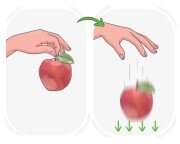
(physics) the universal force of attraction between any pair of objects with mass
gravitație
Gravitația este ceea ce menține planetele pe orbită în jurul Soarelui și Luna pe orbită în jurul Pământului.
(physics) an oscillating movement by which energy is transferred without the transport of matter, such as light and sound
undă, vibrație
Lumina călătorește prin spațiu sub formă de undă.
(physics) the state of being under pressure as a result of getting stretched
tensiune, presiune
Tensiunea din frânghie a crescut pe măsură ce greutatea era ridicată.
(physics) the amount of force exerted per area that is measured in pascal, newton per square meter, etc.
presiune, presiune fizică
Sistemele hidraulice folosesc presiunea fluidului pentru a ridica utilaje grele.
the ability to go back to the original form after being stretched
elasticitate
Elasticitatea benzii de cauciuc i-a permis să revină la loc.
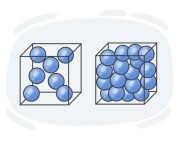
(physics) the degree to which a substance is compacted, measured by dividing its mass by its volume
densitate, masă volumetrică
Densitatea apei este de aproximativ 1 gram pe centimetru cub (g/cm³).
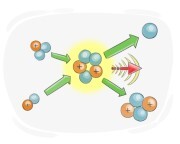
(physics) a nuclear reaction by which the nuclei of atoms combine and form a heavier nucleus, producing nuclear energy
fuziune, fuziune nucleară
Energia soarelui provine din fuziunea hidrogenului în heliu.
a theory that explains the relationship between motion, space, and time
relativitate
Relativitatea explică de ce sateliții GPS trebuie să-și ajusteze ceasurile din cauza gravitației Pământului.
the energy difference that drives current, typically measured in volts
potențial, tensiune
Potencialul la bornele bateriei a fost măsurat la 12 volți.
(physics) any of the smallest units that energy or matter consists of, such as electrons, atoms, molecules, etc.
particulă
Electronii sunt particule fundamentale cu sarcină electrică negativă.
a phenomenon of attracting and repulsing forces that a moving electrical charge produces
magnetism, forță magnetică
Magnetismul Pământului ghidează acele busolei spre polul nord.
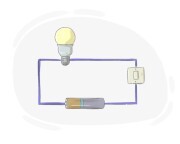
a flow of electricity resulted from the movement of electrically charged particles in a direction
curent, flux electric
Un curent alternativ este utilizat în mod obișnuit pentru a alimenta electrocasnicele.
