pattern

Ordförråd för IELTS Academic (Poäng 5) - Fysik

Här kommer du att lära dig några engelska ord relaterade till Fysik som är nödvändiga för det grundläggande akademiska IELTS-provet.

Recension

Flashcards

Stavning

Quiz

Starta lärandet
Vocabulary for IELTS Academic (Band 5)
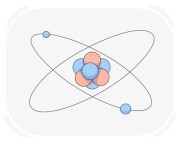
electron
electron
[Substantiv]

an extremely small elementary particle with a negative electric charge

elektron

elektron

Ex: Electric current in a metal involves the movement of electrons. 
Stäng
Logga in
proton
proton
[Substantiv]

a small positively charged particle present in atoms

proton

proton

Ex: Particle accelerators smash protons together to study fundamental forces. 

Partikelacceleratorer krockar protoner tillsammans för att studera fundamentala krafter.

Stäng
Logga in
neutron
neutron
[Substantiv]

a small particle with no charge present in atoms

neutron, neutral partikel

neutron, neutral partikel

Ex: Isotopes differ only in their number of neutrons (e.g., carbon-12 vs. carbon-14). 

Isotoper skiljer sig endast i antalet neutroner (t.ex., kol-12 mot kol-14).

Stäng
Logga in
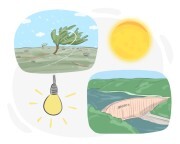
quantum
quantum
[Substantiv]

the smallest possible amount of a particular quantity that cannot be divided any further

kvant, minsta möjliga odelbara mängd

kvant, minsta möjliga odelbara mängd

Ex: Quantum tunneling allows particles to pass through energy barriers that would be impassable according to classical mechanics. 

Kvanttunnelning tillåter partiklar att passera energibarriärer som enligt klassisk mekanik skulle vara oöverstigliga.
Stäng
Logga in
energy
energy
[Substantiv]

(physics) a source of power that is required to do any work that may exist in potential, kinetic, thermal and other forms

energi, effekt

energi, effekt

Ex: Moving objects possess kinetic energy. 
Stäng
Logga in
force
force
[Substantiv]

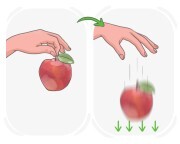
(physics) a push or pull that can change an object's motion, direction, or shape

kraft,  styrka
kraft, styrka

Ex: A force can change the speed or direction of an object. 
Stäng
Logga in
gravity
gravity
[Substantiv]

the force by which objects with mass attract one another, especially the force that draws objects toward the Earth

gravitation

gravitation

Ex: Gravity keeps the planets in orbit around the Sun. 
Stäng
Logga in
wave
wave
[Substantiv]

(physics) an oscillating movement by which energy is transferred without the transport of matter, such as light and sound

våg, svängning

våg, svängning

Ex: Sound waves carry energy through the air. 
Stäng
Logga in
tension
tension
[Substantiv]

(physics) the state of being under pressure as a result of getting stretched

spänning, tryck

spänning, tryck

Ex: The tension in the cable supports the weight of the bridge. 
Stäng
Logga in
pressure
pressure
[Substantiv]

(physics) the amount of force exerted per area that is measured in pascal, newton per square meter, etc.

tryck, fysiskt tryck

tryck, fysiskt tryck

Ex: Water pressure increases with depth. 
Stäng
Logga in
elasticity
elasticity
[Substantiv]

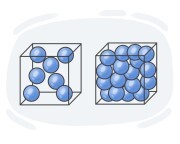
the ability to go back to the original form after being stretched

elasticitet

elasticitet

Ex: This fabric's elasticity makes it ideal for sportswear. 

Denna tygs elasticitet gör den ideal för sportkläder.
Stäng
Logga in
density
density
[Substantiv]

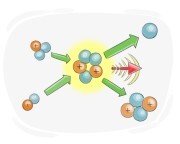
(physics) the mass of a substance or object per unit of volume

densitet
densitet

Ex: Daniel measured the object's mass and volume to determine its density. 
Stäng
Logga in
fusion
fusion
[Substantiv]

a nuclear reaction in which light atomic nuclei combine to form a heavier nucleus and release energy

kärnfusion, fusion

kärnfusion, fusion

Ex: The experiment produced fusion reactions for only a brief period. 
Stäng
Logga in
relativity
relativity
[Substantiv]

a theory that explains the relationship between motion, space, and time

relativitet

relativitet

Ex: Time dilation in relativity means astronauts age slightly slower. 

Relativitet innebär att astronauter åldras något långsammare i tidsdilatation.

Stäng
Logga in
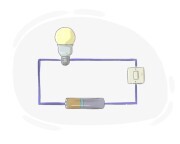
potential
potential
[Substantiv]

the energy difference that drives current, typically measured in volts

potential, spänning
potential, spänning

Ex: Electric current flows because of a difference in potential. 
Stäng
Logga in
particle
particle
[Substantiv]

an extremely small unit of matter or radiation treated as a discrete entity in physics

partikel

partikel

Ex: The collision produced several high-energy particles. 
Stäng
Logga in
magnetism
magnetism
[Substantiv]

a phenomenon of attracting and repulsing forces that a moving electrical charge produces

magnetism, magnetisk kraft

magnetism, magnetisk kraft

Ex: MRI machines use powerful magnetism to create detailed body scans. 

MRI-maskiner använder kraftfull magnetism för att skapa detaljerade kroppsskanningar.
Stäng
Logga in
current
current
[Substantiv]

a flow of electricity resulted from the movement of electrically charged particles in a direction

ström, elektrisk ström

ström, elektrisk ström

Ex: The alternator produces a current by moving charged particles within its magnetic field. 
Stäng
Logga in
voltage
voltage
[Substantiv]

total potential energy provided by a power source

spänning, volt

spänning, volt

Ex: Industrial machines require 480V to operate. 
Stäng
Logga in
LanGeek
Ladda ner LanGeek app
