Vocabulary for IELTS Academic (Band 5) - Physics

Here, you will learn some English words related to Physics that are necessary for the Basic Academic IELTS exam.

review-disable

review

flashcard-disable

flashcard

spelling-disable

spelling

quiz-disable

quiz

start-learning
Vocabulary for IELTS Academic (Band 5)
electron [noun]

a small particle in an atom with negative charge

Ex: The number of electrons determines an element 's chemical properties .
proton [noun]

a small positively charged particle present in atoms

Ex: In acidic solutions , free protons ( H⁺ ions ) create sourness .
neutron [noun]

a small particle with no charge present in atoms

Ex: Nuclear reactors split neutrons from atoms to release energy .
quantum [noun]

the smallest possible amount of a particular quantity that cannot be divided any further
Ex:
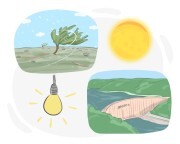
energy [noun]

(physics) a source of power that is required to do any work that may exist in potential, kinetic, thermal and other forms

Ex:
force [noun]

(physics) an effect that causes a body to move or change direction
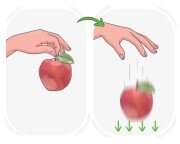
Ex: She applied a force of 10 newtons to push the box across the floor .
gravity [noun]

(physics) the universal force of attraction between any pair of objects with mass

Ex: Einstein 's theory of general relativity revolutionized our understanding of gravity by explaining it as the curvature of spacetime caused by mass .
wave [noun]

(physics) an oscillating movement by which energy is transferred without the transport of matter, such as light and sound

Ex: Scientists study how waves interact with different materials .
tension [noun]

(physics) the state of being under pressure as a result of getting stretched

Ex: The tension in the cable supporting the elevator must exceed the maximum load .
pressure [noun]

(physics) the amount of force exerted per area that is measured in pascal, newton per square meter, etc.

Ex:

the ability to go back to the original form after being stretched
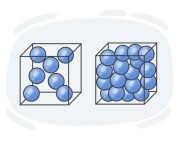
Ex: The elasticity of the spring ensures it can be used repeatedly .
density [noun]

(physics) the degree to which a substance is compacted, measured by dividing its mass by its volume
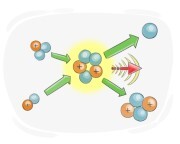
Ex: The density of a material can affect its physical properties , such as its strength and buoyancy .
fusion [noun]

(physics) a nuclear reaction by which the nuclei of atoms combine and form a heavier nucleus, producing nuclear energy

Ex:

a theory that explains the relationship between motion, space, and time

Ex: General relativity predicts black holes bend spacetime .

the energy difference that drives current, typically measured in volts

Ex: The potential in the power line dropped significantly due to a fault in the system .
particle [noun]

(physics) any of the smallest units that energy or matter consists of, such as electrons, atoms, molecules, etc.

Ex:

a phenomenon of attracting and repulsing forces that a moving electrical charge produces
Ex: Magnetism is why some metals cling to refrigerator doors .
current [noun]

a flow of electricity resulted from the movement of electrically charged particles in a direction

Ex: Solar panels convert sunlight into electrical current by moving charged particles within the cells .
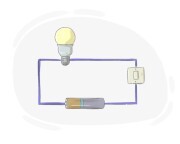
voltage [noun]

total potential energy provided by a power source

Ex:
Vocabulary for IELTS Academic (Band 5)
Size and Scale Dimensions Weight and Steadiness Increase in Amount
Decrease in Amount High Intensity Low Intensity Space and Area
Shapes Speed Significance Influence and Strength
Uniqueness Complexity Value Quality
Challenges Wealth and Success Poverty and Failure Appearance
Age Body Shape Wellness Textures
Intelligence Positive Human Traits Negative Human Traits Moral Traits
Emotional Responses Emotional States Social Behaviours Tastes and Smells
Sounds Temperature Probability Relational Actions
Body Language and Gestures Postures and Positions Opinions Thoughts and Decisions
Knowledge and Information Encouragement and Discouragement Request and Suggestion Regret and Sadness
Respect and Approval Attempt and Prevention Physical Actions and Reactions Movements
Commanding and Giving Permissions Engaging in Verbal Communication Understanding and Learning Perceiving The Senses
Resting and Relaxing Touching and Holding Eating and Drinking Preparing Food
Changing and Forming Organising and Collecting Creating and Producing Science
Education Research Astronomoy Physics
Biology Chemistry Geology Psychology
Mathematics Graphs and Figures Geometry Environment
Energy and Power Landscapes and Geography Technology Computer
Internet Manufacture and Industry History Religion
Culture and Custom Language and Grammar Arts Music
Film and Theatre Literature Architecture Marketing
Finance Management Medicine Sickness and Symptoms
Law Crime Punishment Politics
War Measurement Positive Emotions Negative Emotions
Animals Weather Food and Drinks Travel and Tourism
Pollution Migration Disasters Materials
Adverbs of Manner Adverbs of Comment Adverbs of Certainty Adverbs of Frequency
Adverbs of Time Adverbs of Place Adverbs of Degree Adverbs of Emphasis
Adverbs of Purpose and Intention Conjunctive Adverbs