
Architecture and Construction - Columns
Here you will learn some English words related to columns such as "footstall", "abacus", and "entasis".
Review
Flashcards
Spelling
Quiz

a flat, stone block that sits on top of a column, used to support the parts above it such as a roof
the curved or sloping transition between the shaft of a column and its base or capital, providing a graceful connection between the two elements
a sculpted male figure or column in the form of a standing human figure, often used as a decorative support or columnar element in architecture
the bottom portion or support of a column, pillar, or structure, providing stability and transitioning between the column and the ground or foundation
a sculpted female figure used as a supporting column or pillar in architecture, often taking the place of a traditional column and bearing the weight of the structure on its head and shoulders
the slight curvature applied to the shaft of a column to create an optical illusion of straightness and visual harmony
the base or lower part of a column that provides support and stability, typically consisting of a wider section at the bottom that rests on the ground or a pedestal
the narrow, usually cylindrical section between the capital and the shaft of a column, serving as a transitional element
the main vertical part of a column between its base and capital
a convex, semi-circular molding or projection that is often used to ornament the base or capital of a column, providing visual interest and a decorative touch
a type of classical architectural column characterized by a plain, fluted shaft, a capital with a simple circular molding, and no base
a type of classical architectural column characterized by a slender, fluted shaft, a capital with volutes, and a base
a type of classical architectural column characterized by a slender, fluted shaft, a capital adorned with acanthus leaves, and a base
a base or support structure for an architectural element or statue
the upper part of a column that transitions to and supports the structure above it
a decorative column or pilaster that typically features a human or animal head or bust at the top, often used to support an entablature or other architectural elements
a vertical, rectangular or flattened column-like element that is typically attached to a wall and often features a capital, base, and entablature
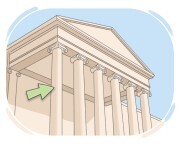
an upright, tall, and strong structure made of stone, metal, or wood that provides support for a part of a building such as the roof
the sharp edge or ridge formed by the meeting of two surfaces, particularly in architectural elements such as columns, moldings, or corners of buildings, often created by chamfering or beveling the edges
a rounded and convex element found in the capital of a column, adding visual appeal to the architectural design
a structural element in architecture that refers to a square or rectangular column or pilaster-like projection at the end of a wall, typically found at the corners of a building or as a division between spaces
a row of columns having equal distance from each other, often supporting a roof or arch
a shallow vertical groove or channel that is typically found on the surface of a column or pilaster
a column with eight sides or faces, forming an octagon shape, commonly used in architectural design to provide structural support and aesthetic variation
a column with four sides or faces, forming a square shape, often used in architecture to provide support and visual symmetry in structures such as buildings, temples, or porticos
a column that is partially embedded or attached to a wall, often used in architecture as a decorative element or for structural support, appearing as a half-column projecting from a surface
a twisted or spiral column characterized by a helical or corkscrew-like design, commonly associated with Baroque and Renaissance architecture
a column designed in the Tuscan order, featuring a plain and unadorned shaft with a simple capital and base, known for its simplicity and classical proportions
a vertical supporting element that divides a large opening, such as a doorway or window, into two smaller sections
a simple protective or finishing element placed on top of the column shaft
