Music - Parts of Musical Pieces

Here you will learn some English words related to the different parts of musical pieces such as "accompaniment", crescendo"", and "prelude".

review-disable

review

flashcard-disable

flashcard

spelling-disable

spelling

quiz-disable

quiz

start-learning
Music

a slow and constant increase in the loudness of a musical piece

Ex: As the orchestra played , the music 's crescendo created a thrilling experience .
strain [noun]

the tune or sound of a musical piece or song

tempo [noun]

the speed that a piece of music is or should be played at

Ex: The tempo of the music gradually slowed down toward the end .

the musical support provided by one or more instruments or voices to enhance or complement a soloist or main melody

Ex: The jazz pianist improvised a captivating accompaniment , seamlessly weaving intricate harmonies beneath the saxophonist 's solo .
cadence [noun]

a sequence of musical notes or chords that marks the conclusion of a phrase, section, or entire composition

Ex: The choir held the last note of the cadence in perfect harmony .
coda [noun]

the final passage of an extended musical composition

Ex: As the orchestra reached the coda , the conductor emphasized the dynamics , guiding the musicians to a thrilling and emphatic finish .
descant [noun]

a melody sung or played above the main melody, typically in a higher register

Ex: The descant sung by the sopranos added a sense of ethereal beauty to the choir 's rendition of the Christmas carol .
excerpt [noun]

a short piece taken from a longer composition

a theme that appears in a literary or musical piece several times and is associated with a particular person, idea or object

a contrasting section in a song that typically spans eight bars, serving as a bridge between verses and choruses

movement [noun]

one of the main parts that a long musical work is divided into, having its own structure

Ex: He studied the structure of each movement in the sonata to understand its musical development .
prelude [noun]

a short section of a musical performance such as a fugue, opera, suite, etc. that introduces the main theme or subject

part [noun]

the specific music played or sung by a particular voice or instrument in multiple parts

section [noun]

a portion of a composition distinguished by its own melody, rhythm, or harmony

Ex:
theme [noun]

a recurring melody, rhythm, chord progression, or motif in a musical composition that serves as a unifying element

Ex: The jazz standard featured a catchy and infectious theme that became instantly recognizable to listeners .
vocal [noun]

a section or part of a musical composition that is sung

Ex: The vocal was harmonized beautifully with the instrumental section .

a version of a musical theme with alterations in rhythm, tempo, melody, etc. in a way that the original theme is recognizable

cadenza [noun]

a solo section at the end of a musical piece for the performer to show their skill and creativity

Ex: The pianist 's cadenza in the concerto was an extraordinary display of technical prowess and expressive depth .

a musical part that is integral to a piece of music and cannot be omitted

Ex: The cellist 's obbligato wove through the orchestral texture , adding depth and emotion to the symphonic movement .
form [noun]

the overall structure or organization of a musical composition
Ex: The symphony 's form typically includes multiple movements , each with its own distinct structure and thematic material .
beat [noun]

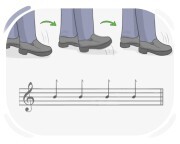
a piece of music's or a poem's main rhythm

Ex: The metronome helps musicians practice their timing by providing a steady beat to follow .
passage [noun]

a short section or phrase of a musical piece, considered separately