Essential Vocabulary for TOEFL - Point of View

Here you will learn some English words about point of view, such as "defend", "dispute", "stand", etc. that are needed for the TOEFL exam.

review-disable

review

flashcard-disable

flashcard

spelling-disable

spelling

quiz-disable

quiz

start-learning
Essential Vocabulary for TOEFL

to firmly and persistently express an opinion, belief, or statement as true and valid
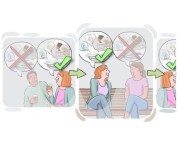
Ex: The scientist maintains that climate change is a significant threat that needs immediate attention .
to hold [verb]

to have a specific opinion or belief about someone or something

Ex: He holds radical views on economic reform .

to support someone or try to justify an action, plan, etc.

Ex: He had to defend his business decisions during the board meeting .

to publicly support or recommend something

Ex: The organization advocates for mental health awareness , working to reduce stigma .

to form an opinion by considering the information at hand
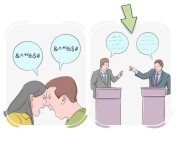
Ex: The team calculated that the weather would improve by the weekend .

to argue with someone, particularly over the ownership of something, facts, etc.

Ex: The neighbors began to dispute property boundaries , resulting in a heated argument .

to form a broad conclusion or principle by considering specific instances

Ex: Teachers often generalize patterns from student responses .

to disagree with or not fit well with a specific rule, concept, or standard

Ex: This decision goes against the company 's core values of integrity and transparency .

to mention someone or something of prominence as a support or reason for an argument or action

Ex: He often invokes the authority of scientific research to support his claims .
to stand [verb]

to have a certain opinion regarding an issue

Ex: As an advocate for education , she stands for increased funding for schools .

to form a theory or opinion about a subject without knowing all the facts

Ex: When the stock prices suddenly dropped , investors started to speculate on the reasons for the market downturn .

to disagree with someone or to hold different opinions, viewpoints, or beliefs

Ex: Experts in the field may differ in their interpretations of the research findings .

to disagree with someone, particularly by asserting the opposite of their statement
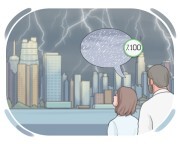
Ex: The witness contradicted the defendant 's testimony during the trial .
to bet [verb]

to express confidence or certainty in something happening or being the case

Ex: He 's betting that the new restaurant will become a popular spot in town .

the act of judging or evaluating someone or something carefully based on specific standards or principles
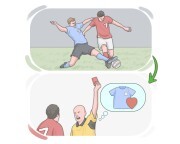
Ex: The doctor performed a medical assessment to evaluate the patient 's overall health .

the act of claiming something or declaring something to be true

bias [noun]

a prejudice that prevents fair consideration of a situation
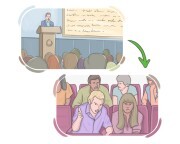
Ex:
controversial [adjective]

causing a lot of strong public disagreement or discussion

Ex: The controversial film explored sensitive social issues , prompting both praise and criticism from viewers .

an opposing argument or viewpoint that challenges an idea or theory

Ex: In the essay , he addressed potential counterarguments to his thesis to strengthen his argument .
furthermore [adverb]

used to introduce additional information
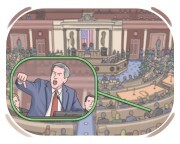
Ex: The software offers a user-friendly interface , and furthermore , it incorporates advanced security features for data protection .

to strongly disagree with a policy, plan, idea, etc. and try to prevent or change it

Ex: The senator opposed the bill , citing its potential negative impact on the economy .

to give a fact or an opinion as a reason against something

Ex: He objected that the proposed route was too dangerous for inexperienced hikers .
inclined [adjective]

having a tendency to do something

Ex: The team is inclined to celebrate every small victory along the way .
moderate [adjective]

(of a person or ideology) not extreme or radical and considered reasonable by a majority of people

Ex: The professor 's lecture offered a moderate perspective on the historical event , emphasizing multiple viewpoints .

the opinions, activities, or methods that are considered normal because they are accepted by a majority of people

Ex: His views are far from the mainstream , often sparking controversy .
division [noun]

disagreement among members of a group or society

Ex: Religious differences often lead to division within communities .

a conclusion one reaches from the existing evidence or known facts

Ex: In literature , readers often make inferences about characters ' motivations based on their actions and dialogue .
objective [adjective]

based only on facts and not influenced by personal feelings or judgments

Ex: The court appointed an objective mediator to help resolve the dispute between the two parties .
subjective [adjective]

based on or influenced by personal feelings or opinions rather than facts

Ex: Taste in music is subjective , with individuals preferring different genres and artists .
arguable [adjective]

open to question and disagreement

Ex: His actions during the crisis are arguable , as some believe he acted wisely while others disagree .
affirmative [adjective]

favorable or supportive in attitude or response

Ex: The committee 's response to the proposal was affirmative , indicating their full support for the new initiative .
argumentative [adjective]

(of a person) ready to argue and often arguing

Ex: Her argumentative demeanor made it difficult for others to work with her collaboratively .
challenging [adjective]

intending to provoke thought or discussion

Ex:
hostile [adjective]

strongly opposing or resistant to something

Ex: The audience remained hostile to the speaker .

the quality of always acting or being the same way, or having the same opinions or standards

Ex: In leadership , consistency is key to building trust and maintaining morale among team members .

negative feedback that highlights mistakes or areas for improvement

Ex: Her criticism felt personal , but it was focused on improving the work .