Essential Vocabulary for TOEFL - Space

Here you will learn some English words about space, such as "galaxy", "solar", "cosmic", etc. that are needed for the TOEFL exam.

review-disable

review

flashcard-disable

flashcard

spelling-disable

spelling

quiz-disable

quiz

start-learning
Essential Vocabulary for TOEFL
universe [noun]

all that exists in the physical world, such as space, planets, galaxies, etc.

Ex: Scientists use powerful telescopes to observe celestial objects and unravel mysteries of the universe .
cosmos [noun]

the universe, particularly when it is thought of as a systematic whole

Ex: Astronomers use telescopes to observe distant phenomena in the cosmos .
galaxy [noun]

a large number of star systems bound together by gravitational force
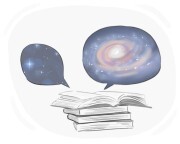
Ex: The Hubble Space Telescope has captured images of thousands of galaxies , providing insights into their formation and evolution .

a branch of science that studies space, planets, etc.

Ex: Historical records show how ancient civilizations used astronomy to develop calendars and navigate across oceans .

a pale band of light seen in the sky at night that contains the solar system and billions of other stars
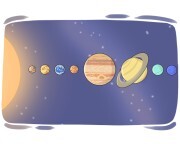
Ex: Astronomers study the structure and evolution of the Milky Way galaxy .

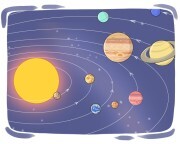
the sun and the group of planets orbiting around it, including the earth
Ex: Some moons in the solar system may have conditions suitable for life .

the earth's atmosphere and the space beyond it
Ex: The company specializes in aerospace manufacturing , producing components for aircraft and spacecraft .
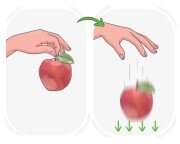
gravity [noun]

(physics) the universal force of attraction between any pair of objects with mass

Ex: Einstein 's theory of general relativity revolutionized our understanding of gravity by explaining it as the curvature of spacetime caused by mass .

a scientist who studies or observes planets, stars, and other happenings in the universe

Ex: She became an astronomer because of her fascination with the mysteries of the cosmos .

a specific group of stars that form a pattern and have a name related to their shape

Ex: The Big Dipper is a prominent constellation consisting of seven bright stars .
solar [adjective]

related to the sun

Ex:
lunar [adjective]

relating to the moon

Ex:
big bang [noun]

the explosion that, according to most scientists, caused the existence of the universe
Ex:

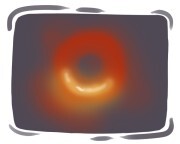
a place in the space with such high gravity that pulls in everything, even light
Ex: Scientists detect black holes by observing the effects of their gravity on nearby objects and light , rather than seeing the black holes themselves directly .
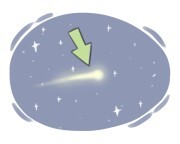
comet [noun]

an object in space that is a mass of ice and dust and when it nears the sun it starts illuminating in the shape of a tail

Ex: The tail of a comet forms when solar radiation causes ice and dust to vaporize and stream away from the nucleus .
cosmic [adjective]

related to the universe and the vast space outside the earth
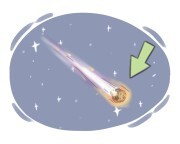
Ex:
meteor [noun]

a piece of rock coming from outer space that passes through the Earth's atmosphere, producing light

Ex: The study of meteors helps astronomers understand the composition of objects from the early solar system .

a piece of rock or metal from space that has hit the surface of the earth
Ex: The impact crater was formed by a large meteorite that struck Earth millions of years ago .
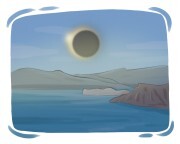
eclipse [noun]

a period during which the sun or moon is temporarily obscured by the shadow of another celestial body
Ex: An eclipse occurs when the Earth , moon , and sun align perfectly .
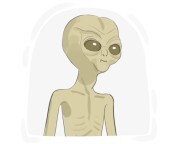
alien [noun]

a creature that is believed to exist in other worlds or planets
Ex: In the movie " Independence Day " , aliens invade Earth , causing a global crisis that humanity must unite to overcome .

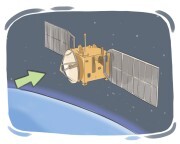
an object sent into space to travel around the earth and send or receive information
Ex: The satellite 's camera captured detailed images of the planet ’s surface for environmental monitoring .
to orbit [verb]

to move around a star, planet, or a large object in space

Ex: Jupiter has the largest number of moons of any planet in our solar system , with 79 known moons orbiting around it .
rotation [noun]

a single complete circular movement around an axis or along an orbit
Ex: Each rotation of the hand wheel raises the platform slightly .

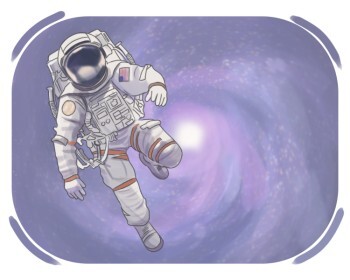
someone who is trained to travel and work in space
Ex: He underwent rigorous physical and mental training to qualify as an astronaut .

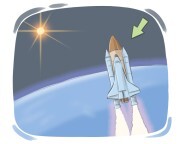
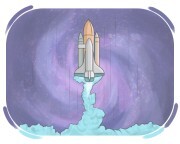
a vehicle designed to travel in space

Ex: The documentary showcased the development and launch of a new spacecraft designed for deep-space exploration .
rocket [noun]

a propulsion device with its own fuel that produces thrust through reaction forces

Ex: The model rocket used solid propellant .
mission [noun]

an operation carried out in space

Ex: The Hubble Space Telescope has completed numerous scientific missions to observe distant galaxies and nebulae .

to send an object, such as a satellite, missile, etc., into space

Ex: The submarine successfully launched a torpedo during the naval exercise .

the act of counting numbers backwards to zero before the launch of a missile or spacecraft
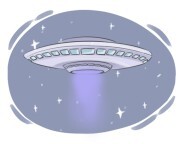
a mysterious object that some people claim to have seen flying around in the sky and assume that it is a spaceship from another world

Ex: Scientists study reports of unidentified flying objects to determine if they have natural or man-made origins .
voyage [noun]

a long journey taken on a ship or spacecraft

Ex: They planned a voyage to Antarctica to study the continent ’s unique wildlife and climate .
NASA [noun]

a US government agency responsible for space travel and the study of space

Ex: Astronauts from NASA conducted experiments aboard the International Space Station to study microgravity effects on the human body .

the distance that a beam of light travels in a year, equal to 9.46 trillion kilometers

ray [noun]

a column of light, such as that emitted from a beacon or focused source

Ex: He followed the ray into the dark tunnel .