pattern

Verbes d'Action Verbale - Verbes pour Ordonner et Contraindre

Ici, vous apprendrez quelques verbes anglais se référant à l'ordre et à la contrainte tels que "commander", "obliger" et "expulser".

Réviser

Flashcards

formes

Orthographe

Quiz

Commencer à apprendre
Categorized English Verbs of Verbal Action
to order
to order
[verbe]

to give an instruction to someone to do something through one's authority

ordonner

ordonner

Ex: The captain ordered the crew to prepare for an emergency landing .

Le capitaine a ordonné à l'équipage de se préparer pour un atterrissage d'urgence.

to command
to command
[verbe]

to give an official order to a person or an animal to perform a particular task

ordonner

ordonner

Ex: The coach commands the team to focus on their defensive strategy .

L'entraîneur ordonne à l'équipe de se concentrer sur leur stratégie défensive.

to tell
to tell
[verbe]

to instruct or recommend someone to do a particular thing

dire

dire

Ex: She told her son to clean his room before watching TV .

Elle a dit à son fils de nettoyer sa chambre avant de regarder la télé.

to summon
to summon
[verbe]

to officially call someone, typically to attend court or fulfill a legal obligation

convoquer, assigner

convoquer, assigner

Ex: The regulatory agency summoned the company executives to discuss compliance issues .

L'agence de régulation a convoqué les dirigeants de l'entreprise pour discuter des problèmes de conformité.

to decree
to decree
[verbe]

to make an official judgment, decision, or order

décréter

décréter

Ex: The council decreed new zoning regulations for the residential area .

Le conseil a décrété de nouvelles réglementations de zonage pour la zone résidentielle.

to ordain
to ordain
[verbe]

to officially order something using one's higher authority

ordonner, décréter

ordonner, décréter

Ex: The king will ordain a special ceremony to honor outstanding citizens for their contributions .

Le roi ordonnera une cérémonie spéciale pour honorer les citoyens exceptionnels pour leurs contributions.

to dictate
to dictate
[verbe]

to tell someone what to do or not to do, in an authoritative way

dicter

dicter

Ex: The leader was dictating changes to the organizational structure .

Le leader dictait des changements à la structure organisationnelle.

to force
to force
[verbe]

to make someone behave a certain way or do a particular action, even if they do not want to

forcer, contraindre

forcer, contraindre

Ex: Right now , the manager is forcing employees to work overtime due to the tight deadline .

En ce moment, le manager oblige les employés à faire des heures supplémentaires en raison de l'échéance serrée.

to compel
to compel
[verbe]

to make someone do something

contraindre

contraindre

Ex: The continuous pressure was compelling him to reevaluate his career choices .

La pression continue le contraignait à réévaluer ses choix de carrière.

to coerce
to coerce
[verbe]

to force someone to do something through threats or manipulation

contraindre, forcer

contraindre, forcer

Ex: The manager is coercing employees to work longer hours without proper compensation .

Le manager contraint les employés à travailler plus longtemps sans compensation appropriée.

to obligate

to make someone do something, typically through legal, moral, or social means

obliger

obliger

Ex: The terms of the loan obligate the borrower to make monthly repayments with a fixed interest rate.

Les termes du prêt obligent l'emprunteur à effectuer des remboursements mensuels avec un taux d'intérêt fixe.

to oblige
to oblige
[verbe]

to make someone do something because it is required by law, duty, etc.

obliger

obliger

Ex: The invitation obliged him to attend the formal event .

L'invitation l'a obligé à assister à l'événement formel.

to constrain

to force someone to act in a certain way

contraindre, forcer

contraindre, forcer

Ex: Social expectations constrained them to conform to traditional gender roles .

Les attentes sociales les contraignaient à se conformer aux rôles traditionnels de genre.

to make
to make
[verbe]

to force someone or something to do something

forcer, obliger, faire faire

forcer, obliger, faire faire

Ex: A lack of resources made the organization struggle to meet its goals .

Un manque de ressources a fait que l'organisation a eu du mal à atteindre ses objectifs.

to impel
to impel
[verbe]

to strongly encourage someone to take action

pousser

pousser

Ex: The alarming statistics about climate change impelled scientists to intensify their research efforts .

Les statistiques alarmantes sur le changement climatique ont poussé les scientifiques à intensifier leurs efforts de recherche.

to bludgeon

to forcefully pressure someone to do something

forcer, contraindre

forcer, contraindre

Ex: The fear of social ostracism bludgeoned her into conformity with the group 's norms .

La peur de l'ostracisme social l'a matraquée pour se conformer aux normes du groupe.

to dragoon
to dragoon
[verbe]

to pressure someone into doing something through intimidation or threats

forcer

forcer

Ex: In certain oppressive regimes , authorities may dragoon journalists into self-censorship to control the narrative .

Dans certains régimes oppressifs, les autorités peuvent enrôler de force les journalistes dans l'autocensure pour contrôler le récit.

to dismiss
to dismiss
[verbe]

to remove someone from their job or position, typically due to poor performance

renvoyer, licencier, congédier
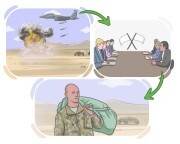
renvoyer, licencier, congédier

Ex: The government dismissed the official from their position amid allegations of corruption .

Le gouvernement a licencié l'agent de son poste suite à des allégations de corruption.

to discharge

to make someone leave the armed forces or police and relieving them from their duties

décharger

décharger

Ex: Following a period of exemplary service, the sergeant was granted a discharge with full honors.

Après une période de service exemplaire, le sergent a obtenu une libération avec tous les honneurs.

to expel
to expel
[verbe]

to force someone to leave a place, organization, etc.

renvoyer, exclure

renvoyer, exclure

Ex: The school expelled him for cheating .

L'école l'a expulsé pour tricherie.

to oust
to oust
[verbe]

to remove someone from a position or place, often forcefully

congédier

congédier

Ex: After a vote of no confidence , the team decided to oust the coach for poor performance .

Après une motion de censure, l'équipe a décidé de renvoyer l'entraîneur pour mauvaise performance.

to deport
to deport
[verbe]

to force a foreigner to leave a country, usually because they have broken the law

expulser

expulser

Ex: Border patrol agents are currently deporting a group of migrants apprehended near the southern border .

Les agents de la patrouille frontalière expulsent actuellement un groupe de migrants arrêtés près de la frontière sud.

to exile
to exile
[verbe]

to force someone to live away from their native country, usually due to political reasons or as a punishment

exiler

exiler

Ex: The journalist was exiled for exposing government corruption .

Le journaliste a été exilé pour avoir exposé la corruption gouvernementale.

to banish
to banish
[verbe]

to force someone to leave a country, often as a form of punishment or to keep them away

bannir, exiler

bannir, exiler

Ex: The criminal was banished from the country as part of the punishment for their crimes .

Le criminel a été banni du pays dans le cadre de la punition pour ses crimes.

to extradite

to send someone accused of a crime to the place where the crime happened or where they are wanted for legal matters

extrader

extrader

Ex: The judge ruled that they could not extradite the accused without proper evidence .

Le juge a statué qu'ils ne pouvaient pas extrader l'accusé sans preuves appropriées.

to evict
to evict
[verbe]

to legally force someone to leave a property, often because they broke the rules of the rental agreement

expulser

expulser

Ex: The landlord had no choice but to evict the tenant who consistently damaged the property .

Le propriétaire n'avait d'autre choix que d'expulser le locataire qui endommageait systématiquement la propriété.

to kick out

to forcefully make someone leave a place or residence

expulser, mettre à la porte

expulser, mettre à la porte

Ex: The homeowner had kicked the tenant out before the eviction notice was served.

Le propriétaire avait expulsé le locataire avant que l'avis d'expulsion ne soit signifié.

to drum out

to remove someone from a group or organization in a shameful manner

exclure, radier

exclure, radier

Ex: The politician was drummed out due to a major ethics violation .

Le politicien a été expulsé en raison d'une violation majeure de l'éthique.

LanGeek
Télécharger l'application LanGeek