Vocabulary for IELTS Academic (Band 8-9) - War

Here, you will learn some English words related to War that are necessary for the Academic IELTS exam.

review-disable

review

flashcard-disable

flashcard

spelling-disable

spelling

quiz-disable

quiz

start-learning
Vocabulary for IELTS Academic (Band 8-9)
armada [noun]

a massive group of warships organized for military or strategic purposes

Ex: Historians study the armada as a turning point in maritime warfare .

a professional soldier hired to serve in a foreign army, often motivated by payment rather than ideological or national allegiance

Ex: Mercenaries played a crucial role in historical battles , often fighting for the side that offered the most lucrative compensation .

a temporary stoppage or truce in hostilities between parties engaged in a war or conflict

Ex: The armistice allowed both sides to retrieve their wounded and dead from no man 's land between the trenches .

a defensive barrier erected during wartime to obstruct enemy movement and provide protection for defending forces

Ex: During the siege , the defenders relied on makeshift barricades to shield themselves from enemy gunfire .

a military unit composed of a varying number of companies or platoons, typically commanded by a lieutenant colonel

Ex: During the review , the general inspected each battalion for readiness .
platoon [noun]

a military unit, subdivision of a company, typically with a headquarters and two or more squads, usually led by a lieutenant

Ex: Soldiers from the platoon were assigned different tasks .

the covert gathering of information for political, military, or economic purposes, often conducted by intelligence agencies
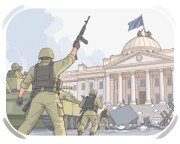
Ex: During the conflict , both sides employed sophisticated technology for espionage , including surveillance satellites and encrypted communication .
coup [noun]

an unexpected, illegal, and often violent attempt to change a government

Ex: International condemnation followed the military 's coup d'état , urging a return to democratic governance .

a person who participates in irregular fighting as a member of an unofficial military group

Ex: He joined the guerrilla group to fight for independence and social justice in his homeland .

a fierce and intense attack, often with the goal of overwhelming the opponent
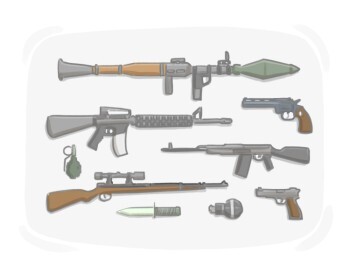
Ex: The military base prepared for an impending onslaught , fortifying defenses and mobilizing troops for the anticipated attack .
armament [noun]

the military equipment and weaponry used by a country or military force

Ex: During the Cold War , both superpowers engaged in a race to build up their nuclear armament , leading to a tense arms race .

big heavy guns that are attached on top of moving wheels or tracks

Ex: The artillery battery moved into position to provide support for the advancing infantry .
arsenal [noun]

a building, complex, or site used for producing, keeping, or repairing arms and ammunition

Ex: The soldiers secured the main arsenal to prevent theft .

a military strategy or capability designed to dissuade an adversary from aggression

Ex: A well-equipped and trained army can be a deterrent to neighboring countries considering acts of aggression .

bullets, shells, or other projectiles used in firearms

Ex: The museum displayed antique firearms along with their ammunition .
catapult [noun]

a large weapon that was used in ancient times to throw stones or other objects with great force

Ex: Modern historians study the mechanics and design of ancient catapults to better understand siege warfare technologies of the past .
bazooka [noun]

a portable rocket launcher designed for use against tanks and armored vehicles

Ex:
to lance [verb]

to thrust or strike with a long-pointed weapon

Ex: The skilled jouster aimed to lance the target with precision while charging on horseback .
shrapnel [noun]

fragments from an explosion, causing damage to surroundings

Ex: The artillery shell exploded , releasing shrapnel that damaged nearby vehicles and structures .
musket [noun]

an early firearm with a long barrel, used by infantry from the 16th to 18th centuries
Ex: Soldiers in the English Civil War were equipped with muskets , marking a transition from traditional pikes .
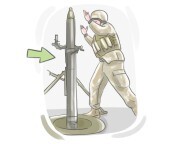
mortar [noun]

a short-barreled, muzzle-loaded artillery piece that fires explosive shells at high angles for close-range support

Ex:
affray [noun]

a public fight involving a group of people, typically causing a disturbance or public disorder

Ex: The bar owner intervened to stop an affray that broke out between patrons over a dispute .
air raid [noun]

an attack by aircraft, typically involving the dropping of bombs, on a location or a series of locations

Ex: The blackout curtains were drawn to minimize visibility during the nightly air raids .
atrocity [noun]

an extremely brutal act, especially in war

Ex: The international community condemned the atrocity , calling for immediate action to bring the perpetrators to justice .

an area in hostile territory captured and secured as a foothold for further troops and supplies

Ex: The bridgehead served as a staging area for the next offensive .
evacuee [noun]

an individual who is forced to flee from a dangerous place or region

Ex: The school served as an evacuation center , providing food and shelter for evacuees displaced by the wildfire .
garrison [noun]

a military stronghold where soldiers are stationed for defense
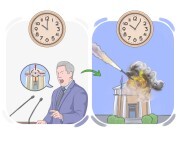
Ex: Artillery was installed at the garrison to defend the harbor .
to blitz [verb]

to carry out a sudden and intense military attack

Ex:

to plunder, typically during times of war or civil unrest
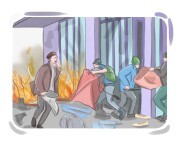
Ex: The conquering army pillaged the conquered city , seizing art , treasures , and other valuable assets .

to steal goods from a place or person, especially during times of war, chaos, or civil disorder

Ex: The pirates planned to plunder the merchant ship and seize its valuable cargo .

to attack ground targets, such as enemy troops or installations, with gunfire from low-flying aircraft

Ex: The bomber planes were equipped with machine guns to strafe enemy airfields and disable aircraft on the ground .

to maneuver around the side of an enemy force, position, or defensive line in order to gain a tactical advantage
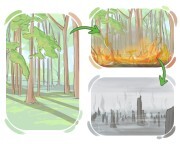
Ex: The guerrilla fighters utilized their knowledge of the terrain to outflank the larger enemy force , catching them by surprise .

to destroy someone or something completely
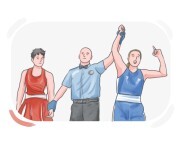
Ex: The superhero 's laser beams could seemingly annihilate any obstacle in his path .

to defeat someone completely and decisively

Ex: The hero embarked on a quest to vanquish the evil sorcerer and restore peace to the kingdom .