Music - Musical Elements

Here you will learn some English words related to musical elements such as "scale", "tonality", and "vibrato".

review-disable

review

flashcard-disable

flashcard

spelling-disable

spelling

quiz-disable

quiz

start-learning
Music
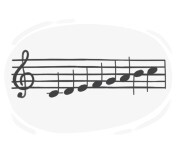
pitch [noun]

the degree of highness or lowness of a tone that is determined by the frequency of waves producing it
Ex:
scale [noun]

an arrangement of a series of musical notes with specified intervals, in ascending or descending pitch order

Ex: In this composition , the melody moves up and down the scale , creating a sense of tension and release .
mode [noun]

a specific arrangement of tones and semitones that create a distinctive scale pattern

Ex: The Phrygian mode imparts a distinctive Spanish flavor to flamenco music .
dynamics [noun]

the variation or contrast in volume or intensity of a musical performance

in music refers to how notes or sounds are played, including factors like attack, duration, and release, which shape the expressiveness of a performance

texture [noun]

in music refers to how different musical elements are combined to create the overall sound of a piece

a combination of notes or chords that sounds harsh or unstable

Ex: The sudden dissonance in the melody surprised the audience .

a musical quality where tones or chords blend smoothly, producing a sense of stability or pleasantness
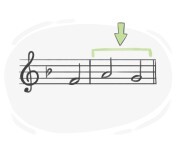
Ex: The duet achieved consonance in every phrase .
measure [noun]

any of the short sections consisting of musical beats located between two consecutive lines

Ex: The composer added an extra measure to create a dramatic pause .
interval [noun]

a dissimilarity in pitch between two notes

Ex: To identify intervals , the musician listened carefully to the pitches .
motif [noun]

a short musical idea or pattern that is repeated or developed within a composition

Ex: The composer developed the motif into a complex orchestral passage .

the use of dynamics, phrasing, tempo, articulation, and other interpretive elements by a performer to convey the emotional or artistic intent of a piece of music, adding depth, feeling, and individuality to the performance

step [noun]

the interval between two consecutive pitches in a scale

Ex:
harmony [noun]

notes of music played or sung in a combination that produces a pleasing effect
Ex: She practiced the piano piece with her sister , focusing on achieving perfect harmony between their parts .
melody [noun]

the arrangement or succession of single musical notes in a tune or piece of music
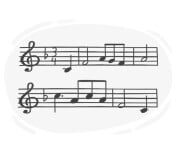
Ex: The composer crafted a haunting melody that evoked deep emotions in the audience .
notation [noun]

a system of written signs or symbols that are used in music or mathematics

rhythm [noun]

a strong repeated pattern of musical notes or sounds

Ex: The rhythm of the song made everyone want to dance .
timbre [noun]

the unique quality of a sound that distinguishes it from others, even when pitch and loudness are the same, often described as tone color

Ex: The singer 's timbre made the performance unforgettable .

a slow and constant decrease in the volume of a musical piece

beat [noun]

the fundamental unit of time that forms the basis of musical rhythm

Ex:
harmonic [noun]

a component of a musical sound that is produced alongside the fundamental pitch, contributing to the overall richness and timbre of the sound
Ex:
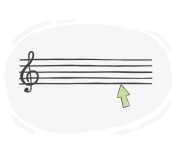
stave [noun]

a set of horizontal lines and spaces on which musical notes are written

Ex: The conductor emphasized the importance of reading the notes accurately on the stave during rehearsals .
pulse [noun]

the rhythmic or metrical regularity and sense of timing that is created by a repeating pattern of beats

downbeat [noun]

the first beat of a measure, typically emphasized in terms of accentuation and providing a sense of rhythmic stability

Ex: The downbeat of each measure serves as a reference point for musicians to coordinate their playing and maintain a steady tempo .
tone [noun]

a vocal or musical sound with a particular pitch, intensity, and quality

Ex: She spent hours practicing to perfect the tone of her voice , ensuring it was just right for the important audition .

a seven-note scale with a specific pattern of whole and half steps

Ex: In solfege , the diatonic scale is represented by the syllables do , re , mi , fa , sol , la , ti , do .
discord [noun]

an unusual combination of musical notes that sound strange when played

Ex: A moment of discord disrupted the otherwise harmonious melody .
unison [noun]

the simultaneous performance of the same pitch or note by multiple musicians or instruments

Ex: The brass section performed a fanfare in unison , commanding attention with their synchronized playing .
riff [noun]

a short, repeated musical pattern found in both jazz and popular music, serving as a prominent and recognizable element within a song or composition

Ex: The DJ sampled a famous hip-hop riff in their remix .
tonality [noun]

the organization of pitches and chords around a central pitch, creating a sense of harmonic stability and establishing a key center

Ex: The shift away from traditional tonality in the late 19th and early 20th centuries led to the development of atonal and modal music styles .
phrasing [noun]

the organization and shaping of musical phrases or sections to convey expression, emotion, and musical coherence

Ex: The conductor guided the orchestra in shaping the phrasing of the melody , emphasizing dynamics and articulation .
phrase [noun]

a musical unit or segment consisting of several notes played or sung together

Ex: In classical music , a phrase typically ends with a cadence , providing a sense of closure to the musical thought .
tremolo [noun]

a rapid repetition of a single musical note or alternation between two notes

Ex: The conductor signaled for the strings to play with tremolo , creating a sense of tension in the orchestral passage .
vibrato [noun]

a slight, rapid variation in pitch and intensity of a note

Ex: Jazz saxophonists often employ vibrato to infuse their solos with soulful expression .
form [noun]

the overall structure or organization of a musical composition

Ex: The symphony 's form typically includes multiple movements , each with its own distinct structure and thematic material .