pattern

Advanced Vocabulary for TOEFL - Literature and Writing

Here you will learn some English words about literature and writing, such as "lurid", "epic", "psalm", etc. that are needed for the TOEFL exam.

review-disable

Review

flashcard-disable

Flashcards

spelling-disable

Spelling

quiz-disable

Quiz

Start learning
Advanced Words Needed for TOEFL
abridged
[Adjective]

(a book, play, text, etc.) made shorter than the original by omitting some details

daily words
wordlist
Close
Sign in
allegorical
[Adjective]

(of a story, play, image, etc.) using characters or events in a symbolic sense that represent a concept, quality, etc.

daily words
wordlist
Close
Sign in
lurid
[Adjective]

shocking or sensational, especially in a gruesome or vulgar way

Ex: The lurid gossip surrounding the celebrity 's drug addiction and erratic behavior painted a troubling picture of the pressures of fame and fortune .
daily words
wordlist
Close
Sign in
turgid
[Adjective]

(of speech or writing) using a serious and elevated style that makes it tedious and complicated

Ex: The legal document was filled with turgid language that made it nearly impossible to understand .
daily words
wordlist
Close
Sign in
acrostic
[noun]

a poem or other piece of writing in which certain letters of each line, usually the initial letters, spell out a word or phrase

daily words
wordlist
Close
Sign in
burlesque
[noun]

an absurd or comically exaggerated replication of a literary or dramatic work

daily words
wordlist
Close
Sign in
doggerel
[noun]

humorous and poorly written poetry

Ex: The critics have been mocking his recent collection as nothing more than lazy doggerel.
daily words
wordlist
Close
Sign in
elegy
[noun]

a song or poem expressing sadness, especially in the memory of a dead person or a bitter event in the past

Ex: Through the elegy, the poet found catharsis in expressing their grief and honoring the memory of the departed .
daily words
wordlist
Close
Sign in
epic
[noun]

a long poem in narrative form giving an account of the extraordinary deeds and adventures of a nation's heroes or legends

Ex: The poet's latest work is an epic celebrating the founding of a legendary kingdom.
daily words
wordlist
Close
Sign in
haiku
[noun]

a Japanese poem with three unrhymed lines that have five, seven and five syllables each

Ex: She recited a haiku about the fleeting cherry blossoms .
daily words
wordlist
Close
Sign in
lament
[noun]

a song, musical piece, poem, etc. that expresses the feeling of sorrow and sadness after a loss or death

Ex: The novel included a lament from the protagonist that highlighted their deep sense of loss .
daily words
wordlist
Close
Sign in
lampoon
[noun]

a drawing, speech, or text aiming to criticize something or someone in a humorous manner

Ex: The lampoon in the satire magazine cleverly critiqued the government 's handling of the crisis .
daily words
wordlist
Close
Sign in
ode
[noun]

a lyric poem, written in varied or irregular metrical form, for a particular object, person, or concept

Ex: The ode was filled with elaborate metaphors and vivid imagery .
daily words
wordlist
Close
Sign in
parody
[noun]

a piece of writing, music, etc. that imitates the style of someone else in a humorous way

Ex: The theater troupe performed a parody of a well-known Shakespeare play , adding comedic twists and contemporary references to the dialogue .
daily words
wordlist
Close
Sign in
psalm
[noun]

any holy poem, song, or hymn, especially the ones in the Book of Psalms, used in Christian and Jewish worship

daily words
wordlist
Close
Sign in
sonnet
[noun]

a verse of Italian origin that has 14 lines, usually in an iambic pentameter and a prescribed rhyme scheme

Ex: She wrote a sonnet for her literature class , following the traditional 14-line structure .
daily words
wordlist
Close
Sign in
bard
[noun]

a person who writes pieces of poetry and stories
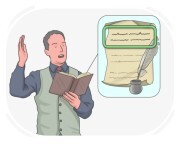
Ex: At the festival , the bard captivated the audience with a lively performance of traditional songs .
daily words
wordlist
Close
Sign in
stanza
[noun]

a series of lines in a poem, usually with recurring rhyme scheme and meter

Ex: The stanza's rhyme scheme was ABAB , giving the poem a rhythmic flow .
daily words
wordlist
Close
Sign in
canto
[noun]

any of the sections into which a long poem is divided

Ex: The epic was originally composed in a series of cantos, each offering a unique perspective on the journey .
daily words
wordlist
Close
Sign in
conceit
[noun]

an elaborate or far-fetched poetic image or comparison between very dissimilar things, used in literature

Ex: The conceit of merging war and love imagery made the sonnet memorable .
daily words
wordlist
Close
Sign in

the continuation of a line of poetry into another couplet or stanza without a break

daily words
wordlist
Close
Sign in
rhetoric
[noun]

bombastic or meaningless language

Ex: The teacher warned against relying on rhetoric instead of evidence .
daily words
wordlist
Close
Sign in
prosody
[noun]

the systematic study of metrical structures and sounds in poetry

daily words
wordlist
Close
Sign in
addendum
[noun]

a section of additional material that is usually added at the end of a book

Ex: The manuscript ’s addendum contained supplementary information not covered in the main chapters .
daily words
wordlist
Close
Sign in

villainous character who strongly opposes another person or thing

Ex: Throughout the story , the protagonist 's struggle against the antagonist served as a metaphor for larger themes of good versus evil and the resilience of the human spirit .
daily words
wordlist
Close
Sign in
appendix
[noun]

a separate part at the end of a book that gives further information

Ex: Readers could find detailed technical specifications in the appendix, including experimental procedures and calculations .
daily words
wordlist
Close
Sign in
blurb
[noun]

a short promotional description of a book, motion picture, etc. published on the cover of a book or in an advertisement

Ex: When browsing books online , readers often rely on blurbs to help them decide whether a particular title is worth exploring further .
daily words
wordlist
Close
Sign in

marks and notes written in the margins of a book or document

daily words
wordlist
Close
Sign in
glossary
[noun]

a list of technical terms or jargons of a particular field or text, provided in alphabetical order with an explanation for each one

Ex: The glossary not only defines terms but also provides examples of how to use them in sentences .
daily words
wordlist
Close
Sign in
erratum
[noun]

an error in a written or printed document

daily words
wordlist
Close
Sign in
canon
[noun]

generally accepted rules or principles, especially those that are considered as fundamental in a field of art or philosophy

Ex: In philosophy , the writings of Plato and Aristotle are foundational to the canon of Western thought , influencing generations of thinkers and scholars .
daily words
wordlist
Close
Sign in
motif
[noun]

a subject, idea, or phrase that is repeatedly used in a literary work

Ex: The motif of " nature versus civilization " serves as a central theme in the story , highlighting the tension between humanity 's primal instincts and societal norms .
daily words
wordlist
Close
Sign in
codex
[noun]

an ancient book, written by hand, especially of scriptures, classics, etc.

Ex: The monastery 's library houses a remarkable collection of codices, each one meticulously copied and illustrated by hand by dedicated scribes .
daily words
wordlist
Close
Sign in

the greatest literary or artistic piece that an author or artist has created

Ex: The novelist 's magnum opus, a sweeping epic that spans generations , has been celebrated for its intricate plot and richly developed characters .
daily words
wordlist
Close
Sign in
novella
[noun]

a work of fiction with an intermediate length, which could be considered a short novel

Ex: The novella was praised for its concise storytelling and rich character development .
daily words
wordlist
Close
Sign in
plot hole
[noun]

an apparent mistake or inconsistency in the narrative of a book, motion picture, etc.

daily words
wordlist
Close
Sign in
prolixity
[noun]

the fact of having an excessive number of words that results in being tedious

Ex: The editor advised the writer to avoid prolixity by cutting unnecessary words and focusing on concise , impactful statements to maintain the readers ' interest .
daily words
wordlist
Close
Sign in

to use satire in order to criticize or ridicule a system, person, etc.

daily words
wordlist
Close
Sign in
epilogue
[noun]

a brief section added at the end of a literary work, providing closure, commentary, or resolution

Ex: The epilogue offered insight into the protagonist 's later life .
daily words
wordlist
Close
Sign in
Advanced Vocabulary for TOEFL
LanGeek
Download LanGeek app