pattern

Cambridge English: CAE (C1 Advanced) - Physics & States of Matter

Review

Flashcards

Spelling

Quiz

Start learning
Cambridge English: CAE (C1 Advanced)
atomic
atomic
[Adjective]

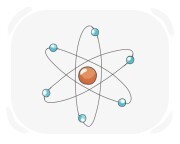
related to atoms, the smallest units of matter, including their structure, properties, and interactions
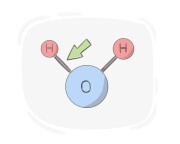
Ex: The atomic structure of an element includes its nucleus, composed of protons and neutrons, surrounded by electrons. 
Close
Sign in
bond
bond
[noun]

a link that holds atoms or ions together in any molecule or crystal
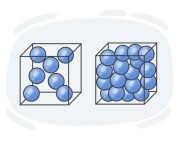
Ex: The covalent bond between the hydrogen and oxygen atoms forms a water molecule. 
Close
Sign in
charge
charge
[noun]

the physical property in matter that causes it to experience a force in an electromagnetic field
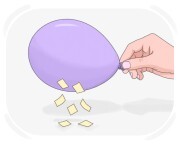
Ex: Electric charge is a fundamental property of matter that can be positive or negative. 
Close
Sign in
density
density
[noun]

(physics) the degree to which a substance is compacted, measured by dividing its mass by its volume

Ex: The density of water is approximately 1 gram per cubic centimeter (g/cm³). 
Close
Sign in
gravity
gravity
[noun]

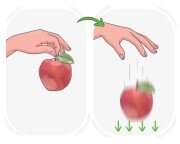
(physics) the universal force of attraction between any pair of objects with mass

Ex: Gravity is what keeps the planets in orbit around the Sun and the Moon in orbit around the Earth. 
Close
Sign in
property
property
[noun]

a feature or quality of something

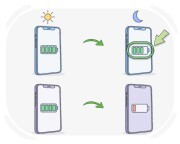
Ex: The most desirable property of the new smartphone is its long-lasting battery life. 
Close
Sign in
acid
acid
[noun]

a water-soluble chemical substance that contains Hydrogen and has a sour taste or corrosive feature with a PH less than 7
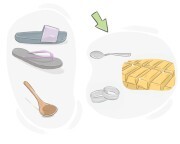
Ex: The lemon juice contains citric acid, which gives it a sour taste and a pH of around 2. 
Close
Sign in
conductor
conductor
[noun]

a substance that permits electricity to pass through or along it

Ex: Copper is widely used as a conductor in electrical wiring because of its excellent conductivity. 
Close
Sign in
crystal
crystal
[noun]

a solid substance formed when a chemical compound solidifies, with atoms arranged in a highly regular, repeating pattern

Ex: Salt forms a cubic crystal when it solidifies. 
Close
Sign in
composition

the different elements that form something or the arrangement of these elements

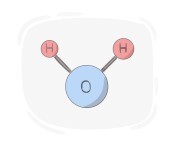
Ex: The composition of water molecules consists of two hydrogen atoms and one oxygen atom, chemically bonded together. 
Close
Sign in
ray
ray
[noun]

a column of light, such as that emitted from a beacon or focused source

Ex: A ray of sunlight streamed through the window. 
Close
Sign in
magnet
magnet
[noun]

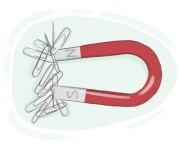
an object that produces an invisible field capable of attracting certain metals without physical contact

Ex: At school we played with magnets and saw how they push and pull metal pieces on a sheet. 
Close
Sign in
thermal
thermal
[Adjective]

related to heat or temperature, including how heat moves, how materials expand with temperature changes, and the energy stored in heat

Ex: As the temperature increased, the metal expanded due to thermal expansion. 
Close
Sign in
vacuum
vacuum
[noun]

a space that is utterly empty of all matter

Ex: In physics, a vacuum is defined as a space devoid of any matter particles, including atoms and molecules. 
Close
Sign in
gassy
gassy
[Adjective]

having the form or characteristics of gas

Ex: The volcano released a gassy cloud that drifted across the valley. 
Close
Sign in
molecule
molecule
[noun]

the smallest structure of a substance consisting of a group of atoms

Ex: Molecules are made up of two or more atoms bonded together. 
Close
Sign in
radiation
radiation
[noun]

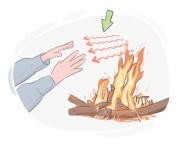
energy transmitted through space or matter in the form of waves or particles

Ex: The sun emits radiation that warms the Earth. 
Close
Sign in
LanGeek
Download LanGeek app