Advanced Vocabulary for TOEFL - Crime and Punishment

Here you will learn some English words about crime and punishment, such as "bribe", "abuse", "slander", etc. that are needed for the TOEFL exam.

review-disable

review

flashcard-disable

flashcard

spelling-disable

spelling

quiz-disable

quiz

start-learning
Advanced Vocabulary for TOEFL

to violently attack someone

Ex: The bouncer intervened to stop the aggressive patron from assaulting another customer .
to bribe [verb]

to persuade someone to do something, often illegal, by giving them an amount of money or something of value

Ex: The contractor was accused of trying to bribe inspectors to overlook building code violations .

to intentionally damage something, particularly public property

Ex:

to make some alterations in order to make something that has been obtained illegally, especially money and currency appear legal or acceptable
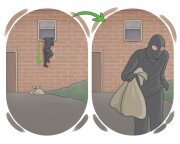
Ex: She launders the money through multiple bank accounts .

to take something for one's own use, especially illegally or without the owner's permission

Ex: The author discovered that someone had appropriated their work and published it under a different name .

goods or items whose importation, exportation, or possession is prohibited by law
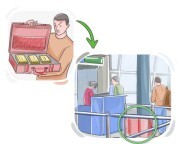
Ex: The police found contraband hidden in the suspect ’s vehicle .

to move goods or people illegally and secretly into or out of a country

Ex: Authorities discovered a tunnel used to smuggle goods between two countries .
to abuse [verb]

to cruelly or violently treat a person or an animal, especially regularly or repeatedly

Ex: Animal rights activists work tirelessly to expose and stop individuals who abuse animals for entertainment purposes .

to gain money, property, or some advantage by threatening someone

Ex: She was blackmailed with private photographs .

to illegally take someone away, especially by force or deception

Ex: The organization was notorious for attempting to abduct scientists to gain access to classified information .

to use deceit in order to deprive someone of their money or other possessions

Ex: The online scammer swindled victims by posing as a legitimate seller and never delivering the purchased goods .

‌to cooperate secretly or illegally for deceiving other people

Ex: The defendants were accused of colluding with foreign agents to influence the outcome of the election .

to make secret plans with other people to commit an illegal or destructive act

Ex: The court found evidence that the suspects had conspired to commit white-collar crimes .

to make false and adverse statements about someone for defamation

the act of stealing funds that are placed in one's trust and belong to one's employer

Ex: The nonprofit organization implemented stricter financial controls to prevent future incidents of embezzlement .

to enter someone's land or building without permission

Ex:

the act of violently stealing a car while someone is inside it

Ex: The police are investigating a carjacking that happened in the downtown area .

a minor crime or misdeed, especially of a young person

Ex:
felon [noun]

someone who has committed or has been legally found guilty of a serious crime

Ex: Amanda 's conviction for arson resulted in her being labeled a felon and serving a lengthy prison sentence .

someone who helps another to commit a crime or do a wrongdoing

Ex: The investigators uncovered evidence linking him to the crime , establishing his role as an accomplice .

an action that is considered wrong or unacceptable yet not very serious

Ex: His misdemeanor conviction for shoplifting led to a few months of community service and probation .
felony [noun]

a serious crime such as arson, murder, rape, etc.

Ex: The suspect was arrested and charged with a felony after being found in possession of illegal firearms .
homicide [noun]

the act of one person killing another, whether lawfully or unlawfully

Ex: Not all homicides are criminal ; some occur in self-defense .
genocide [noun]

a mass murder committed in order to destroy a particular nation, religious or ethnic group, or race

Ex: The Holocaust is one of the most well-known instances of genocide in history , targeting Jews and other marginalized groups .
heist [noun]

‌an act of violently stealing something valuable, especially from a shop or bank

larceny [noun]

the act of stealing something from someone, especially without breaking into a building

perjury [noun]

the offense of telling lies in a court of law after you have vowed to tell the truth

someone who commits a series of murders in a similar pattern

the action of keeping someone in a closed space, prison, etc., usually by force

the act of suggesting that someone is guilty, particularly of a crime
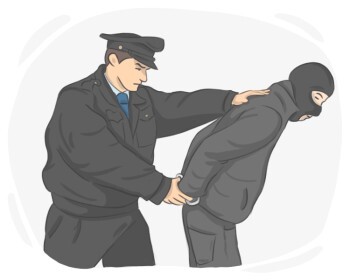
to arrest someone

Ex: The decision to apprehend the suspect was made after careful surveillance and analysis .

to send someone accused of a crime to the place where the crime happened or where they are wanted for legal matters
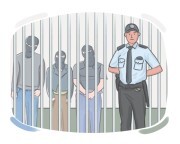
Ex: The suspect evaded arrest for years but was finally extradited to the country where the crime occurred .

to officially hold someone in a place, such as a jail, and not let them go

Ex: During the investigation , law enforcement has the power to detain individuals suspected of a crime .

the act of putting or keeping someone in captivity
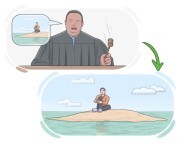
Ex: Many activists are pushing for alternatives to incarceration for non-violent offenders .
to exile [verb]

to force someone to live away from their native country, usually due to political reasons or as a punishment

Ex: The dictator decided to exile his political opponents to maintain control .
disciplinary [adjective]

relating to the enforcement of rules or the correction of behavior

Ex: Disciplinary proceedings were initiated following allegations of professional misconduct .

to officially take away something from someone, usually as punishment
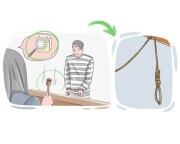
Ex: If students violate school rules , teachers may confiscate unauthorized items .

to kill someone, especially as a legal penalty
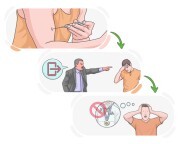
Ex: The controversial practice of executing prisoners by firing squad has been abolished in many places due to ethical concerns .

to no longer be able to access a right, property, privilege, etc. as a result of violating a law or a punishment for doing something wrong

Ex: Companies involved in environmental violations may forfeit their licenses to operate .