
pattern

Verbs of Movement - Verbs for Navigation

Here you will learn some English verbs referring to navigation such as "stray", "head off", and "reroute".

Review

Flashcards

Forms

Spelling

Quiz
Start learning
Categorized English Verbs of Movement
to map
to map
[Verb]

to create or make a map to visually depict geographical features

Ex: As part of the archaeological project , researchers worked to map the ancient ruins .
Close
Sign in
to chart
to chart
[Verb]

to create a visual representation that illustrates the features and details of a specific region

Ex: Environmental scientists charted the ecological zones of the national park .
Close
Sign in
to plot
to plot
[Verb]

to mark or indicate a route, position, or specific points on a map

Ex: The cartographer plotted the river 's meandering path on the geographical chart .
Close
Sign in
to navigate

to choose the direction of and guide a vehicle, ship, etc., especially by using a map

Ex: The navigator instructed the driver on how to navigate through diverse landscapes and terrains .
Close
Sign in
to orient
to orient
[Verb]

to determine or adjust the direction of an object or oneself in relation to specific directions or reference points
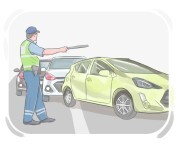
Ex: The satellite dish was carefully oriented to ensure a strong and stable signal reception .
Close
Sign in
to reroute

to change the originally planned path or direction of something, especially in transportation
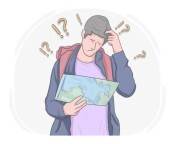
Ex: The event organizers decided to reroute the marathon course to showcase more scenic areas of the city .
Close
Sign in
to disorient

to cause someone to lose their sense of direction, leading to confusion or a feeling of being lost

Ex: The intense flashing lights at the concert temporarily disoriented some audience members .
Close
Sign in
to divert
to divert
[Verb]

to change direction or take a different course
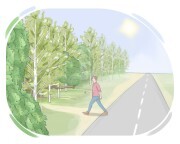
Ex: In response to unexpected obstacles on the hiking trail , the group decided to divert and explore a nearby clearing .
Close
Sign in
to stray
to stray
[Verb]

to wander off or deviate from the intended or established path
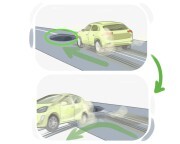
Ex: The lost driver realized he had strayed from the highway and ended up on a rural road .
Close
Sign in
to deviate

to cause something to depart from an established course
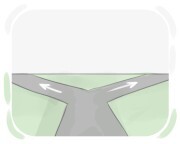
Ex: The captain deviated the ship 's course to avoid a potential collision with an iceberg .
Close
Sign in
to diverge

to move apart and continue in another direction

Ex: In the city 's central square , several streets diverged, leading to various neighborhoods .
Close
Sign in
to deflect

to change direction or turn aside, typically as a result of encountering an obstacle or external force

Ex: The ping pong ball , rolling towards the edge of the table , began to deflect.
Close
Sign in
to head off

to block someone or something's path in order to redirect them or prevent them from proceeding in a particular direction
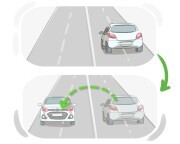
Ex: The police officer had to head off the suspect to prevent them from escaping .
Close
Sign in
to veer
to veer
[Verb]

to abruptly turn to a different direction

Ex: Realizing another skier was on a collision course , she had to veer to the side to avoid an accident on the slopes .
Close
Sign in
to swerve
to swerve
[Verb]

to change direction suddenly, often to avoid something or someone in the way

Ex: The skier swerved expertly to avoid a collision with another skier .
Close
Sign in
to sheer
to sheer
[Verb]

to move with a sudden and rapid change in direction, turning away from the current path or trajectory

Ex: The point guard sheered past defenders with quick and unpredictable movements .
Close
Sign in
LanGeek
Download LanGeek app
