
Music - Parts of Musical Instruments
Here you will learn some English words related to the different parts of musical instruments such as "fret", "bridge", and "resonator".
Review
Flashcards
Spelling
Quiz

(plural) a mechanical tool that produces a current of air to blow into a fire or produce a sound in a musical instrument

a long and partially curved, thin rod made out of wood with horsehair strings stretched alongside it, used to play stringed instruments such as the cello and violin


a type of durable cord that is obtained from animal intestines used in making musical instruments

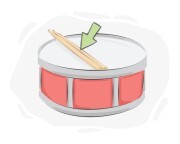
a stick with a round head that is used to strike drums to produce sound

a small metal bar on the neck of a string instrument pressed with fingers to produce a particular note

a light drumstick with a rounded head used to strike percussion instruments like chimes, kettledrums, marimbas, and glockenspiels


a mechanical part that is pressed or activated to produce sound in musical instruments


the opening of a wind instrument into which the player blows


the part on a stringed musical instrument that extends from its main body, upon which the fingerboard is found

a flat bar on a musical instrument such as a piano or an organ that is pushed by the feet to change or control the sound produced

a wooden, metal or plastic screw that is turned to regulate the strings of a musical instrument

any one of the long, hollow tubes in musical instruments, such as organs or wind instruments, that directs air to produce sound

a small flat piece of plastic, wood, etc. that is used in plucking the strings of a musical instrument such as a guitar, harpsichord, etc.
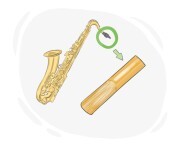
a thin, stiff strip of material that vibrates to produce a tone when air passes over it

the hollow part inside a musical instrument or a piece of equipment that resonates a single sound or wave length


the handle of a pipe organ that is pulled or pushed in order to let pressurized air through the pipes, controlling the sound produced
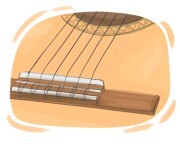
a cord of stretched wire, nylon, etc. on a musical instrument that is plucked to produce sound
a wooden, metal or plastic screw that is turned to regulate the strings of a musical instrument

a device for extending the length of the tube in a brass instrument that allows the performer to reach various notes
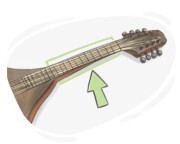
a narrow flat part on the neck of a string instrument where the fingers press the strings to play various notes

the part of a musical instrument that slides backward or forward to change the sound quality

the hollow part of a string instrument such as a guitar or violin that produces a resonance

the portion at the end of the neck of a stringed musical instrument that holds the tuning pegs or machine heads

a rotating spindle used to apply tension, often used in musical instruments and other mechanical devices
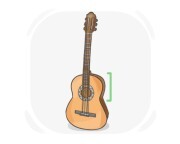
the curved upper section of the body of a stringed musical instrument, such as a violin, viola, or cello, that sits above the instrument's waist and is located between the neck and the upper part of the f-holes
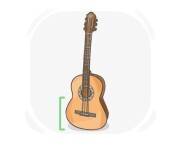
the lower curved section of the body of a musical instrument, typically a stringed instrument such as a guitar or violin

an opening in a stringed instrument's body that enhances its sound

a protective plate attached to a stringed instrument to prevent scratches or damage from picking or strumming

a component of a stringed instrument that supports the strings and helps transmit their vibrations to the instrument's body
the wooden surface on a stringed instrument that amplifies the vibrations of the strings to produce sound

the curved middle part of the instrument that forms an hourglass shape, enabling a comfortable grip and playability
the main structure of a stringed instrument that houses the sound-producing components and provides support

a transducer device used to capture the vibrations of a musical instrument's strings and convert them into an electrical signal

a component on a guitar that allows for the connection of a cable to an amplifier or other audio equipment for amplification or recording purposes

a control on an electric guitar or other electronic instrument that allows the player to adjust the tonal characteristics of the instrument's sound, typically by boosting or cutting certain frequencies

a variable resistor that can be used to control the amount of current flowing through a circuit by adjusting the resistance of the potentiometer

the small piece on a guitar's headstock that supports the strings and keeps proper spacing and height over the fretboard

a structural component inside the body of a string instrument, such as a violin or cello, that helps support the pressure exerted by the strings on the top (soundboard) of the instrument


a tailpiece is a component on stringed musical instruments, such as violins, cellos, and guitars, that anchors the strings at the bottom end of the instrument and provides a point of attachment for the strings to the instrument's body

the decorative, often curved, end of the peg box on certain string instruments, such as violins and cellos
the mechanical assembly inside a piano that translates the depression of keys into the striking of strings, controlling the hammer's movement and allowing for dynamics and expression in playing

the hinged covering that can be raised to access the keyboard of a piano or lowered to protect it when not in use

