Agreement and Disagreement - Opposition

Here you will learn some English words related to opposition such as "demur", "deadlock", and "criticize".

review-disable

review

flashcard-disable

flashcard

spelling-disable

spelling

quiz-disable

quiz

start-learning
Agreement and Disagreement

to make an attack in response to someone else's attack

Ex: The cybersecurity team detected the cyberattack and promptly counterattacked to neutralize the threat .

an attack made in response to someone else's attack

Ex: A swift counterattack turned the tide of the battle .

negative feedback that highlights mistakes or areas for improvement
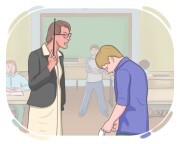
Ex: Her criticism felt personal , but it was focused on improving the work .

to point out the faults or weaknesses of someone or something

Ex: It 's easy to criticize the government 's policies , but coming up with viable alternatives is more challenging .

to argue or have a disagreement with someone

Ex: As the negotiations reached a critical point , the business partners began to cross swords over the terms of the partnership agreement .
deadlock [noun]

a situation in which the parties involved do not compromise and therefore are unable to reach an agreement

Ex: Due to a deadlock between the investors , the merger plans were put on hold indefinitely .
deadlocked [adjective]

(of disagreements, disputes, etc.) unable to be settled because the parties involved do not compromise

debate [noun]

a discussion about a particular issue between two opposing sides, mainly held publicly

Ex: A heated debate erupted in the council meeting over the proposed budget cuts .

to formally discuss a matter, usually in a structured setting

Ex: The students debated the merits of implementing a dress code policy at their school .
to demur [verb]

to express one's disagreement, refusal, or reluctance

Ex: Instead of openly agreeing , John demurred and suggested exploring alternative solutions .

to negotiate with someone, particularly about the price of something

Ex: The skilled negotiator knew how to dicker effectively , securing favorable terms in the business deal .

to hold or give a different opinion about something

Ex:

an argument or a situation in which people have different opinions about something

Ex: Despite their disagreement on political issues , they managed to maintain a respectful friendship .

to make it known that one is not connected with or does not support or agree with someone or something; to declare that something does not have any connection with something else

discord [noun]

lack of agreement between people

Ex: The business partnership suffered from discord as the co-founders had conflicting visions for the company 's future .
discordant [adjective]

having conflicting or opposing elements that create disagreement or tension

Ex: The board meeting was filled with discordant opinions about the new policy .

disagreement over important things that makes people become unfriendly toward one another

disputable [adjective]

not yet proven true or right

Ex: His claims about the event were disputable , with many experts disagreeing .

a formal discussion where people hold differing views and fail to reach an agreement

Ex: A heated disputation erupted during the conference regarding the ethical implications of the study .
dispute [noun]

a disagreement or argument, often involving conflicting opinions or interests
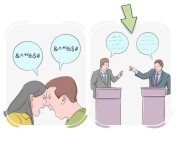
Ex: Their dispute over the budget allocation led to a heated discussion during the meeting .

to argue with someone, particularly over the ownership of something, facts, etc.

Ex: The neighbors began to dispute property boundaries , resulting in a heated argument .

lack of agreement between people

Ex: Their dissension started over a minor issue but grew into a major conflict .
dissent [noun]

a difference of opinion, especially from commonly accepted beliefs

Ex: Academic dissent is essential for intellectual progress .

to give or have opinions that differ from those officially or commonly accepted

Ex:

someone who disagrees with a common belief or an official decision

dissenting [adjective]

having or giving opinions that differ from those officially or commonly accepted

the action or process of disagreeing or disobeying established authority or doctrine

Ex: Their dissidence took the form of counter-cultural art and music that delivered anti-establishment messages .

someone who declares opposition to the government of one's country, knowing there is punishment for doing so

Ex:
dissident [adjective]

opposing official policy, especially that of an authoritarian government or dominant group

Ex: She published dissident essays criticizing the state 's surveillance practices .

to make it clear that one has no connection with or does not support or agree with someone or something; to state that something does not have any connection with something else

the action of separating or removing something from an association or connection

Ex: The dissociation of the two departments improved efficiency .

a state of disagreement between people's opinions, actions, or personalities, often resulting in tension

Ex: Their marriage was marked by constant dissonance in values and priorities .
dissonant [adjective]

having elements or ideas that strongly disagree or clash

Ex: The board meeting ended on a dissonant vibe due to disagreement over budget allocations .

to cause disagreement or separation between a group of people

disunity [noun]

the lack of harmony or agreement within a group, leading to division or conflict

(of views, opinions, etc.) to be different from each other

Ex: The survey results indicated that public opinions on the matter tended to diverge .

a difference in interests, views, opinions, etc.

Ex: The family 's religious divergence led to lively dinner table debates .

to cause disagreement among people

Ex: The decision to implement a dress code at the office divided the employees .

to not allow people become united and pose a threat to one by keeping them busy through causing disagreement and argument between them

Ex: The activist group advocates for unity instead of falling victim to the " divide and rule " tactics of those in power .
divided [adjective]

(of a society, organization, or group) separated by disagreement

division [noun]

disagreement among members of a group or society

Ex: Religious differences often lead to division within communities .
divisive [adjective]

causing disagreement or hostility by creating strong differences of opinion among people

Ex: The proposed policy changes proved to be divisive , leading to conflicts within the organization .
divisively [adverb]

in a way that causes a split between people

a split in people disagreeing or opposing one another