ACT Science - Astronomy and Aerospace Science

Here you will learn some English words related to astronomy and aerospace science, such as "rover", "probe", "flare", etc. that will help you ace your ACTs.

review-disable

review

flashcard-disable

flashcard

spelling-disable

spelling

quiz-disable

quiz

start-learning
ACT Science

a scientist who studies or observes planets, stars, and other happenings in the universe

Ex: She became an astronomer because of her fascination with the mysteries of the cosmos .

a scientist who studies the physical properties and phenomena of celestial objects and the universe as a whole
Ex: The astrophysicist specializes in cosmology , exploring the origins and evolution of the universe .

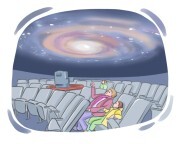
a building with a dome in which moving images of planets, starts, and constellations are projected for educational or entertainment purposes

Ex: The planetarium offers nightly sky shows that are both educational and entertaining .

a building where scientists observe stars, meteors, the weather, etc. using equipment such as telescope
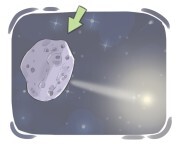
asteroid [noun]

any of the rocky bodies orbiting the sun, ranging greatly in diameter, also found in large numbers between Jupiter and Mars

Ex: The asteroid impact that led to the extinction of the dinosaurs occurred approximately 66 million years ago .

a piece of rock or metal from space that has hit the surface of the earth
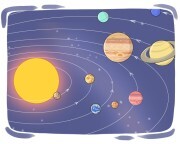
Ex: The impact crater was formed by a large meteorite that struck Earth millions of years ago .
to orbit [verb]

to move around a star, planet, or a large object in space

Ex: Jupiter has the largest number of moons of any planet in our solar system , with 79 known moons orbiting around it .

an exploding star that as a result is emitting a very large amount of light, more than the sun

Ex: Astronomers observed a distant galaxy where a supernova had recently occurred .

a specific group of stars that form a pattern and have a name related to their shape
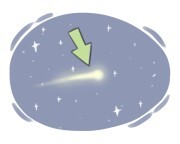
Ex: The Big Dipper is a prominent constellation consisting of seven bright stars .
comet [noun]

an object in space that is a mass of ice and dust and when it nears the sun it starts illuminating in the shape of a tail

Ex: The tail of a comet forms when solar radiation causes ice and dust to vaporize and stream away from the nucleus .

a small, dense, and faint stellar remnant that is left after a medium-sized star exhausts the nuclear fuel in its core and undergoes gravitational collapse

Ex: White dwarfs have extremely high densities , with mass comparable to that of the Sun but condensed into a smaller volume .

a planet that is outside the solar system

Ex: The Kepler Space Telescope has been instrumental in identifying distant exoplanets using the transit method .

a region in the solar system located between the orbits of Mars and Jupiter, populated by numerous small celestial bodies called asteroids

Ex: Space missions like NASA 's Dawn spacecraft have explored asteroids within the asteroid belt to gather data on their structure and composition .
ablation [noun]

the process by which the surface of an object, such as a comet or an asteroid, erodes or vaporizes due to the effects of solar radiation and other environmental factors

corona [noun]

the outer layer of the Sun's atmosphere, observable as a plasma halo during a solar eclipse

Ex: Solar missions , like NASA 's Parker Solar Probe , aim to explore the corona up close and gather valuable data .
flare [noun]

a sudden, brief burst of increased brightness observed from the sun's surface, usually accompanied by a burst of energy and radiation

Ex: A sudden flare caused intense geomagnetic storms on Earth .
planetary [adjective]

related to or characteristic of planets or the solar system

Ex: Planetary geology investigates the surfaces and interiors of planets and moons .
crater [noun]

the round top of a volcano

Ex: The impact crater in Arizona is a famous geological site attracting visitors worldwide .

a unit of mass used in astronomy, defined as the mass of the Sun

extraterrestrial [adjective]

relating to or originating from outside the Earth or its atmosphere

Ex: UFO sightings often spark speculation about extraterrestrial visitors .

the visible surface of a star, including the Sun, where energy is emitted as light and other forms of electromagnetic radiation

Ex: The temperature of the photosphere of a star like Sirius can reach over 10,000 degrees Celsius .

to overshadow another astrological body

Ex: The astronomical event saw Venus eclipse the sun , resulting in a stunning transit visible from Earth .
interstellar [adjective]

situated or occurring between stars or within the space that exists between stars

Ex:
Nebula [noun]

a glowing cloud of gas and dust in outer space, often the result of a star explosion or formation

Ex:
aurora [noun]

a natural light display in the Earth's polar regions, caused by the collision of charged particles from the sun with atoms in the Earth's atmosphere

Ex: Many myths and legends are inspired by the mystical and ethereal nature of the aurora lights .

a celestial body that orbits the Sun and has sufficient mass for its gravity to pull it into a nearly spherical shape

celestial [adjective]

related to or occurring in the sky or outer space

Ex: Ancient civilizations often built monuments aligned with celestial events , such as solstices and equinoxes .
probe [noun]

an unmanned spacecraft or device sent to gather information from space and transmit it back

Ex: The probe collected data on the planet 's atmosphere .

a vehicle designed to travel in space

Ex: The documentary showcased the development and launch of a new spacecraft designed for deep-space exploration .

to send an object, such as a satellite, missile, etc., into space

Ex: The submarine successfully launched a torpedo during the naval exercise .

a designated area at a spaceport or rocket launch site where rockets or spacecraft are positioned and prepared for liftoff

Ex: Spectators gathered at the launch pad to witness the historic launch of the Mars rover .
rover [noun]

a robotic vehicle designed to move across the surface of a celestial body to conduct scientific experiments and gather data

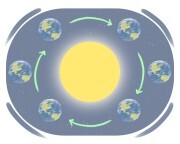
the orbital movement of a planet, moon, or satellite around another body

Ex: Mars 's revolution around the sun defines its seasonal cycle .

the science and practice of designing, building, and operating aircraft, including airplanes and spacecraft

Ex: Universities offer specialized programs in aeronautics for aspiring aerospace engineers .

a type of solar eclipse where the moon, passing between the earth and the sun, appears smaller than the sun, creating a ring of sunlight around the darkened moon

Ex: The path of an annular eclipse can be narrower than that of a total eclipse , and the duration of the ring phase varies depending on the relative distances between the Earth , Moon , and Sun .

a model of the celestial sphere, historically used to depict and study the positions of celestial objects, consisting of a series of hoops representing important circles in the sky

Ex: The armillary sphere in the museum 's collection accurately depicts the positions of stars and constellations .
tektite [noun]

a small, natural glassy object formed from terrestrial debris ejected during meteorite impacts, known for its smooth texture and found in strewn fields across the Earth's surface

Ex: Scientists study tektites to understand the dynamics of impact events and their effects on Earth 's surface .