pattern

ACT Math and Assessment - Geometry

Here you will learn some English words related to geometry, such as "tangent", "vertex", "ellipse", etc. that will help you ace your ACTs.

Review

Flashcards

Spelling

Quiz

Start learning
ACT Vocabulary for Math and Assessment
slope
slope
[noun]

the measure of how steep a line is, found by dividing the change in height by the change in horizontal distance

Ex: The slope of the line between points (1, 2) and (3, 6) is 2. 
Close
Sign in
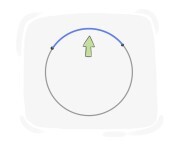
arc
arc
[noun]

(geometry) a part of a circle, which is curved

Ex: In a circle, a minor arc is shorter than a major arc. 
Close
Sign in
radian
radian
[noun]

a unit for measuring angles, defined by the angle made when the radius of a circle is laid along its edge
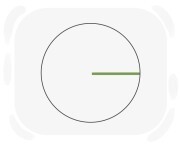
Ex: An angle of 1 radian means the arc length is the same as the radius of the circle. 
Close
Sign in
radius
radius
[noun]

the length of a straight line drawn from the center of a circle to any point on its outer boundary
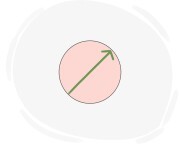
Ex: The radius of a circle is half the length of its diameter, extending from the center to any point on the circumference. 
Close
Sign in
diameter
diameter
[noun]

a straight line from one side of a round object, particularly a circle, passing through the center and joining the other side

Ex: The diameter of a circle is the longest distance between any two points on its circumference, passing through the center. 
Close
Sign in
perimeter
perimeter
[noun]

the total length of the external boundary of something
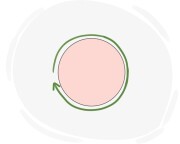
Ex: The geometry student calculated the perimeter of the rectangular garden to determine how much fencing would be needed. 
Close
Sign in
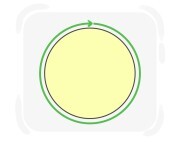
circumference

(geometry) the length of the external boundary of a curved shape, especially a circle
Ex: The formula for finding the circumference of a sphere involves multiplying the diameter by π (pi). 
Close
Sign in
area
area
[noun]

the measurement of a piece of land or a flat surface
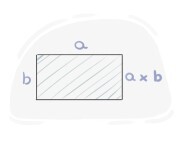
Ex: The area of a rectangle can be calculated by multiplying its length by its width. 
Close
Sign in
volume
volume
[noun]

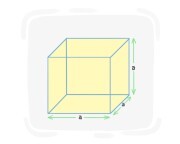
the amount of space that a substance or object takes or the amount of space inside an object
Ex: The volume of water in the glass was 250 milliliters. 
Close
Sign in
angle
angle
[noun]

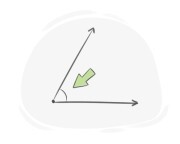
the space between two lines or surfaces that are joined, measured in degrees or radians
Ex: She used a protractor to measure the angle of the triangle accurately. 
Close
Sign in
right angle

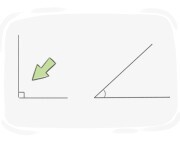
an angle measuring exactly 90 degrees

Ex: To construct a square, each corner must form a perfect right angle. 
Close
Sign in
vertical angle

one of a pair of opposite angles made by two intersecting lines, which are always equal

Ex: Vertical angles are always congruent to each other. 
Close
Sign in
interior angle

an angle formed between two sides of a polygon that lies inside the shape
Ex: Each interior angle of a regular pentagon measures 108 degrees. 
Close
Sign in
acute angle

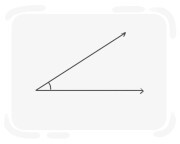
an angle that measures between 0 and 90 degrees, which is less than a right angle (90 degrees)

Close
Sign in
consecutive angle

pairs of angles that share a common side and vertex in a polygon or between intersecting lines

Ex: In a parallelogram, consecutive angles are supplementary, meaning their measures add up to 180 degrees. 
Close
Sign in
obtuse
obtuse
[Adjective]

(of angle) greater than 90 degrees but less than 180 degrees
Ex: The angle formed by the hands of the clock at 2:30 is obtuse, measuring approximately 120 degrees. 
Close
Sign in
protractor

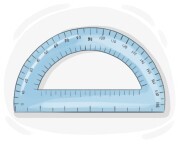
a measuring instrument used to measure and draw angles
Ex: The teacher used a protractor to show how to measure angles in the geometry lesson. 
Close
Sign in
perpendicular
perpendicular
[Adjective]

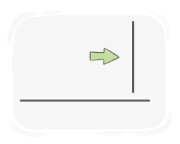
(of lines or planes) intersecting each other at a 90 degree angle
Ex: In technical drawings, architects ensure walls are precisely perpendicular to allow for square structures. 
Close
Sign in
polygon
polygon
[noun]

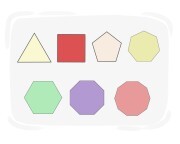
(geometry) a flat shape consisting of three or more straight sides
Ex: A triangle is the simplest type of polygon with three sides. 
Close
Sign in
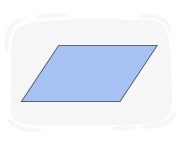
parallelogram

(geometry) any flat shape with four straight sides, the opposite sides of which are equal and parallel to each other

Close
Sign in
tetrahedral
tetrahedral
[Adjective]

characterized by or resembling a tetrahedron, which has four triangular faces
Ex: The chemist explained that a methane molecule has a tetrahedral geometry, with the carbon atom at the center. 
Close
Sign in
trapezoid
trapezoid
[noun]

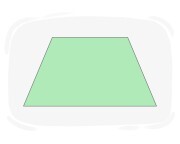
(geometry) a flat shape with four flat sides, two of which are parallel

Close
Sign in
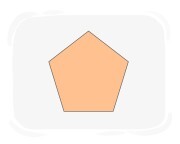
pentagon
pentagon
[noun]

a geometric shape with five angles and five straight sides
Ex: The flag of the city had a pentagon in the center, symbolizing the five founders. 
Close
Sign in
quadrilateral

(geometry) a flat figure with four straight sides and four angles

Close
Sign in
rhombus
rhombus
[noun]

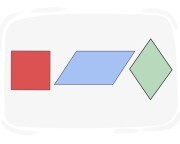
(geometry) a flat shape with four equal sides in which opposite angles are equal

Close
Sign in
epicycle
epicycle
[noun]

a small circle whose center moves around the circumference of a larger circle

Ex: The concept of an epicycle allows for the modeling of complex periodic movements in geometry and astronomy. 
Close
Sign in
hyperbola
hyperbola
[noun]

a geometric curve formed by the intersection of a plane with two cones, resulting in two symmetrical branches
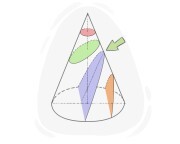
Ex: The hyperbola is a conic section formed by intersecting a plane with two cones on opposite sides of the plane. 
Close
Sign in
parabola
parabola
[noun]

(geometry) a symmetrical open curve that is similar to the path of an object thrown into the air passes till it falls back to earth
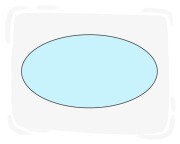
Ex: The path of a thrown ball forms a parabola. 
Close
Sign in
ellipse
ellipse
[noun]

(geometry) a closed plane curve that has two focal points

Close
Sign in
right triangle

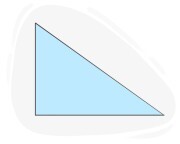
a flat geometric shape consisting of three straight sides and one right angle

Close
Sign in
acute triangle

a triangle in which all three interior angles are less than 90 degrees
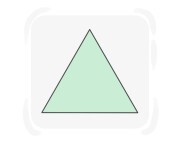
Ex: In an acute triangle, each angle measures less than 90 degrees. 
Close
Sign in
equilateral triangle

a type of triangle with all three sides of equal length
Ex: Each side of an equilateral triangle is the same length. 
Close
Sign in
scalene triangle

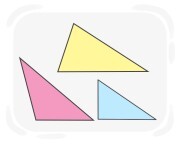
a type of triangle that has all three sides of different lengths

Ex: The sides of a scalene triangle are not equal in length. 
Close
Sign in
isosceles
isosceles
[Adjective]

describing a triangle with at least two sides of equal length

Ex: The triangle has two equal sides, making it an isosceles triangle. 
Close
Sign in
hypotenuse

the longest side of a right-angled triangle, opposite the right angle, and defined as the side opposite the right angle in a right-angled triangle

Ex: In a right-angled triangle with legs of length 3 and 4 units, the hypotenuse can be calculated using the Pythagorean theorem as √(3² + 4²) = 5. 
Close
Sign in
right circular cylinder

a three-dimensional geometric shape with two parallel circular bases connected by a curved surface at a right angle to the bases

Ex: To find the surface area of a right circular cylinder, you need to account for both the lateral surface area and the area of the two bases. 
Close
Sign in
rectangular pyramid

a three-dimensional geometric shape that has a rectangular base and four triangular faces that meet at a single point called the apex
Ex: In the art project, students created models of rectangular pyramids using cardboard for the base and sides. 
Close
Sign in
asymmetry
asymmetry
[noun]

(geometry) a lack of symmetry or equivalence in shape or size between the two sides or parts of something

Ex: In geometry, asymmetry means the two sides are not identical. 
Close
Sign in
vertex
vertex
[noun]

a point where two or more lines, edges, or rays meet to form an angle, or the point at which the sides of a polygon intersect
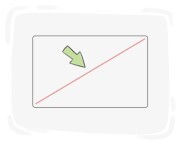
Ex: In a triangle, each of its three corners is a vertex where two sides meet. 
Close
Sign in
diagonal
diagonal
[noun]

a straight line connecting opposite corners of a flat shape at an angle

Ex: The rectangle's diagonal was longer than its sides. 
Close
Sign in
congruent
congruent
[Adjective]

(in geometry) describing shapes of the same size and form

Ex: If you fold the paper along the crease, the two halves are congruent. 
Close
Sign in
base
base
[noun]

the side of a geometric shape, usually the one considered as the bottom, from which the height is measured
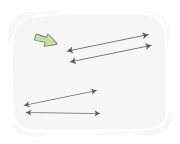
Ex: In a triangle, the base is the side used to calculate the height for finding the area. 
Close
Sign in
parallel
parallel
[noun]

a pair of geometric figures, such as lines or planes, that do not meet or intersect, no matter how far they are extended

Ex: The two parallels in the diagram never intersect. 
Close
Sign in
line of symmetry

a line that divides a shape into two congruent parts

Ex: A circle has an infinite number of lines of symmetry because it can be divided into two equal halves along any diameter. 
Close
Sign in
geometric series

a series of numbers in which each term after the first is found by multiplying the previous term by a fixed, non-zero number

Ex: The geometric series 2, 4, 8, 16, ... has a common ratio of 2. 
Close
Sign in
surface area

the total area that the surface of a three-dimensional object occupies

Ex: To find the surface area of a cube, you calculate the area of one face and multiply it by six. 
Close
Sign in
transversal
transversal
[Adjective]

(of a line) intersecting two or more other lines at different points

Ex: In geometry, a transversal line can create various angles with the lines it intersects. 
Close
Sign in
quadrant
quadrant
[noun]

one-fourth of a circle, formed by two perpendicular radii and the connecting arc

Ex: Each quadrant of a circle represents one-fourth of the circle's area. 
Close
Sign in
asymptote
asymptote
[noun]

a straight line that a curve approaches indefinitely but never intersects, characterizing the limiting behavior of the curve
Ex: The hyperbola has asymptotes that represent the lines the curve approaches but never crosses. 
Close
Sign in
to bisect
to bisect
[Verb]

to divide something into two equal parts
Ex: Using a ruler, she carefully bisected the line on the paper. 
Close
Sign in
tangent
tangent
[noun]

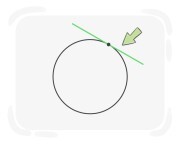
a straight line that touches a curve or surface at exactly one point, known as the point of tangency

Ex: In geometry class, we learned how to draw a tangent to a circle, ensuring it only touched the circle at a single point. 
Close
Sign in
chord
chord
[noun]

a straight line segment that connects two points on the edge of a circle

Ex: The longest chord in a circle is its diameter. 
Close
Sign in
to translate

(geometry) to move a shape or figure from one position to another without rotating, resizing, or otherwise altering its shape

Ex: To translate the triangle 5 units to the right and 3 units up, you add 5 to the x-coordinates and 3 to the y-coordinates of each vertex. 
Close
Sign in
LanGeek
Download LanGeek app