pattern

Land Transportation - Railroad Infrastructure

Here you will learn some English words related to passenger accommodations such as "rail", "track ballast", and "gauge."

Review

Flashcards

Forms

Spelling

Quiz

Start learning
Words Related to Land Transportation
rail
rail
[noun]

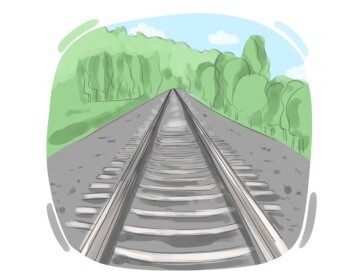
a steel track on which trains run

Ex: They laid new rail for the expanding line .
Close
Sign in
track
track
[noun]

a pair of metal bars that trains use to move

Ex: Whether for freight or passenger transport , tracks play a vital role in the functioning of railway systems worldwide .
Close
Sign in
railroad line

a set of tracks that trains travel on between destinations
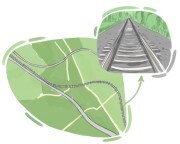
Ex: The new railroad line reduced travel time significantly .
Close
Sign in
main line
main line
[noun]

an important railroad line between two cities or large towns

Ex: Travelers often prefer the main line for its frequent train services and convenience .
Close
Sign in
branch line

a secondary railway line that splits from a main line

Ex: The branch line was less busy than the main line .
Close
Sign in
siding
siding
[noun]

a short track connected to a main track, used for loading, unloading, or storing trains

Ex: Maintenance equipment was kept on the siding.
Close
Sign in
spur
spur
[noun]

a short railway track branching off from a main line, typically leading to a specific facility

Ex: The train switched to the spur to drop off cargo .
Close
Sign in
track ballast

the layer of crushed stones or gravel placed under and around railway tracks to keep them in place and provide drainage
Ex: The maintenance team regularly checks the track ballast to ensure it is in good condition .
Close
Sign in
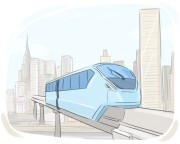
monorail
monorail
[noun]

a railway system that has only one rail instead of two, usually in an elevated position

Ex: Engineers praised the monorail for its minimal footprint and environmentally friendly design compared to traditional rail systems .
Close
Sign in
switch
switch
[noun]

a mechanical installation enabling trains to be guided from one track to another

Ex: The switch was manually operated by the railway staff .
Close
Sign in
funicular
funicular
[noun]

a type of railway powered by cables that goes up and down a slope

Ex: Riding the funicular was a highlight of their trip , as they marveled at the engineering feat that allowed for such a comfortable ascent .
Close
Sign in
third rail

an additional rail providing electric power to trains, often used in subway systems

Ex: She was warned to stay clear of the electrified third rail.
Close
Sign in
overhead line

a wire or cable that is used to carry electricity or signals and is supported above the ground by poles or towers
Ex: Engineers inspected the overhead lines to ensure they were safe and in good condition .
Close
Sign in
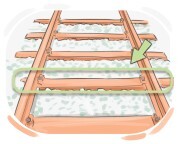
tie
tie
[noun]

a crosspiece used to hold the rails in place and keep them evenly spaced

Ex: Concrete ties were used for increased durability .
Close
Sign in
railhead
railhead
[noun]

the farthest point reached by a railway line or the starting point for transport of goods

Ex: The railhead was bustling with activity .
Close
Sign in
track bed
track bed
[noun]

the layer of stones or other material on which the railway tracks are laid

Ex: Engineers studied the track bed to improve its durability and performance .
Close
Sign in
tie plate
tie plate
[noun]

a flat piece of metal used to join and support the ends of rails in a railroad track

Ex: During maintenance , engineers inspect each tie plate to ensure it is secure and undamaged .
Close
Sign in
gauge
gauge
[noun]

the distance between the inner sides of the two parallel rails of a track

Ex: The project involved converting the railway to a broader gauge.
Close
Sign in
narrow gauge

a smaller distance between railroad tracks, less than the standard size, often used in mountains or small space

Ex: The narrow gauge was perfect for the terrain .
Close
Sign in
standard gauge

the most common distance between railroad tracks, which is 1,435 mm apart
Ex: Standard gauge allowed for interoperability with other railways .
Close
Sign in
train station

a place where trains regularly stop for passengers to get on and off

Ex: The train station was located in the city center , making it convenient for travelers .
Close
Sign in
railroad station

a place where trains stop to pick up or drop off passengers and cargo
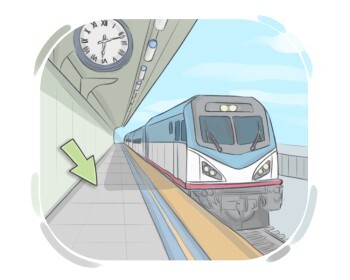
Ex: The railroad station was a hub of activity .
Close
Sign in
platform
platform
[noun]

the raised surface in a station next to a railroad track where people can get on and off a train

Ex: The train pulled into the platform, and the passengers began to board .
Close
Sign in
concourse
concourse
[noun]

a large open space or hallway within a building, often used for gatherings or as a central area in transportation hubs like airports or train stations

Ex: As the concert ended , fans streamed out of the arena into the concourse, their faces still glowing with the energy of the performance .
Close
Sign in
signal box

a building or structure from which railway signals and switches are controlled

Ex: They upgraded the equipment in the signal box.
Close
Sign in
infill station

a new train or bus station built on an existing line to serve an area that previously did not have a nearby station

Ex: The infill station was part of a larger project to modernize the entire transit system .
Close
Sign in
railroad terminal

a major station where multiple train routes converge and services are provided

Ex: He checked the schedule at the railroad terminal.
Close
Sign in
island platform

a raised structure in a train station where passengers can board and alight from trains, surrounded by tracks on both sides

Ex: The island platform was accessible via an overhead bridge that connected it to the main station building .
Close
Sign in
adhesion railway

a type of railroad where trains rely on friction between the wheels and the track for propulsion rather than using a cog or rack system

Ex: Engineers design adhesion railways to handle various weather conditions and track gradients efficiently .
Close
Sign in
cog railway

a railway with a toothed rail, allowing trains to operate on steep gradients

Ex: The cog railway used a special gear system .
Close
Sign in
railway yard

a complex of tracks where trains are stored, maintained, and built

Ex: They organized the freight cars in the railway yard.
Close
Sign in
classification yard

a specialized railway facility where freight trains are sorted into different tracks according to their destinations or routes

Ex: The smooth operation of a classification yard depends on precise coordination and communication among railway personnel .
Close
Sign in
balloon loop

a circular railway track that allows trains to change direction without needing to turn around

Ex: The historic railway museum features a fully restored balloon loop used during the steam era .
Close
Sign in
wye
wye
[noun]

a track arrangement where three rails converge to allow trains to change direction

Ex: Train conductors use the wye to position their locomotives for onward journeys along various routes .
Close
Sign in
rail profile

the cross-sectional shape or contour of a railway track's metal rail

Ex: Advanced technologies now allow for precise measurements of rail profiles to optimize performance and safety .
Close
Sign in
wayobject
wayobject
[noun]

a term used to describe any equipment, device, or structure used on or alongside railway tracks to facilitate safe and efficient operations

Ex: Maintenance crews use specialized wayobjects such as track trolleys and inspection vehicles to keep the railway infrastructure in good condition .
Close
Sign in
traction current pylon

a tall structure supporting electrical wires used to power trains

Ex: The design of modern traction current pylons focuses on durability and efficiency to sustain heavy electrical loads .
Close
Sign in
midway
midway
[noun]

a wide main pathway in facilities like railroad yards or factories, flanked by work buildings or storage areas

Ex: Storage warehouses bordered both sides of the midway in the rail yard .
Close
Sign in
LanGeek
Download LanGeek app