C1 Level Wordlist - History and Artifacts

Here you will learn some English words about history and artifacts, such as "carriage", "dungeon", "abolition", etc. prepared for C1 learners.

review-disable

review

flashcard-disable

flashcard

spelling-disable

spelling

quiz-disable

quiz

start-learning
C1 Level Wordlist
archive [noun]

a place or a collection of records or documents of historical importance

Ex: The museum curator carefully preserved the old photographs in the museum 's archive .

the study of books' history, their classification, production, editions, etc.

Ex:

the act of formally and completely ending a system, practice, institution, or law

Ex: The civil rights movement in the United States aimed at the abolition of segregation laws that enforced racial discrimination .

an area where a battle is being or was fought
Ex: Despite the dangers , journalists bravely reported from the front lines of the battlefield .
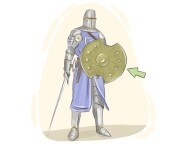
shield [noun]

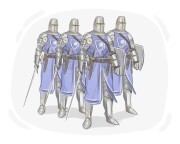
a large piece of armor made of strong material, carried on the arm by soldiers in the past

Ex: The Roman soldiers marched in formation , shields held high to protect against arrows .
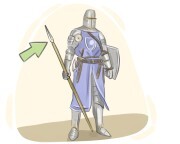
spear [noun]

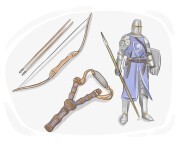
a weapon with a long handle and a metal pointed tip, used for fighting and fishing in the past

Ex: He crafted a spear from a sturdy tree branch and a sharpened stone for the tip .
tomahawk [noun]

a small-sized ax used by Native Americans for fighting or as a tool
Ex: He used a tomahawk to chop firewood while camping in the wilderness .
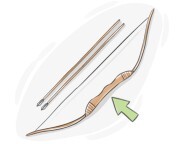
bow [noun]

a curved weapon joined at both ends by a string, capable of shooting arrows

Ex: He practiced for hours , perfecting his technique with the new compound bow he had purchased .
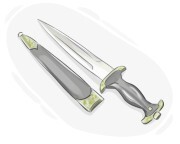
dagger [noun]

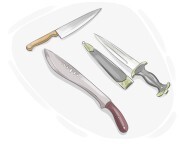
a short weapon with a pointed blade

Ex: The historical artifact museum displayed a collection of ornate daggers from different cultures .
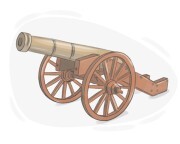
cannon [noun]

a large and powerful gun that was used in the past to fire stone or metal balls
Ex: The museum exhibit showcased a collection of historical cannons used in naval warfare .
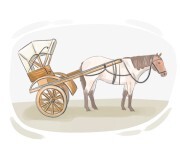
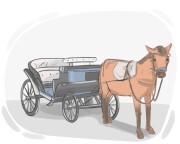
carriage [noun]

a vehicle with usually four wheels, pulled by one or more horses

Ex: The carriage driver skillfully navigated through the crowded marketplace .
chariot [noun]

a vehicle with two wheels, drawn by horses, used in ancient times for warfare and racing

Ex: The chariot driver skillfully maneuvered the horses around obstacles on the race track .
dungeon [noun]

an underground room in which prisoners were confined, particularly in a castle

Ex: The dungeon held a mysterious atmosphere , with echoes of past occupants ' despair .
fort [noun]

a building or group of buildings used by troops to protect an area

Ex: Archaeologists uncovered the ruins of an ancient fort dating back to Roman times .

someone who forcibly takes control of a city or country and its citizens

Ex: After defeating the enemy forces , the conqueror established his rule over the newly acquired lands .

a person or thing that is next in line to someone or something else

Ex: After the professor 's retirement , her most promising student became her successor in the department .
reign [noun]

the length of time during which a king, queen, or other monarch rules

Ex: During his reign , the empire expanded significantly .
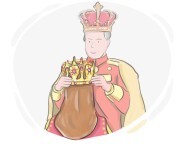
to crown [verb]

to place a crown on someone's head in a ceremony so that person officially becomes a king or queen

Ex: The majestic ceremony took place in the grand hall , where the queen was gracefully crowned by the royal dignitary .
peasant [noun]

a farmer who owns or rents a small piece of land, particularly in the past or in poorer countries
Ex: The peasant 's small plot of land was just enough to sustain his household through the seasons .
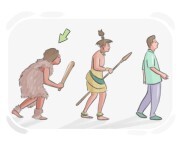
primitive [adjective]

characteristic of an early stage of human or animal evolution

Ex: The discovery of primitive plants helped scientists understand ancient ecosystems .
datable [adjective]

able to be dated to a specific time

Ex: The coins found in the excavation site were datable , helping historians piece together a more accurate timeline of the settlement .
prehistoric [adjective]

relating or belonging to the time before history was recorded
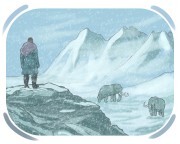
Ex: The museum exhibit showcased prehistoric fossils of dinosaurs and other ancient creatures .
ice age [noun]

one of the periods in history when ice covered large parts of the world
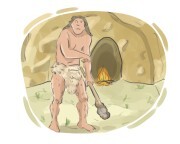
Ex: Scientists study ice cores to understand the climate changes that occurred during the ice age .

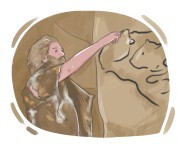
the early period of human history when people used things such as stone, horn, bone, etc. to make tools

Ex:

the period when iron was not discovered and people used bronze to make tools

Ex: Archaeologists uncovered a Bronze Age burial site , revealing intricate jewelry and weapons crafted from bronze .
Iron Age [noun]

the period that began about 1100 BC when people used iron tools for the first time

Ex: The discovery of iron-smelting techniques allowed Iron Age cultures to produce stronger and more efficient tools .

an idealized or imagined period of peace, prosperity, and happiness
Ex: People often look back nostalgically on the golden age of childhood .
medieval [adjective]

belonging or related to the Middle Ages, the period in European history from roughly the 5th to the 15th century

Ex: Historians often refer to the time between the fall of the Roman Empire and the Renaissance as the medieval period .

a philosophical movement in the late 17th and 18th centuries that emphasized reason and science were of more importance than tradition and religion

Ex:

a war that is between people who are in the same country

Ex: Civil wars often result in devastating consequences for the affected country , including loss of life and destruction of infrastructure .
colonial [adjective]

related to a country that controls another territory or country

Ex: Colonial struggles for independence were driven by a desire to assert national sovereignty and end foreign domination .
imperial [adjective]

related to the characteristics or actions of an empire or emperor

Ex: The imperial capital served as the seat of government and cultural center .

a collection of ancient myths, particularly one that belongs to a group of people and their history, etc.

Ex: Many cultures around the world have their own mythology , explaining natural phenomena and the origins of their societies .

the period of time in the 18th and 19th centuries that machines were used for the first time for mass production of goods, started in Britain

Ex:
pharaoh [noun]

a title used for ancient Egyptian rulers

Ex:

the study of civilizations of the past and historical periods by the excavation of sites and the analysis of artifacts and other physical remains

Ex:

all family members of a person over several generations, particularly a notable person

Ex: The artist 's creativity is deeply rooted in her family 's artistic bloodline , stretching back to renowned painters of past centuries .
artifact [noun]

a man-made object, tool, weapon, etc. that was created in the past and holds historical or cultural significance

Ex: Each artifact in the exhibit told a story about the civilization that created it .
war-torn [adjective]

(of a country or place) damaged or destroyed severely as an aftermath of war
Ex: Refugees fled the war-torn region in search of safety and shelter in neighboring countries .

any weapon that is capable of hitting a target at a distance beyond the reach of hands
Ex: The development of firearms revolutionized military tactics , introducing new types of ranged weapons such as muskets and rifles .

a hand-held weapon such as a sword, spear, etc., used when one attacks enemies at a close range

Ex: Samurai warriors were trained in the art of using the katana as a deadly melee weapon .
machete [noun]

a long knife that has a wide and heavy blade, used as a weapon or a tool to cut plants and trees

Ex: The explorer carried a machete to navigate through dense jungle terrain during the expedition .
spartan [adjective]

relating to a city-state in ancient Greece called Sparta or its people

Ex: Spartan society valued military prowess and physical fitness above all else .